Quick answer: In October 2025, EPFO's Central Board of Trustees approved a proposal to significantly simplify withdrawal rules — consolidating 13 purposes into three categories (Essential Needs, Housing Needs, Special Circumstances) and setting 12 months as the uniform minimum service period. This framework requires a gazette notification amending the EPF Scheme, 1952 to become legally operative; verify the current rules at epfindia.gov.in. If notified, the key changes would be: up to 75% of your total EPF balance withdrawable for any eligible purpose with a 25% minimum balance retained; full settlement after resignation requires 12 months of unemployment rather than the earlier 2 months. Tax rules are unchanged: withdrawal before 5 years of service is taxable, with TDS at 10% (with PAN) on amounts above ₹50,000.
Important: This guide covers both currently operative EPF withdrawal rules and the October 2025 reforms approved by EPFO's Central Board of Trustees (CBT). Several reforms discussed in this article require formal notification before becoming legally operative. Where applicable, we distinguish between current rules and proposed changes.
This article covers EPF rule changes approved by EPFO's Central Board of Trustees on October 13, 2025. CBT approval and public announcement do not by themselves make changes legally operative — formal implementation requires an amendment to the EPF Scheme, 1952 through an official gazette notification. Always verify the current operative rules at epfindia.gov.in or consult a Chartered Accountant before making financial decisions.
Estimate your EPF corpus instantly → EPF Calculator — Free, no login required
Can I withdraw EPF before retirement? Yes — under the current operative EPF Scheme (Paragraph 68HH, notified 2018), you can withdraw up to 75% of your balance after one month of unemployment. A CBT-approved proposal from October 2025 would remove the one-month wait and make 75% available on the day of job loss, with the remaining 25% accessible after 12 months — but this requires gazette notification to become operative. Under the current operative rule (Paragraph 69(2)), full settlement is available after 2 months of unemployment. While still employed, partial withdrawals are available for specific purposes under the current EPF Scheme with varying service requirements; the CBT-approved proposal would set a uniform 12-month minimum (pending gazette notification). Full withdrawal without restriction is available at retirement (age 58) and is completely tax-free after 5 years of service.
How much EPF can I withdraw? Up to 75% of your total EPF balance — including both your own contributions and your employer's contributions plus interest. Under the CBT-approved proposal, a minimum 25% would be required to remain in your account at all times (pending gazette notification); the current EPF Scheme has no such mandatory minimum balance requirement.
Is EPF withdrawal taxable? Only if you withdraw before completing 5 continuous years of EPF-covered service. After 5 years, all withdrawals are tax-free. Premature withdrawals above ₹50,000 attract TDS at 10% (with PAN) or 34.608% (without PAN).
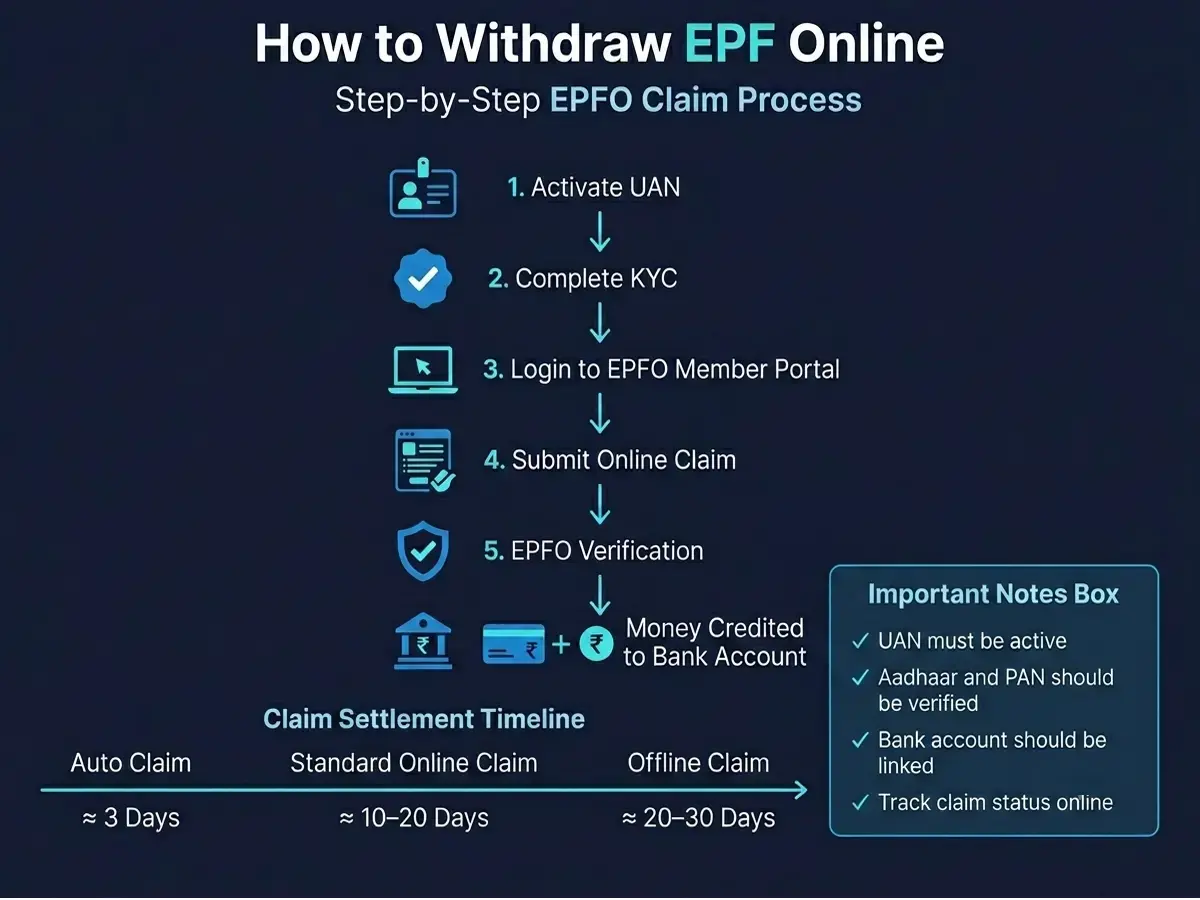
How long does EPF withdrawal take? Auto-settled partial claims process in approximately 3 working days. Standard online claims take 10 to 20 working days. Physical claims at an EPFO office take 20 to 30 working days.
Can EPF be withdrawn through ATM? EPFO 3.0 approved ATM-based withdrawals in October 2025. Testing is complete but the facility has not been gazette-notified or launched nationally as of June 2026. Check epfindia.gov.in for the current status.
Most salaried employees in India know EPF as that monthly deduction on their payslip. What they rarely know is how the withdrawal rules actually work — until they need the money.
Whether you are changing jobs, planning to buy a house, dealing with a medical situation, or approaching retirement — EPF rules matter a lot. And in October 2025, EPFO's Central Board of Trustees approved the biggest proposed changes to these rules in decades. The old system of 13 different withdrawal purposes with varying service requirements is proposed to be consolidated into a far simpler three-category framework — pending gazette notification to the EPF Scheme, 1952.
This guide explains how things work now — the new rules, the unchanged rules, the tax implications, and the practical process — in plain language without unnecessary jargon.
Quick Reference: EPF Withdrawal at a Glance
| Question | Answer |
|---|
| Can I withdraw EPF after resigning? | Current rule: 75% after 1 month of unemployment (Para 68HH), full settlement after 2 months (Para 69(2)). CBT proposal: 75% immediately, full settlement after 12 months (pending gazette notification) |
| Is EPF withdrawal taxable? | Yes, if service is below 5 continuous years |
| What is the TDS rate on premature withdrawal? | 10% with PAN, 34.608% without PAN, on amounts above ₹50,000 |
| Minimum service for partial withdrawal? | Varies by purpose under current scheme; CBT-proposed uniform 12 months (pending gazette notification) |
| Can I withdraw while still employed? | Yes — for purposes permitted under the current EPF Scheme; CBT-proposed categories: Essential Needs, Housing, Special Circumstances (pending gazette notification) |
| How long does an online claim take? | 3 days for auto-settled claims; up to 20 working days for standard claims |
| Maximum withdrawal limit? | Purpose-specific under current scheme; CBT proposal: 75% universal cap with 25% minimum balance (pending gazette notification) |
| Can I withdraw EPF through ATM or UPI? | EPFO 3.0 approved by CBT — testing complete, not yet gazette-notified or launched as of June 2026 |
Key Takeaways
| Area | Rule (Updated 2025) |
|---|
| Withdrawal categories | CBT-proposed: 3 categories (Essential Needs, Housing Needs, Special Circumstances) — pending gazette notification |
| Minimum service period | CBT-proposed uniform 12 months (pending gazette notification); current scheme varies by purpose |
| Maximum withdrawal amount | CBT-proposed: 75% of total EPF balance including employer share (pending gazette notification) |
| Minimum balance to retain | CBT-proposed: 25% minimum balance (pending gazette notification); no such requirement in current EPF Scheme |
| Full settlement after resignation | Current rule: 75% after 1 month, full settlement after 2 months; CBT proposal: immediate 75%, remainder after 12 months (pending gazette notification) |
| EPS withdrawal waiting period | CBT-proposed: 36 months (pending gazette notification); current operative rule: 2 months |
| Documentation | Zero documentation for most claims — self-declaration basis |
| Claim settlement speed | Auto-settled in ~3 days; standard claims 10–20 working days |
| Tax-free withdrawal | After 5 continuous years of EPF-covered service |
| TDS threshold | ₹50,000 — 10% TDS with PAN; 34.608% without PAN |
Important Terms Explained
EPF — Employee Provident Fund
EPF is a mandatory retirement savings scheme for employees in organisations with 20 or more employees. You and your employer both contribute 12% of your basic salary plus dearness allowance every month. The money earns interest declared annually by EPFO — both 2023–24 and 2024–25 rates were set at 8.25% per annum.
EPFO — Employees' Provident Fund Organisation
EPFO is the government body under the Ministry of Labour and Employment that runs the EPF, EPS, and EDLI schemes. It manages member accounts, processes withdrawal claims, and declares interest rates each year. Members interact with EPFO through its online Member Portal and the UMANG app.
UAN — Universal Account Number
UAN is a 12-digit number assigned to you as an EPF member. It stays the same no matter how many times you change jobs. All your EPF accounts across different employers are linked under this single UAN. You must activate your UAN and link your Aadhaar, PAN, and bank account to it before filing any online claim.
EPS — Employees' Pension Scheme
Your employer's 12% contribution is not entirely deposited into your EPF account. Out of it, 8.33% goes into EPS — capped at ₹1,250 per month based on a ₹15,000 salary ceiling — and only 3.67% goes into your EPF. EPS provides a monthly pension after retirement. If your EPS service is below 10 years, you can withdraw this amount as a lump sum (but under the CBT-approved proposal, only after 36 months of unemployment — pending gazette notification; the current operative rule is 2 months). If it is 10 years or more, you get a monthly pension from EPFO starting at age 58.
TDS — Tax Deducted at Source
If you withdraw EPF before completing 5 years of continuous service and the amount exceeds ₹50,000, EPFO deducts TDS. The rate is 10% if you have submitted your PAN, or 34.608% (maximum marginal rate including surcharge and cess) if PAN is not submitted. Note: From April 2026, the governing provision has moved from Section 192A to Section 392(7) under the new Income Tax Act 2025, but the rates and thresholds remain unchanged.
If your total income — including the EPF withdrawal — stays below the taxable limit, you can submit Form 15G (for those below 60 years) or Form 15H (for those aged 60 and above) to prevent TDS from being deducted. These are self-declarations submitted directly to EPFO when filing the claim.
- Form 19 — Full EPF settlement (final withdrawal)
- Form 10C — EPS withdrawal or scheme certificate
- Form 31 — Partial withdrawal (advance)
- Form 10D — Monthly pension claim
In the online system, all these are accessed through a single claim interface on the EPFO Member Portal.
Proposed Three-Category EPF Withdrawal Framework (CBT-Approved)
The most significant CBT-approved proposal from October 2025 is the consolidation of 13 separate withdrawal provisions into three categories. Subject to gazette notification, if your purpose fits any one of these and you have at least 12 months of EPF membership, you would qualify.
Category 1: Essential Needs
This covers three situations where employees need money for life's important milestones or emergencies.
Medical Emergency
If you or an immediate family member needs hospitalisation or medical treatment, under this proposal you would be able to withdraw up to 75% of your total EPF balance, up to 3 times per financial year. No documents would be needed — a self-declaration would suffice.
Education
For your own higher education or your children's post-matriculation studies, under this proposal you would be able to withdraw up to 75% of your balance, up to 10 times during your entire membership — a significant increase from the earlier combined limit of just 3 times.
Marriage
For your own marriage or that of your children or siblings, under this proposal you would be able to withdraw up to 75% of your balance, up to 5 times during your service. Previously, marriage and education combined were allowed only 3 times total.
Category 2: Housing Needs
This covers anything related to your home.
House Purchase, Construction, or Home Loan Repayment
Under this proposal you would be able to withdraw up to 75% of your EPF balance for buying a house, constructing one, or repaying a home loan, up to 5 times during your membership.
The earlier rules were more restrictive — separate limits of 24 months basic salary for purchase, 36 months for home loan repayment, and a once-in-a-lifetime restriction. If gazette-notified, the new framework would make access simpler and more generous.
Category 3: Special Circumstances
This is the most flexible proposed category. It covers unemployment, natural calamities, pandemics, and factory lockouts. Under this proposal members would no longer need to assign a specific reason. Members could access up to 75% of their balance, up to 2 times per financial year.
EPF Withdrawal After Resignation: Current Rules vs Proposed Changes
This is where many employees trip up, because the CBT-approved proposals from October 2025 would materially change these rules once gazette-notified.
Current operative rule: Under Paragraph 68HH (notified 2018), you can withdraw up to 75% of your balance after one month of unemployment. Full settlement (100%) is available after 2 months of unemployment under Paragraph 69(2).
CBT-approved proposal (pending gazette notification):
- On job loss, you would be able to immediately withdraw 75% of your total EPF balance without any waiting period
- The remaining 25% would become available after 12 months of continuous unemployment
- Full 100% withdrawal would remain available at age 55+, permanent disability, voluntary retirement, retrenchment, or permanent move abroad
The practical implication: if you resign and join a new employer within a few months, transfer your EPF rather than withdraw. Under the current operative rule, 75% is accessible after one month of unemployment. If the CBT proposal is gazette-notified, this would be available immediately on job loss.
EPS Withdrawal After Resignation
The EPS (pension) portion has a separate and important change:
- Earlier: You could withdraw your EPS lump sum after just 2 months of unemployment (if service was below 10 years)
- CBT-approved proposal (pending gazette notification): The waiting period would be extended to 36 months of unemployment before EPS lump-sum withdrawal. The current operative rule remains 2 months of unemployment.
This change is designed to discourage people from draining their pension fund prematurely. If your EPS service is 10 years or more, the rules remain the same — no lump sum, monthly pension from EPFO at age 58.
Full EPF Withdrawal Eligibility
| Situation | Eligibility |
|---|
| Retirement at age 58 | Full withdrawal, completely tax-free |
| Age 55+ (early retirement) | Full withdrawal allowed |
| Job loss / resignation | Current rule: 75% after 1 month (Para 68HH), full settlement after 2 months (Para 69(2)); CBT proposal: immediate 75%, remainder after 12 months (pending gazette notification) |
| Permanent disability | Full withdrawal |
| Retrenchment or VRS | Full withdrawal |
| Permanent relocation abroad | Full withdrawal |
| Death of member | Full amount to nominee or legal heir |
Partial Withdrawal Summary Table
| Category | Purpose | Minimum Service | Max Withdrawal | Frequency |
|---|
| Essential Needs | Medical emergency | CBT-proposed: 12 months (pending gazette notification) | CBT-proposed: 75% of total balance | CBT-proposed: 3 times per financial year |
| Essential Needs | Education | CBT-proposed: 12 months (pending gazette notification) | CBT-proposed: 75% of total balance | CBT-proposed: up to 10 times in service |
| Essential Needs | Marriage | CBT-proposed: 12 months (pending gazette notification) | CBT-proposed: 75% of total balance | CBT-proposed: up to 5 times in service |
| Housing Needs | Purchase / construction / home loan | CBT-proposed: 12 months (pending gazette notification) | CBT-proposed: 75% of total balance | CBT-proposed: up to 5 times in service |
| Special Circumstances | Unemployment / calamity / no reason needed | CBT-proposed: 12 months (pending gazette notification) | CBT-proposed: 75% of total balance | CBT-proposed: 2 times per financial year |
Under the CBT-approved proposal, 25% minimum balance would remain in the account at all times (pending gazette notification).
How EPF Contributions Work
Understanding where your money actually goes makes withdrawal decisions easier.
Every month, you contribute 12% of your basic salary plus dearness allowance to EPF. Your employer also contributes 12%, but this is split differently. Since EPF is calculated directly from basic salary, the same basic-to-CTC ratio that drives your HRA exemption also determines how fast your EPF corpus grows:
- 8.33% goes into EPS — capped at ₹1,250/month based on a ₹15,000 salary ceiling
- The balance (12% minus EPS contribution) goes into your EPF account — this is 3.67% only when your basic salary is exactly ₹15,000; for higher salaries the employer EPF share increases because the EPS is capped
- 0.5% goes toward EDLI (life insurance scheme) — paid separately by the employer above the 12%
Example with ₹30,000 basic salary:
Your contribution: ₹3,600 → EPF
Employer contribution: ₹3,600 total → ₹2,350 to EPF + ₹1,250 to EPS (EPS capped at ₹15,000 wage ceiling)
EDLI: ₹150 additional (0.5% of basic, paid separately by employer above the 12%)
So your EPF account grows by roughly ₹5,950 per month from both contributions — not ₹7,200. The remainder goes to pension (EPS) and insurance (EDLI).
Both 2023–24 and 2024–25 EPF interest rates were confirmed at 8.25% per annum, credited annually after the financial year closes.
Use the PaisaPilotAI EPF Calculator to see exactly how your corpus builds over time based on your salary and service years.
How to Withdraw EPF Online: Step by Step
Before You Start: Prerequisites
- UAN activated at unifiedportal-mem.epfindia.gov.in
- Aadhaar linked and verified with UAN
- PAN linked to UAN
- Bank account linked and KYC approved by your employer
- Mobile number linked to Aadhaar (for OTP)
Steps to File the Claim
- Log in to the EPFO Member Portal using your UAN and password
- Go to Online Services → Claim (Form-31, 19, 10C & 10D)
- Verify your bank account details shown on screen
- Enter the last 4 digits of your bank account number to confirm
- Click Proceed for Online Claim
- Select the claim type — Form 19 (full settlement), Form 10C (EPS), Form 31 (partial), or Form 10D (pension)
- Select the withdrawal category and purpose
- Enter the amount (for partial claims)
- Submit Form 15G or 15H if your income is below the taxable limit
- Enter the Aadhaar OTP sent to your registered mobile and submit
Save the claim reference number to track your application.
Tracking Your Claim
- EPFO Member Portal → Track Claim Status
- UMANG app
- SMS: Send
EPFOHO UAN ENG to 7738299899
- Missed call: 9966044425 from your UAN-registered mobile
For the full walkthrough of each method — including UMANG and portal passbook steps — see our EPF balance check guide.
If your status shows rejected instead of settled, the remarks field will usually point to the cause — see EPF Claim Rejected? Common Reasons and Fixes for how to read that message and what to do next.
Documents Required
For Most Online Claims
Under EPFO's ongoing claim simplification, most partial withdrawal claims with completed KYC require no supporting documents. A self-declaration through the online portal is sufficient; verify current requirements at epfindia.gov.in.
For Full Settlement or Specific Situations
| Claim Type | What You Need |
|---|
| Full EPF settlement (Form 19) | Active bank account linked to UAN, PAN, Aadhaar, Form 15G/15H if applicable |
| EPS withdrawal (Form 10C) | Same as above |
| Housing claims | Relevant property or loan documents may be required for verification |
| Nominee claim after death | Form 20, death certificate, KYC documents of nominee |
Tax on EPF Withdrawal: The Rules That Have Not Changed
While withdrawal rules were overhauled in October 2025, the tax treatment of EPF withdrawal remains exactly as before.
The 5-Year Rule
Your EPF withdrawal is completely tax-free if:
- You have completed 5 continuous years of EPF-covered employment, OR
- You left because of ill health, your employer's business closed, or circumstances genuinely beyond your control
The 5 years count across employers — as long as you transferred (not withdrew) your EPF balance between jobs. Transferring keeps the service period intact. Withdrawing resets it to zero.
If You Withdraw Before 5 Years
The entire withdrawal amount becomes taxable in that financial year:
- Your own contributions that you claimed under Section 80C are added back to your income
- Your employer's contributions to EPF are added to your income
- Interest earned on both is also taxed
All of this is taxed at your applicable income tax slab rate — which depends on whether you are filing under the old or new regime. If you have not yet decided, the Old vs New Tax Regime comparison explains how each regime treats this kind of additional taxable income.
TDS on Early Withdrawal
| Situation | TDS Rate |
|---|
| Withdrawal above ₹50,000, PAN submitted, service below 5 years | 10% |
| Withdrawal above ₹50,000, PAN NOT submitted | 34.608% (maximum marginal rate with surcharge and cess) |
| Withdrawal below ₹50,000 | No TDS (but still taxable) |
| Withdrawal after 5+ years of service | No TDS, no tax |
You can claim TDS credit when filing your annual ITR.
If your total annual income — after including this EPF withdrawal — is still below the basic exemption limit, submit Form 15G (below 60 years) or Form 15H (60 and above) when filing the claim. EPFO will not deduct TDS. This avoids the hassle of claiming it back through ITR.
Important Note on Tax Section Renumbering
From April 1, 2026, the TDS provision on EPF withdrawal has moved from Section 192A of the Income Tax Act 1961 to Section 392(7) of the new Income Tax Act 2025. The rates and thresholds are unchanged — only the section number is different.
Tax on High-Contribution Accounts
From April 2021, if your own EPF contributions exceed ₹2.5 lakh in a year (₹5 lakh for government employees), the interest earned on the excess is taxable. This affects only employees with very high basic salaries or those making large voluntary PF contributions. For most salaried professionals, this limit is not reached.
If you want to understand how EPF-related TDS appears in your salary documents, the PaisaPilotAI Form 16 Analyzer can help you read and decode the deductions clearly — or follow the Form 16 reading and ITR filing guide for a section-by-section walkthrough. Your year-start declarations on Form 12BB also affect how much TDS your employer deducts in the first place, including on any EPF-linked components.
EPF Claim Settlement Timeline
| Claim Type | Expected Time | Notes |
|---|
| Auto-settled partial claims | ~3 working days | Zero-documentation claims with verified KYC processed automatically |
| Standard online claims | 10–20 working days | Requires employer digital approval |
| Physical claims at EPFO office | 20–30 working days | Regional office dependent |
| Claims with data mismatch | Indefinite | Name or date of birth mismatch between Aadhaar and EPF records causes rejection |
If your claim is stuck, raise a grievance at epfigms.gov.in or call 1800-118-005 (toll-free).
EPFO 3.0: UPI and ATM Withdrawals
EPFO 3.0 — which covers UPI-linked claim settlement, ATM-style PF card access, and a new core banking platform — is a separate IT and policy reform programme approved by CBT in October 2025. As of June 2026, UPI PF withdrawal is under development and not available to members. ATM PF cards have no confirmed EPFO press release confirming rollout.
For a complete, source-verified breakdown of what is live today versus what is still pending gazette notification, see the EPFO 3.0 Explained guide. This guide covers current withdrawal rules; that guide covers the digital reform roadmap.
EPF Transfer vs. EPF Withdrawal: Make the Right Call
When changing jobs, you have two choices — transfer your EPF to the new employer, or withdraw it.
| Factor | Transfer | Withdrawal |
|---|
| 5-year service continuity for tax | Maintained | Broken — restarts from zero |
| Corpus growth | Continues at 8.25% | Stops — you must reinvest elsewhere |
| Tax on the transaction | None | Applicable if service is below 5 years |
| EPS service preservation | Carried forward | Lost or reset |
| Future pension eligibility | Preserved | Weakened or lost |
| Immediate cash | No | Yes |
For most people, transferring is the right answer. The only time withdrawal makes clear sense is when you genuinely need the money and have no alternative — and even then, under the current operative rule 75% is available after one month of unemployment — and the CBT-approved proposal (once gazette-notified) would make this available immediately on job loss.
Common Mistakes That Cost People Money
From payroll teams: Employees who switch jobs frequently often delay transfer requests because their previous employer has not updated the date of exit in the ECR system. The transfer claim gets stuck at the EPFO source office, sometimes for months. The fix is simple — chase the previous employer's HR to confirm date of exit entry within two weeks of your last working day. After 10 working days of employer inaction, raise a grievance at epfigms.gov.in directly.
From claim processing: The most common reason auto-settlement fails — even for claims well within the ₹5 lakh limit — is a name mismatch between Aadhaar and the EPFO member profile. Many employees link Aadhaar after a name change (marriage, legal correction) without updating the EPFO profile. Verify your name exactly as it appears on both before filing.
From mid-career job changers: Employees who withdraw EPF at every job change often discover the tax consequence only when filing their ITR that year. The entire withdrawal — employee contributions, employer contributions, and interest — becomes taxable income if service was below 5 years. For someone in the 20% bracket withdrawing ₹2 lakh, that is ₹40,000 in unexpected tax. Transfer, not withdrawal, is the default right answer.
Withdrawing EPF at Every Job Change
This is the most expensive habit in Indian personal finance. Every time you withdraw on a job change, you restart the 5-year clock, lose compounding at 8.25%, and pay unnecessary tax. Transfer instead — it takes under 10 minutes online.
Not Updating KYC Before Filing
Claims bounce when Aadhaar details, PAN, or bank account information do not match what is on the EPFO system. Check your KYC status on the portal before filing any claim.
Assuming You Can Withdraw the Full 24% Contribution
Your own 12% contribution goes entirely to EPF. Of your employer's 12%, a portion goes to EPS — capped at ₹1,250/month (8.33% of the ₹15,000 wage ceiling) — and the balance goes to EPF. For most salaried professionals earning above ₹15,000 basic, the employer's EPF contribution is roughly ₹2,350 or more per month, not a flat 3.67% of actual salary. The combined EPF accumulation is well above 15.67% of basic salary once your salary exceeds the ₹15,000 EPS ceiling.
If your income is below the taxable limit and you are withdrawing before 5 years, not filing Form 15G means EPFO deducts 10% TDS unnecessarily. Filing it takes two minutes and saves the hassle of an ITR refund.
Using a Closed Bank Account
If the bank account linked to your UAN is inactive or closed, the transferred withdrawal amount bounces back to EPFO and has to be re-processed. Always verify the linked account is active before filing.
Waiting for Employer Approval When Stuck
If your claim remains pending because of employer approval delays, raise a grievance through EPFiGMS and follow up with EPFO. Processing depends on the circumstances of the claim and applicable EPFO procedures.
Real Scenarios: Current Rules vs CBT-Approved Proposals
Scenario 1: Arjun Leaves His Job After 3 Years
Arjun resigns after 3 years at a private firm. His total EPF balance (employee + employer share + interest) is ₹2.8 lakh.
Under the CBT-approved proposal (if gazette-notified), he could immediately withdraw 75% — that is ₹2.1 lakh — without any waiting period. Under the current operative rule, 75% is accessible after one month of unemployment. Since his service is below 5 years and the amount exceeds ₹50,000, TDS at 10% will be deducted (₹21,000), and the full ₹2.1 lakh becomes taxable income.
Better option: If he joins a new employer within a reasonable period, he should transfer his EPF. This preserves the 3-year service count, avoids tax, and keeps ₹2.8 lakh growing at 8.25%.
Scenario 2: Sunita Needs Money for Her Daughter's Engineering Admission
Sunita has 14 months of EPF membership. Her total EPF balance is ₹1.1 lakh.
Under the old rules, she would not have qualified — education required 7 years of service. Under the CBT-approved proposal (pending gazette notification), she would only need 12 months. She files a partial withdrawal under the CBT-proposed Essential Needs (Education) category. She could withdraw up to 75% — approximately ₹82,500. Since her total service will soon cross 5 years, she checks her tax position carefully. No documents needed — self-declaration suffices. Claim settles in about 3 days.
Scenario 3: Rajesh Is 57 and Planning Retirement
Rajesh has 28 years of EPF service. His EPF balance is substantial and his EPS service is 28 years.
At 57, Rajesh could access a partial withdrawal under the CBT-proposed Special Circumstances category (if gazette-notified), or wait until 58 for full tax-free settlement. His EPS service is well above 10 years, so no lump sum from EPS — he will receive a monthly pension from EPFO starting at 58. He should also estimate his gratuity — use the PaisaPilotAI Gratuity Calculator to calculate that figure separately before his final settlement discussion.
Scenario 4: Meera Faces a Sudden Medical Emergency
Meera has been contributing to EPF for 13 months — just enough to qualify under the CBT-proposed 12-month rule (if gazette-notified). Her total EPF balance is ₹95,000.
She files a partial withdrawal under the CBT-proposed Essential Needs (Medical) category. She could access up to 75% — about ₹71,250. Because her service is below 5 years and this exceeds ₹50,000, TDS at 10% will apply unless she submits Form 15G. If her total annual income is below ₹2.5 lakh, she files Form 15G and receives the full amount without deduction. The claim auto-settles in approximately 3 days.
What Happens to EPF When You Die in Service
The full EPF balance is paid to your registered nominee or legal heir. The family also becomes eligible for:
- EDLI benefit: Up to ₹7 lakh in life insurance (subject to scheme rules)
- EPS family pension: Monthly pension for the spouse
The nominee should contact EPFO with Form 20 (EPF claim), Form 10D (EPS pension), and Form 5IF (EDLI claim), along with the death certificate and KYC documents.
This makes it important to register and update your EPF nominee — it can be done online through the EPFO Member Portal under the e-Nomination section.
Editorial Policy & Review Process
This article was written by the PaisaPilotAI editorial team and reviewed by Manjeeta Raj, Founder of PaisaPilotAI. All information is based on publicly available EPFO rules, official government notifications, Income Tax Act provisions, and EPFO press releases available at the time of writing. The article was fact-checked against official sources and updated to reflect the October 2025 EPFO rule changes approved by the Central Board of Trustees.
Financial and tax regulations change over time. Readers should verify important decisions through official EPFO channels at epfindia.gov.in, the Income Tax Department at incometax.gov.in, or by consulting a qualified Chartered Accountant or tax professional.
Sources & References
The following official and authoritative sources were used in researching and verifying this article:
Frequently Asked Questions
1. What is the minimum service required for EPF partial withdrawal now?
Under the CBT-approved proposal, 12 months would be the uniform minimum (pending gazette notification). Under the current operative EPF Scheme, minimum service requirements vary by purpose.
2. How much of my EPF balance can I withdraw at one time?
Up to 75% of your total EPF balance (employee contributions + employer contributions + interest) under the CBT-approved proposal. Under the CBT-approved proposal, a minimum 25% would be required to remain in your account at all times (pending gazette notification); the current EPF Scheme has no such operative requirement.
Under the CBT-approved proposal (pending gazette notification), 75% would be available immediately on job loss and the remaining 25% after 12 months. Under the current operative rule, 75% is accessible after one month of unemployment (Paragraph 68HH) and full settlement after 2 months (Paragraph 69(2)).
4. Is EPF withdrawal completely tax-free?
Only if you have completed 5 continuous years of EPF-covered service. At retirement (age 58), withdrawal is fully tax-free under Section 10(12) of the Income Tax Act. Before 5 years, the entire withdrawal amount — your contributions, employer's contributions, and interest — is taxable.
5. What is TDS on EPF withdrawal and when is it deducted?
TDS is deducted when you withdraw before completing 5 years of service and the amount exceeds ₹50,000. The rate is 10% if you have submitted your PAN. If PAN is not submitted, the rate is 34.608% (maximum marginal rate including surcharge and cess). No TDS applies if the withdrawal amount is ₹50,000 or less — but it is still taxable income.
6. How do I avoid TDS on EPF withdrawal?
Submit Form 15G (below 60 years) or Form 15H (60 and above) when filing your claim. These forms declare that your total annual income is below the basic exemption limit. EPFO will not deduct TDS. This works only if you genuinely qualify — do not submit these forms if your income is above the threshold.
7. What is the difference between EPF and EPS?
EPF is your retirement savings account. It holds your 12% contribution plus 3.67% from your employer, earns 8.25% interest, and is withdrawable as a lump sum. EPS is a pension fund — it receives 8.33% of your employer's contribution and pays a monthly pension from age 58. If EPS service is below 10 years, you can withdraw the EPS balance as a lump sum (but under the CBT-approved proposal, only after 36 months of unemployment — pending gazette notification; the current operative rule is 2 months).
8. Has the EPS withdrawal waiting period changed?
Under the CBT-approved proposal, the waiting period would be extended to 36 months of unemployment (pending gazette notification). The current operative rule remains 2 months. This proposed change is intended to discourage premature depletion of pension savings.
9. Can I withdraw EPF for home loan repayment?
Yes — under the CBT-proposed Housing Needs category (pending gazette notification). Under this proposal, you would need at least 12 months of EPF membership and could withdraw up to 75% of your total balance, up to 5 times during your service.
10. How long does an EPFO claim take to settle?
Auto-settled partial claims (zero-documentation) typically settle in about 3 working days. Standard online claims that require employer approval take 10 to 20 working days. Physical claims at an EPFO office can take 20 to 30 working days.
11. What happens if my EPF claim is stuck or rejected?
Raise a grievance at epfigms.gov.in. Provide your UAN, claim reference number, and a clear description of the issue. You can also call the EPFO helpdesk at 1800-118-005 (toll-free). If your claim remains pending because of employer approval delays, raise a grievance through EPFiGMS and follow up with EPFO. Processing depends on the circumstances of the claim and applicable EPFO procedures.
12. If I transfer EPF between jobs, does the 5-year service count continue?
Yes. Transferring your EPF keeps the service count intact across employers. Only withdrawing resets it. This is the most important reason to transfer rather than withdraw when changing jobs.
13. Can I withdraw EPF through ATM or UPI?
EPFO 3.0 — which would introduce ATM and UPI-based EPF withdrawals — has been approved by CBT but is not yet gazette-notified or launched as of June 2026. Once available, UPI withdrawals would allow up to 75% of balance; ATM withdrawals would be capped at 50%. Check epfindia.gov.in for the latest status.
14. What documents do I need for a partial EPF withdrawal?
Under EPFO's ongoing claim simplification, most partial withdrawal claims with completed KYC require no supporting documents. Members should verify current documentation requirements on the EPFO portal before filing a claim. For specific purposes like housing, some property or loan documents may be needed for verification.
15. How do I check my EPF balance?
Through the EPFO Member Portal passbook, the UMANG app, by sending EPFOHO UAN ENG via SMS to 7738299899, or by giving a missed call to 011-22901406 from your UAN-registered mobile number. Your UAN must be activated and Aadhaar-linked for these to work.
16. What is the EPF interest rate for 2024–25?
8.25% per annum — same as 2023–24. This was confirmed by the Central Board of Trustees in February 2025 and ratified by the Ministry of Finance. Interest was credited to member accounts by May 2025.
17. Can I withdraw EPF if my employer is not responding to the claim?
If your employer has not approved or rejected your claim within 10 days, EPFO is authorised to process it directly without employer intervention. If this is not happening, raise a formal grievance at epfigms.gov.in.
18. Is there a minimum balance rule in EPF withdrawal?
Under the CBT-approved proposal from October 2025 (pending gazette notification), a 25% minimum balance would be required and the maximum withdrawable in any claim would be 75%. Neither is an operative rule under the current EPF Scheme.
Expert Summary
EPF is genuinely one of the best financial instruments available to Indian salaried employees — government-declared interest at 8.25% for FY 2023-24 (reviewed annually by the Central Board of Trustees and ratified by the Ministry of Finance), largely tax-free accumulation, and now much more flexible access than before.
The October 2025 CBT-approved proposals would make the system significantly more accessible once gazette-notified. Under the proposed framework, you would no longer need 5 to 7 years of service to qualify for partial withdrawals, and could access 75% of your total balance — including the employer's share — for a wide range of needs. Documentation requirements have been almost entirely eliminated.
But two things have not changed and still need your attention:
The 5-year tax rule is unchanged. If you withdraw before completing 5 continuous years, the full amount is taxable and TDS is deducted. Transferring EPF between jobs keeps this clock running — withdrawing resets it to zero.
The EPS waiting period is proposed to increase, not decrease. Under the CBT-approved proposal, EPS lump-sum withdrawal would require 36 months of unemployment (pending gazette notification); the current operative rule is 2 months. If you are planning to withdraw your EPS after a job change, verify the current rule at epfindia.gov.in before acting.
For a complete picture of your retirement finances — EPF corpus, gratuity entitlement, and HRA tax savings — the Gratuity Calculator and HRA Exemption Calculator on PaisaPilotAI.com can help you model everything before making decisions.
EPF regulations, interest rates, and procedural rules do change. This guide reflects CBT-approved proposals and existing operative rules as of October 2025. Always verify the current position at epfindia.gov.in or through a qualified Chartered Accountant before acting on financial decisions.
This article is for educational purposes only. It is not financial or tax advice. Always verify current EPF rules and tax provisions at epfindia.gov.in or incometax.gov.in, and consult a qualified professional for decisions specific to your situation.