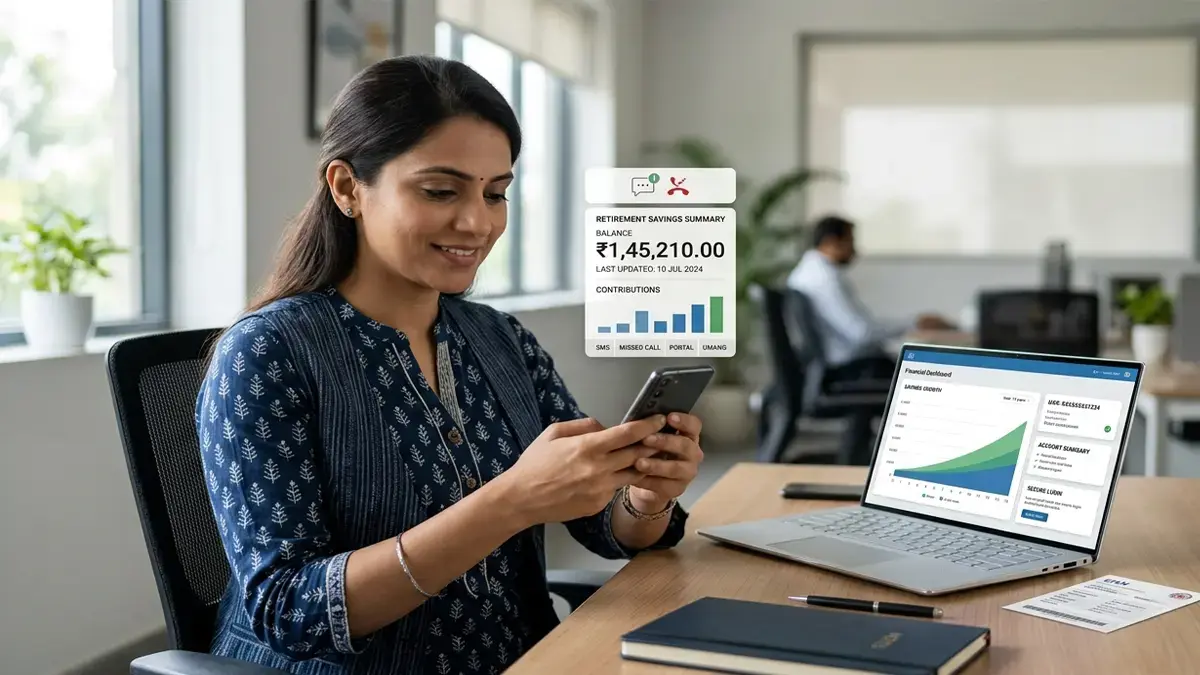
Quick answer: EPF interest accrues every month on your running balance but is posted to your passbook only once a year, after EPFO's Central Board of Trustees recommends a rate and the Ministry of Labour & Employment ratifies it. To check whether your own interest has posted, log in to the EPFO Member e-Sewa passbook, the UMANG app, or use missed call/SMS — and look for a line reading "Int. Updated up to 31/03/[year]" in your passbook. If it's missing, it usually means your account is still in EPFO's verification queue, not that you've lost the interest.
### 📌 Latest Official Update EPF interest rate: 8.25% for FY 2025-26 (unchanged from FY 2024-25 and FY 2023-24) — recommended by EPFO's Central Board of Trustees and ratified by the Ministry of Labour & Employment under Para 60(1) of the EPF Scheme, 1952. EPFO credited roughly ₹1.44 lakh crore in interest to about 34 crore member accounts, with most accounts updated by 15 July 2026 — the fastest crediting cycle in EPFO's history, aided by its newer CITES 2.01 platform. This box reflects the most recent confirmed cycle at the time of review — always check epfindia.gov.in for the current year's rate and status before relying on it.
Reviewed by Manjeeta Raj, Founder of PaisaPilotAI. This guide is based on EPFO's official rate notifications, PIB press releases, and EPFO's own passbook and app channels — not on assumptions about how or when your specific account will update.
Information last verified: - EPF interest rate for FY 2025-26 - Crediting status and completion date - Passbook, UMANG, SMS and missed call check methods - Common reasons interest doesn't appear yet Last verified date: July 2026. EPFO's crediting timeline can vary from year to year depending on Ministry ratification and internal processing — if the dates or status described here don't match what you see on epfindia.gov.in or the UMANG app, treat the official channel as authoritative and this as a sign the cycle has moved on.
Why trust this guide? - Reviewed by PaisaPilotAI's founder before publication - Built from EPFO/PIB notifications and cross-checked media reporting, with disputed or single-sourced claims flagged rather than stated as fact - Updated as EPFO's rate and crediting timeline changes each year
Want to know your balance right now, interest aside? → Check your EPF balance
Rohit Verma, a 34-year-old software engineer in Pune, logged into his EPFO passbook in mid-June, a few months after the financial year closed, expecting to see that year's interest added. It wasn't there. He assumed something had gone wrong with his account — until he checked again a month later and found the interest posted, backdated to 31 March.
This confusion is extremely common, and it happens every single year. EPF interest is not credited the moment the financial year ends — it goes through a government approval chain first, and then a phased processing cycle at EPFO's end. This guide explains exactly what that chain looks like, what the current rate is, how to verify your own account, and what to do if your interest genuinely hasn't shown up after a reasonable wait.
At a Glance
| Question | Quick Answer | Official Source |
|---|
| What's the current EPF interest rate? | See the "Latest Official Update" box above — set annually by EPFO's CBT and ratified by the Ministry of Labour & Employment | epfindia.gov.in |
| When is EPF interest credited? | Once a year, after the financial year closes on 31 March — timing varies by cycle (roughly 3.5 to 8 months post year-end in different years) | EPFO circulars |
| How do I check if it's been credited? | Log in to your EPFO passbook or UMANG app and look for "Int. Updated up to 31/03/[year]" | unifiedportal-mem.epfindia.gov.in |
| Interest missing — should I worry? | Usually not — it's most often a normal processing delay, not lost interest | — |
| Does a delay mean I lose interest? | No — interest accrues monthly regardless of when it's posted to your passbook | Para 60, EPF Scheme 1952 |
| When should I contact EPFO? | If KYC is clean and the delay stretches well beyond a typical cycle, or your payslip shows deductions your passbook doesn't | EPFO grievance portal |
What Does "EPF Interest Credited" Actually Mean?
"EPF interest credited" means EPFO has finalised the year's interest calculation on your Employees' Provident Fund balance and posted it into your passbook, usually shown as a line reading "Int. Updated up to 31/03/[year]." The interest itself accrues monthly all through the financial year based on your running balance, but it is calculated as a lump sum and added to your account only once — after the year closes and the rate is officially ratified.
This distinction matters because it explains why your passbook can look "frozen" for months after 31 March: the money is accruing in the background the whole time, but the passbook entry only appears once EPFO's processing and verification steps are complete.
How Is the EPF Interest Rate Decided Each Year?
The EPF interest rate is set annually by EPFO's Central Board of Trustees (CBT) and only becomes official once the Ministry of Labour & Employment ratifies it under Para 60(1) of the EPF Scheme, 1952. A CBT-recommended rate is not final or binding on its own — it takes effect only after Ministry ratification and a formal EPFO notification instructing regional and zonal offices to credit it to member accounts. This is why the "recommended" rate you may see in early news reports can differ in timing (though rarely in value) from the rate that actually gets credited months later.
| Financial Year | EPF Interest Rate |
|---|
| 2025-26 | 8.25% |
| 2024-25 | 8.25% |
| 2023-24 | 8.25% |
| 2022-23 | 8.15% |
| 2021-22 | 8.10% |
| 2020-21 | 8.50% |
The rate has held at 8.25% for three financial years running (FY 2023-24, FY 2024-25, and FY 2025-26) as of the most recent cycle. For the exact rate currently in force, always check EPFO's own notification, since it is reviewed every year.
How EPF Interest Is Calculated
EPF interest is calculated every month on your running account balance, but the total is credited to your account only once a year, as per Paragraph 60 of the Employees' Provident Fund Scheme, 1952. The formula EPFO uses is:
Monthly Interest = Opening Balance for the Month × (Annual Interest Rate ÷ 12)
The important detail most calculator blogs get wrong: it's the opening balance of that month — your balance as it stood at the start of the month, before that month's own contribution — not the closing balance after the new contribution lands. This is why a contribution made in, say, March does not itself earn any interest until the following month's calculation.
Worked Example
Say Rohit's EPF opening balance on 1 April is ₹4,00,000, and he and his employer together contribute ₹7,000 a month (with 3.67% of the employer's share going to EPF and the rest to EPS) for the rest of the year, with no withdrawals.
- April interest = ₹4,00,000 × (8.25% ÷ 12) ≈ ₹2,750
- Balance carried into May = ₹4,00,000 + ₹7,000 (April contribution) = ₹4,07,000
- May interest = ₹4,07,000 × (8.25% ÷ 12) ≈ ₹2,798
This continues month by month for all 12 months, and the sum of those 12 monthly figures is what gets added to his account as "interest credited" for the year — not applied progressively through the year, but posted as one lump sum after the financial year ends and the rate is finalised.
Only the 3.67% portion of your employer's 12% contribution goes into your EPF account and earns this interest — the remaining 8.33% is routed to the Employees' Pension Scheme (EPS) and does not earn EPF interest.
### 💡 Expert Tip Payroll teams typically remit a month's EPF contribution only after that month's ECR (Electronic Challan cum Return) is processed — often 7 to 15 days into the following month, not on the salary credit date itself. If you resign or switch jobs mid-month, check that your final month's contribution was actually remitted before you leave — a contribution deducted from your last payslip but never filed by the outgoing employer will not show in your passbook and will not earn interest, and chasing it after you've left the company is far harder than confirming it while you're still on the payroll.
When Is EPF Interest Actually Credited?
Interest is credited to accounts only after the financial year closes on 31 March, and only once the rate has cleared CBT recommendation, Ministry ratification, and EPFO's internal processing and verification. There is no fixed universal date each year — the gap between 31 March and your passbook actually showing that year's interest has varied widely from cycle to cycle. In the most recent completed cycle, EPFO credited interest to roughly 34 crore member accounts — around ₹1.44 lakh crore in total — with most accounts updated within about three-and-a-half months of year-end, its fastest crediting cycle to date. In earlier cycles, the same process routinely took far longer: one past year's interest was reportedly not visible in many members' passbooks until nearly eight months after the financial year had closed.
The faster recent cycle was aided largely by EPFO's newer CITES 2.01 (Centralised IT Enabled Services) platform, which lets the organisation auto-process interest calculations before routing them to Field Authorities for verification — rather than relying on a fully manual process at every step.
Why There's a Gap Between 31 March and the Actual Credit Date
The sequence generally looks like this:
- 31 March — the financial year closes; that year's rate and monthly interest figures are finalised on paper.
- CBT recommendation — EPFO's Central Board of Trustees meets and recommends the rate for the year just closed.
- Ministry ratification — the Ministry of Labour & Employment formally approves the recommended rate.
- EPFO notification — EPFO issues a circular instructing its offices to credit the rate to member accounts.
- Processing and verification — accounts are auto-processed and then checked by Field Authorities before the entry posts to your passbook.
- Passbook update — you finally see "Int. Updated up to 31/03/[year]" in your account.
Because of this chain, a delay between 31 March and your passbook showing updated interest is normal, not necessarily a sign of a problem with your specific account. That said, do not assume every delay is harmless — see the "When to Contact EPFO" section below for genuine warning signs.
How to Verify Your EPF Interest Has Been Credited
You can check whether your EPF interest has been credited through the EPFO Member e-Sewa passbook, the UMANG app, SMS, or a missed call — the same channels used to check your general EPF balance, with the added step of looking for the "Int. Updated" line in your passbook.
1. EPFO Passbook (Member e-Sewa Portal)
- Go to unifiedportal-mem.epfindia.gov.in.
- Log in with your 12-digit UAN and password.
- Click "View Passbook."
- Look for a line reading "Int. Updated up to 31/03/[year]" near the bottom of your latest transaction entries.
- If your current financial year's interest is missing, your account is likely still in EPFO's processing or verification queue.
There is also a newer Passbook Lite view on the same portal (under View → Passbook Lite) for a faster summary if you just want to confirm whether interest has posted, without loading the full transaction history.
2. UMANG App
- Open the UMANG app and search for "EPFO" among the listed services.
- Select "Employee Centric Services" → "View Passbook."
- Enter your UAN and verify with the OTP sent to your registered mobile number.
- Check the same "Int. Updated" line as on the web portal.
3. SMS
Send EPFOHO UAN ENG to 7738299899 from your UAN-registered mobile number for a quick balance summary. This gives you your latest balance figure but not a detailed month-by-month interest breakup — use the passbook or UMANG for that level of detail.
4. Missed Call
Give a missed call to 9966044425 from your UAN-registered mobile number. EPFO's system replies by SMS with your latest balance summary within a few minutes.
For the complete walkthrough of each of these four methods — including screenshots-in-words, error troubleshooting, and language options for the SMS service — see our detailed guide: How to Check EPF Balance.
Reasons EPF Interest May Not Appear Yet
The most common reasons EPF interest hasn't shown up in your passbook are that EPFO's processing cycle simply hasn't reached your account yet, your KYC details are incomplete, your UAN isn't Aadhaar-linked, or your employer hasn't remitted contributions on time. Specifically:
- Processing not yet complete — EPFO processes accounts in batches; auto-processing followed by manual Field Authority verification means not every account updates on the same day, even within the same crediting cycle.
- Platform migration effects — the most recent cycle was one of the first run fully on EPFO's newer CITES 2.01 platform, and some members reported uneven update timing during the transition.
- KYC mismatch — incomplete or mismatched KYC details (name, date of birth, bank account) can hold up processing on a specific account.
- UAN not Aadhaar-seeded — an unlinked or non-Aadhaar-seeded UAN can block both portal/app access (no OTP) and, in some cases, processing itself.
- Inoperative account status — accounts with no contribution for an extended period may be flagged inoperative and require extra verification before interest posts.
- Employer non-remittance — if your employer hasn't filed or remitted your monthly contribution (via ECR) correctly, your running balance — and therefore your interest calculation — is affected.
- Unmerged multiple PF accounts — if you've changed jobs without transferring your previous PF account, you may be looking at only part of your total picture.
A delayed passbook entry does not, by itself, mean you have lost any interest — the monthly running-balance calculation continues regardless of when it's posted. But it also doesn't guarantee nothing is wrong with your specific account; genuine issues like unremitted employer contributions need to be chased down, not waited out.
Troubleshooting: EPF Interest Not Showing
Match your situation against the table below before assuming something is wrong — most cases resolve with a wait or a KYC fix, not an EPFO grievance.
| Problem | Possible Reason | Recommended Action |
|---|
| Interest not showing at all for the latest year | Normal processing cycle still in progress | Wait — check again after a few weeks; compare against the "Latest Official Update" box for the expected window |
| Passbook not updated despite months passing | Account still in EPFO's Field Authority verification queue | Cross-check via UMANG app; if both show the same gap well past the typical window, raise a grievance |
| Employer contribution pending | Employer hasn't filed/remitted that month's ECR | Check your payslip vs. passbook; follow up with your employer's payroll/HR team directly — this is not an EPFO-side fix |
| UAN inactive or never activated | First-time login without activation | Try UAN activation via UMANG (Face Authentication) or the portal's "Forgot Password" flow |
| KYC mismatch (name, DOB, bank account) | Details on UAN don't match Aadhaar/PAN/bank records | Update KYC via the UAN portal; this alone commonly unblocks a stuck interest entry |
| Portal or app shows outdated data | Local caching or a lag between backend processing and portal display | Try the alternate channel (UMANG vs. web portal) before assuming the account itself is affected |
| Two PF accounts, inconsistent interest picture | PF not transferred/merged after a job change | Raise an online transfer claim via the UAN portal |
| Balance frozen for several months, no movement at all | Account may be flagged inoperative | Update KYC and check contribution history; contact EPFO if still frozen after resolving KYC |
Common Delays and the Typical Timeline
There's no fixed, guaranteed number of weeks or months for interest to appear — it varies by year depending on how quickly the rate clears Ministry ratification and how EPFO's internal processing goes. What can be said with reasonable confidence:
- The fastest recent cycle saw interest credited within about three-and-a-half months of the financial year closing.
- Slower cycles in the past have taken considerably longer — one year's interest wasn't visible for many members until roughly eight months after year-end.
Be cautious of any source that quotes a fixed "2 to 5 months" window as a rule — that specific claim isn't well supported by the actual year-to-year record, which swings more widely than that. Treat each year's timeline as its own cycle rather than assuming a repeatable schedule.
Practical Examples
Example 1 — Interest simply hasn't posted yet. Anjali, a 29-year-old HR executive in Gurugram, checked her passbook a few months after the financial year closed and saw no interest entry for that year. She checked again about a month later and found it posted, backdated to 31 March. No action was needed — her account was simply in the normal processing queue.
Example 2 — KYC blocking the update. Suresh, a factory supervisor in Coimbatore, changed his bank account two years ago but never updated it on the EPFO portal. His interest calculation was correct, but the passbook entry was delayed because his KYC mismatch flagged his account for manual review. Updating his KYC through the portal resolved it within a few weeks.
Example 3 — Employer non-remittance. Priyanka, a marketing associate at a small firm in Noida, found her PF balance hadn't grown at all for four months, interest or otherwise. The cause wasn't a passbook delay — her employer had stopped filing ECR for those months. This required raising the issue directly with her employer's payroll team, not simply waiting for EPFO.
Who Should Care About This
This matters most if you:
- Are relying on your EPF passbook as proof of savings or income for a loan application, and need it to reflect the latest interest credit.
- Are close to retirement or withdrawal and want an accurate final corpus figure before initiating a claim.
- Have multiple PF accounts from job changes and want to confirm interest has been credited consistently across all of them.
- Suspect your employer may not be remitting contributions correctly, since a missing interest credit can sometimes be the first visible sign of that.
If you're simply curious whether your account has grown this year with no specific deadline riding on it, a delayed passbook entry is rarely something to worry about — it will typically resolve itself within EPFO's normal processing cycle.
Things Most Employees Don't Know
- Interest accrues monthly, not annually — the "once a year" part refers only to when it's posted to your passbook, not when it's calculated.
- Only 3.67% of your employer's contribution earns EPF interest — the 8.33% routed to EPS does not.
- The rate needs Ministry ratification, not just a CBT recommendation — a CBT-recommended rate is not final or binding until the Ministry of Labour & Employment formally approves it.
- "Int. Updated up to 31/03" doesn't mean posted on 31 March — it's the accrual cutoff date shown in the entry, not the date the entry actually appeared in your passbook.
- A missing interest entry for one year doesn't mean prior years were wrong — check your full transaction history, not just the most recent lines, if you're trying to confirm past crediting.
Common Mistakes
- Assuming a missing interest entry in June/July means something is broken. In most years, this is completely normal and resolves within EPFO's processing cycle.
- Confusing your salary slip's PF deduction with your EPFO passbook balance. These update on different timelines — your payslip shows what was deducted; your passbook reflects what EPFO has actually processed and remitted.
- Using a monthly-closing-balance formula to estimate interest. As shown above, EPFO uses the previous month's opening balance, not the closing balance including that month's own contribution — using the wrong variable will overstate your estimate.
- Ignoring KYC mismatches until withdrawal time. KYC issues that delay an interest entry will also delay or block a withdrawal claim later — it's worth fixing them as soon as you notice them, not when you need the money.
Common Myths
Myth: "If my passbook doesn't show this year's interest, I've lost it."
False. The interest is calculated on your running balance regardless of when the entry is posted; a delayed passbook update is an administrative lag, not a loss of accrued interest — though this does not excuse away genuine account problems like employer non-remittance.
Myth: "EPF interest is credited on 31 March every year."
Not accurate in practice. 31 March is the date up to which interest is calculated (the accrual cutoff), not the date it's actually posted to your account — that posting can take anywhere from a few months to, in some past years, nearly a year.
Myth: "A fixed monthly EPF interest rate applies, like a bank recurring deposit."
Not how it works. EPFO doesn't apply a flat "monthly rate" as an operative mechanism — it uses the running-balance method described above, applied monthly and totalled once a year. Framing it as "0.688% a month" (8.25% ÷ 12) is mathematically correct as a derived figure but doesn't reflect how EPFO actually processes it.
Expert Tips
- Check your passbook in mid-to-late July rather than immediately after 31 March — that has been the more realistic window in recent cycles, though it isn't guaranteed every year.
- Keep your KYC current year-round, not just when you're about to withdraw — an outdated bank account or unlinked Aadhaar is one of the most common (and most avoidable) causes of a delayed interest entry.
- Cross-check your payslip PF deduction against your passbook periodically, not just once a year — this is the fastest way to catch employer non-remittance early rather than discovering months of missing contributions all at once.
- If you've changed jobs, confirm your PF transfer has actually gone through, since an untransferred account can create the appearance of "missing" interest when it's really sitting in an old, unmerged account.
Practical Checklist
Before assuming something is wrong with your EPF interest:
- ○Confirm the current financial year has actually closed (31 March) and a reasonable processing window has passed (a few months, going by recent cycles).
- ○Log in to your EPFO passbook and look specifically for the "Int. Updated up to 31/03/[year]" line.
- ○Cross-check via the UMANG app in case the web portal is showing a caching delay.
- ○Verify your KYC (Aadhaar, PAN, bank account) is complete and matches your UAN details.
- ○Check your payslips to confirm your employer has been deducting and remitting PF regularly.
- ○If you have more than one PF account from job changes, check each one separately.
- ○If several months have passed with no update and your KYC is clean, consider contacting EPFO directly (see below).
Contact EPFO directly if it has been several months past the typical crediting window for that financial year, your KYC is complete and accurate, and you still see no interest entry — or if you suspect your employer has not been remitting your contributions. You can raise a grievance through the EPFO Member e-Sewa portal's grievance section, or approach your jurisdictional EPFO regional office directly.
Do not wait indefinitely on the assumption that "it will show up eventually" if:
- Your payslip shows PF deductions but your passbook shows no corresponding contribution or interest movement for multiple consecutive months.
- Your KYC is fully updated and correct, yet the passbook still shows no interest entry well beyond the typical window for that year's cycle.
- You've already tried the UAN portal and UMANG app and see the same missing entry on both.
In these cases, the issue is more likely a genuine processing or employer-compliance problem than a routine delay, and it's worth escalating rather than continuing to wait.
If your concern is specifically about a rejected withdrawal claim rather than a missing interest credit, that's a different process — see our guide on EPF claim rejected reasons for the specific causes and fixes.
Frequently Asked Questions
Has EPF interest been credited for the current year?
Check the "Latest Official Update" box at the top of this article for the most recently confirmed rate and crediting status, and verify against your own EPFO passbook, since crediting completes at a different pace each cycle.
What is the current EPF interest rate?
See the "Latest Official Update" box at the top of this article, and cross-check against epfindia.gov.in, since the rate is reviewed and set fresh each financial year.
How do I check if my EPF interest has been credited?
Log in to the EPFO Member e-Sewa passbook or the UMANG app and look for a line reading "Int. Updated up to 31/03/[year]." You can also check your general balance via SMS (EPFOHO UAN ENG to 7738299899) or a missed call to 9966044425, though these give a balance summary rather than a detailed interest breakup.
Why hasn't my EPF interest been credited yet?
The most common reasons are that EPFO's processing and verification cycle simply hasn't reached your account yet, your KYC is incomplete or mismatched, your UAN isn't Aadhaar-linked, or your employer hasn't remitted your contributions on time.
When does EPFO usually credit EPF interest?
There's no fixed universal date. Across cycles it has ranged from about three-and-a-half months after the financial year closes to, in slower years, close to eight months. See the "Latest Official Update" box for the status of the most recent cycle.
Does a delayed passbook update mean I've lost interest?
No. Interest is calculated on your monthly running balance regardless of when the entry is posted to your passbook — a delay is an administrative lag, not a loss of accrued interest, though genuine account problems still need to be checked and fixed.
How is EPF interest calculated?
EPF interest is calculated monthly on your opening balance for that month (before that month's new contribution is added), using the formula: Opening Balance × (Annual Rate ÷ 12). The 12 monthly figures are summed and credited as one lump sum after the financial year closes.
Does my full employer contribution earn EPF interest?
No. Only the 3.67% portion of your employer's 12% contribution goes into your EPF account and earns interest — the remaining 8.33% goes to the Employees' Pension Scheme (EPS) and does not.
What does "Int. Updated up to 31/03" mean in my passbook?
It means EPFO has calculated and posted your interest for the year up to 31 March of that financial year. It reflects the accrual cutoff date, not necessarily the date the entry actually appeared in your passbook.
When should I contact EPFO about missing interest?
If it's been several months beyond the typical crediting window for that year, your KYC is complete and accurate, and you still see no interest entry — or if your payslip shows deductions your passbook doesn't reflect at all — it's time to raise a grievance through the EPFO portal or your regional office rather than continuing to wait.
Is EPF interest taxable?
Interest on your own contributions up to ₹2.5 lakh in a financial year remains tax-exempt. Interest earned on contributions above that threshold is taxable in the year it's credited — check the Income Tax Department's current rules or consult a tax advisor if your annual contribution is close to or above this limit.
Does an inoperative EPF account still earn interest?
EPFO's own rules on this have changed over the years and can differ by account status, so this is not something to assume either way — verify your specific account's interest-eligibility status directly through your passbook entries or by raising a query with EPFO, rather than relying on a general rule.
Does a partial withdrawal affect how much interest I earn that year?
Yes. Since interest is calculated on your opening balance each month, a partial withdrawal reduces the balance on which interest is calculated for the months following the withdrawal — your passbook will still show interest credited, just calculated on a lower running balance for that portion of the year.
Snippet Blocks — Direct Answers
Current EPF interest rate
See the "Latest Official Update" box at the top of this article for the exact rate in force for the current financial year — it is reviewed annually by EPFO's Central Board of Trustees and the Ministry of Labour & Employment.
When is EPF interest credited each year
EPF interest is credited only after the financial year closes on 31 March, once the rate is ratified and EPFO completes its processing and verification — this has taken anywhere from about three-and-a-half months to close to eight months in different cycles.
How to check EPF interest credited
Log in to the EPFO Member e-Sewa passbook or the UMANG app and look for "Int. Updated up to 31/03/[year]" in your transaction history.
EPF interest not credited reason
Usually because EPFO's processing/verification cycle hasn't reached your account yet, your KYC is incomplete, or your employer hasn't remitted contributions — not because you've lost the interest.
Official Sources and References
This guide is built from EPFO and PIB rate notifications, cross-checked against multiple financial news sources, with any unverified or single-sourced claims flagged rather than presented as fact. Regulations, rates, and processing timelines can change from year to year — always confirm the current cycle's status against EPFO's own channels.
- EPFO official website — epfindia.gov.in — the source for interest-rate circulars, crediting notifications, and general passbook access; check here first for the current year's confirmed rate.
- EPFO Member e-Sewa portal — unifiedportal-mem.epfindia.gov.in — used to directly verify whether your own account's interest has been credited, and to update KYC details that commonly cause delays.
- Press Information Bureau (PIB) — pib.gov.in — publishes official government press releases confirming CBT meeting outcomes and rate ratification, useful for confirming a rate before it's formally notified.
- Ministry of Labour and Employment — the ministry that ratifies EPFO's recommended interest rate under Para 60(1) of the EPF Scheme, 1952; the rate is not final until this step is complete.
- UMANG application — the official Government of India app (published by NeGD) for passbook viewing, UAN activation, and EPFO services, useful as a second channel to cross-check if the web portal seems delayed.
- Income Tax Department — incometax.gov.in — relevant if your annual EPF contribution exceeds ₹2.5 lakh, since interest on contributions above that threshold is taxable; consult this source (or a tax advisor) for the current tax treatment rather than assuming all EPF interest is tax-free.
If any rate, date, or process described here has since changed, treat EPFO's own official channels as authoritative over this article.
Key Takeaways
- The current EPF interest rate is shown in the "Latest Official Update" box at the top of this article — always cross-check it against epfindia.gov.in, since it's reviewed fresh every financial year.
- Interest is calculated monthly on your opening balance, but posted to your passbook only once a year, after Ministry ratification and EPFO's internal processing.
- Crediting timelines vary by cycle — the fastest recent cycle completed within about three-and-a-half months of year-end, while past cycles have taken considerably longer.
- Check your status via the EPFO passbook, UMANG app, SMS, or missed call — look specifically for the "Int. Updated up to 31/03" line.
- A missing entry is usually a normal processing delay, not lost interest — but genuine issues like KYC mismatches or employer non-remittance should be checked and, if needed, escalated to EPFO directly.
If you're also tracking how EPFO's broader digital reforms affect claims and transfers, read our guide on EPFO 3.0 changes for what has actually changed versus what's still pending. If you're planning a withdrawal, EPF withdrawal rules covers eligibility and the claim process, and our EPF claim rejected reasons guide explains the most common causes if a claim doesn't go through smoothly. To project your retirement corpus based on your current balance and this year's rate, try the EPF Calculator on PaisaPilotAI.
You can explore more salary and tax tools on the PaisaPilotAI homepage.
Disclaimer: This article is for general informational purposes only and does not constitute financial advice. EPF interest rates, crediting timelines, and portal processes are set and changed by EPFO and the Ministry of Labour and Employment, and can vary from the figures described here in future cycles. Always verify current rates and processing status directly at epfindia.gov.in or through the official UMANG app before relying on any figure or step described here. Last updated and reviewed: July 2026.