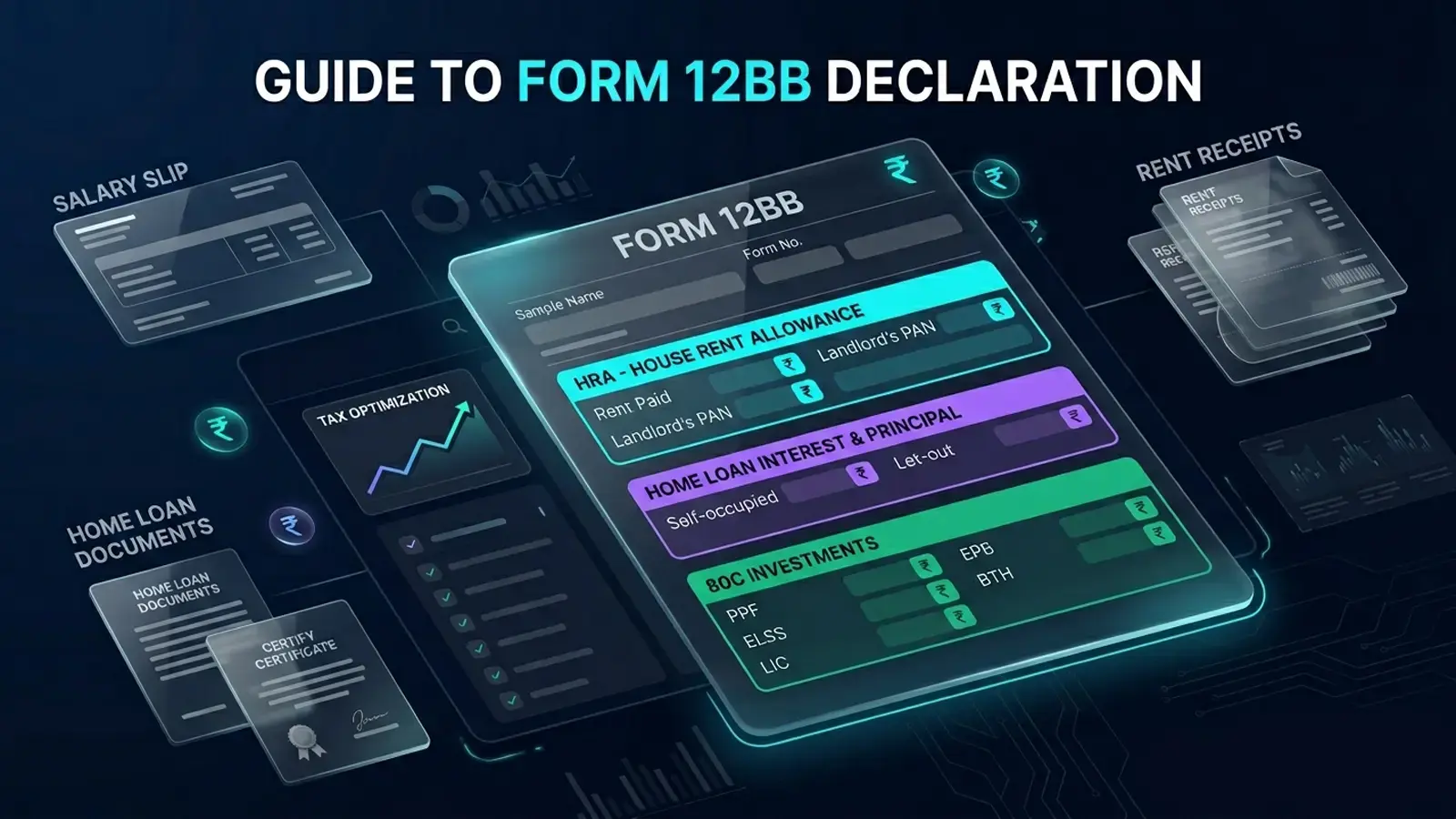
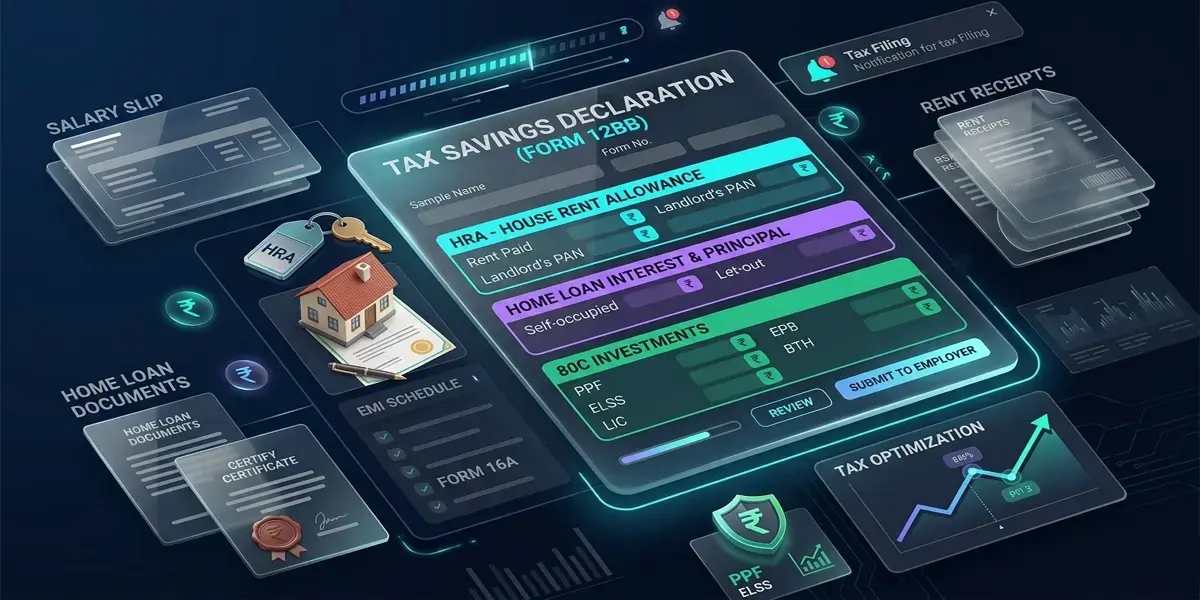
Quick answer: Form 12BB is a self-declaration form that salaried employees submit to their employer at the beginning of each financial year. It tells your employer exactly which tax benefits you plan to claim — HRA, home loan interest, LTA, and Section 80C investments — so they can calculate the right TDS every month instead of deducting too much. It is mandatory under Rule 26C of the Income Tax Rules for anyone who wants to prevent excess TDS from salary.
This article is for educational purposes only. Tax laws and CBDT rules are updated regularly. Always verify the latest provisions at incometax.gov.in and speak with a qualified Chartered Accountant (CA) before making actual tax or investment decisions.
Most salaried professionals in India have experienced this: you receive your monthly salary and notice that TDS deducted is noticeably higher than expected. You think about your rent, your PPF deposits, your ELSS mutual funds — all of which should reduce your taxable income — yet your employer seems to be ignoring all of it.
The reason is almost always the same. You either did not submit Form 12BB at the start of the year, or you submitted it too late, or you submitted it without the supporting documents your employer needed.
Form 12BB is the single form that bridges the gap between what you spend on rent and investments and what your employer deducts as TDS. Done correctly, it ensures you take home what you have rightfully earned throughout the year instead of waiting for an ITR refund that arrives months later.
This guide explains everything about Form 12BB — what it covers, why it exists, how to fill it correctly, and how to avoid the mistakes that lead to excess TDS and filing headaches.
Form 12BB is a declaration form prescribed under Rule 26C of the Income Tax Rules, 1962. It was made mandatory from June 2016, replacing the informal investment declarations that different companies used to collect in their own formats.
Before this form existed, every HR department had its own template. Some were two pages, some were six. Some asked for documents upfront, others did not. The result was chaos — inconsistent TDS deductions, confusion during Form 16 generation, and disputes between employees and payroll teams.
Form 12BB standardised the entire process. Today, every salaried employee in India who wants their employer to account for their deductions and exemptions before deducting TDS must submit this single, uniform form.
In simple terms: Form 12BB is your formal message to your employer saying, "Here is my plan for reducing my taxable income this year — please factor this into my monthly TDS."
It covers four broad categories:
- House Rent Allowance (HRA) exemption
- Leave Travel Allowance (LTA) exemption
- Interest on home loan deduction (Section 24b)
- Chapter VI-A deductions (Section 80C, 80D, 80E, 80G, and others)
Before 2016, the absence of a standardised form created three real problems for the Indian tax system.
Problem 1 — Inconsistent TDS across employers. Two employees earning identical salaries, paying identical rent, and making identical investments could end up with completely different monthly TDS figures just because their employers used different declaration templates. One company might accept rent receipts; another might require a registered rental agreement.
Problem 2 — Audit trail gaps. When the Income Tax Department audited companies, it was nearly impossible to verify whether TDS was computed correctly because each employer maintained declarations in a different format. There was no standard to compare against.
Problem 3 — Employee disputes at year end. When Form 16 was issued at the end of the year, it sometimes showed deductions that the employee never claimed or missed deductions the employee had declared. Without a standard form, proving what was submitted and when was difficult.
Form 12BB solved all three problems by creating a single prescribed format that every employer is legally required to use, every employee is legally required to fill, and every payroll team can verify against a clear checklist.
| Situation | Required? |
|---|
| Salaried employee wanting HRA exemption | Yes |
| Salaried employee with active home loan interest | Yes |
| Salaried employee claiming Section 80C investments | Yes |
| Salaried employee claiming LTA exemption | Yes |
| Salaried employee with no deductions and no exemptions | Technically optional, but most HR teams require it |
| Self-employed individual or freelancer | Not applicable — file ITR directly |
| Pensioner receiving pension from employer | Depends on employer policy |
If you are under the New Tax Regime for FY 2026-27, the situation changes slightly. Under the New Regime, most exemptions and deductions — HRA, LTA, 80C, 80D — are not available. The only deduction still permitted under the New Regime through payroll is the Standard Deduction (₹75,000 for FY 2026-27). In this case, Form 12BB still needs to be submitted for employer-side NPS contribution under Section 80CCD(2). Home loan interest on a self-occupied property does not provide a deduction under the new regime, as Section 115BAC(2)(ii) bars set-off of house property loss against salary income.
If you have not decided your tax regime yet, read the Old vs New Tax Regime comparison before filling Form 12BB — because what you declare here signals to your employer which regime you are operating under.
1. House Rent Allowance (HRA)
HRA exemption is calculated using three rules under Section 10(13A). The minimum of the three is your exemption:
- Actual HRA received from employer
- Rent paid minus 10% of Basic + DA salary
- 50% of Basic + DA (metro city) or 40% of Basic + DA (non-metro city)
You declare your monthly rent amount, the landlord's name and address, and the landlord's PAN (if annual rent exceeds ₹1 lakh) through Form 12BB. The employer uses these numbers each month to reduce your TDS.
Use the HRA Exemption Calculator to calculate your exact exemption before you fill this section — knowing the number in advance prevents errors.
2. Leave Travel Allowance (LTA)
LTA covers actual travel costs incurred during leave within India. You declare your travel details, travel mode, and the amount. Only two claims are allowed in a block of four calendar years.
3. Home Loan Interest (Section 24b)
If you have a home loan on a self-occupied property, you can deduct up to ₹2 lakh of interest paid per year under Section 24b. You declare the lender's name, address, PAN, and the interest amount through Form 12BB.
4. Chapter VI-A Deductions
This is the largest section and covers most popular tax-saving instruments:
| Section | What It Covers | Limit |
|---|
| 80C | PPF, ELSS, LIC, EPF, home loan principal, NSC, ULIP, tuition fees | ₹1.5 lakh |
| 80CCC | Pension fund contribution | Within 80C limit |
| 80CCD(1) | Employee NPS contribution | Within 80C limit |
| 80CCD(1B) | Additional NPS contribution | ₹50,000 extra |
| 80D | Health insurance premium for self, family, parents | ₹25,000–₹50,000 |
| 80E | Interest on education loan | Full interest, no cap |
| 80G | Donations to eligible funds and institutions | 50% or 100% depending on institution |
| 80TTA | Savings account interest | ₹10,000 |
The official Form 12BB has five distinct sections. Here is what each section asks for:
| Section | Information Required | Key Fields |
|---|
| Part A | House Rent Allowance | Landlord name, address, PAN, monthly rent paid |
| Part B | Leave Travel Concession | Journey details, travel mode, amount |
| Part C | Home Loan Interest | Lender name, address, PAN, interest amount |
| Part D | Chapter VI-A Deductions | Nature of each claim, amount, supporting details |
| Declaration | Employee certification | Date, signature, employee name, designation, employer name |
The form ends with a declaration by the employee confirming that all information is true and that they will provide proof documents by the date specified by the employer.
Getting the documents right is more important than filling the form itself. Employers who do not receive proper proof are required by law to ignore that part of your declaration and deduct TDS as if the claim does not exist.
| Claim | Required Document |
|---|
| HRA | Rent receipts (monthly), rental agreement, landlord's PAN if annual rent > ₹1 lakh |
| LTA | Travel tickets, boarding passes, hotel bills for actual travel |
| Home Loan Interest | Interest certificate from bank or NBFC for the financial year |
| Section 80C — PPF | Passbook copy or annual contribution statement from bank or post office |
| Section 80C — ELSS | Statement from AMC or Demat account showing investment amount |
| Section 80C — LIC | Premium receipt with policy number |
| Section 80C — EPF | Usually captured automatically by payroll |
| Section 80C — NPS | Transaction statement from NPS trustee or CRA |
| Section 80D — Health Insurance | Premium payment receipt from insurer |
| Section 80E — Education Loan | Interest certificate from lender |
| Section 80G — Donation | Donation receipt with 80G registration number of institution |
Step 1 — Download the form. Your HR or payroll team will share the form, usually in April or early May. If not, download it from the Income Tax Department website at incometax.gov.in.
Step 2 — Fill the header. Write your full name, PAN, designation, and financial year. For FY 2026-27, write "2026-27."
Step 3 — Fill HRA details (Part A). Enter your landlord's full name and complete address. Enter the monthly rent you pay. If your annual rent exceeds ₹1 lakh (meaning monthly rent exceeds roughly ₹8,334), you must enter your landlord's PAN. Attach rent receipts for each month.
For example, if Priya works in Bengaluru, pays ₹18,000 per month in rent, and her landlord's PAN is ABCDE1234F, she fills all these fields and attaches 12 rent receipts — one per month — or a rental agreement plus three months of receipts, depending on her company's policy.
Step 4 — Fill LTA details (Part B). If you plan to travel and claim LTA this year, enter your travel details. If not, leave this blank.
Step 5 — Fill Home Loan Interest details (Part C). If you have a home loan, enter your bank's or housing finance company's name and address, their PAN (usually available on the interest certificate), and the estimated interest for FY 2026-27. Attach the provisional interest certificate from your lender.
For example, if Arjun borrowed ₹45 lakh from SBI at 8.5%, his annual interest in the initial years will be approximately ₹3.7 lakh — but he can claim only ₹2 lakh under Section 24b. He declares ₹2,00,000 in Part C.
Step 6 — Fill Chapter VI-A deductions (Part D). List every investment and expenditure for which you want deduction. Be specific — write PPF contribution ₹1,00,000, ELSS SIP ₹4,000 per month = ₹48,000, LIC premium ₹22,000, and so on. The total 80C amount cannot exceed ₹1.5 lakh even if you list more.
Step 7 — Sign and date. The declaration at the end requires your signature and the date. An unsigned Form 12BB has no legal value and the employer cannot act on it.
Step 8 — Attach supporting documents. Clip or PDF all documents mentioned above. If your company has an HRMS portal, upload them there. Ensure file names are clear.
Step 9 — Submit by the deadline. Most employers require Form 12BB by the end of April or mid-May. Late submission means TDS is deducted at full rate for the months before submission, and adjustments only happen going forward — not retroactively.
HRA is the most commonly claimed exemption in Form 12BB, and also the most commonly rejected one because of documentation gaps. Here is what you need to get right.
Rent receipt format. A valid rent receipt must include: date, month covered, amount paid, tenant name, landlord name, landlord signature, and property address. A printed receipt without the landlord's signature is not valid proof. A WhatsApp message or UPI payment screenshot is not a substitute for a proper receipt.
Landlord PAN requirement. If your annual rent exceeds ₹1 lakh (roughly ₹8,334 per month), the employer is required by the Income Tax Department to collect your landlord's PAN and report it. If your landlord refuses to share PAN, you must submit a declaration by the landlord stating that they do not have a PAN. Without either, the employer cannot process your HRA claim.
Co-living and PG situations. If you live in a co-living space or paying-guest arrangement and have a proper rent receipt from the operator, you can claim HRA. Many co-living platforms today issue valid monthly receipts with GST numbers. Verify that your employer accepts these.
Renting from parents. You can legally pay rent to your parents if they own the property and claim HRA — but your parents must declare this rental income in their own ITR. If you claim HRA by paying rent to your parents but they do not report it, the Income Tax Department's matching systems (now using AIS) will flag the discrepancy.
To calculate your exact HRA exemption before declaring it, the HRA Exemption Calculator gives you the three-rule breakdown instantly.
The most important document for this section is the provisional interest certificate from your bank or housing finance company. This is different from the year-end interest certificate used for ITR filing — the provisional one gives an estimate of interest for the coming year, which is what your employer needs in April.
Most banks issue provisional certificates in March or April. If your bank has not issued one, call customer care or download it from the net banking portal under the home loan section.
Key points:
- You can claim up to ₹2 lakh per year for a self-occupied property
- For a let-out property, there is no cap on interest deduction, but you must also declare rental income
- If the property is under construction, interest during construction is accumulated and claimed in five equal instalments after possession
- Pre-payment changes your interest amount — update the certificate if you made a large prepayment
Joint home loan situations. If you and your spouse jointly own the property and have a joint loan, each borrower can independently claim up to ₹2 lakh of interest deduction in their own respective Form 12BB — provided both are co-owners, not just co-borrowers.
Section 80C and Other Deductions
Section 80C is the most widely used deduction for salaried employees. The combined limit is ₹1.5 lakh per financial year — this is a ceiling, not a floor. All eligible investments and expenses together cannot exceed this limit.
Practical 80C planning example:
Rohan earns ₹12 LPA. His employer contributes ₹60,000 to EPF annually, which counts toward 80C. He also pays an LIC premium of ₹22,000 and contributes ₹50,000 to PPF. That is ₹1,32,000 already. He starts an ELSS SIP of ₹1,500 per month to reach the full ₹1.5 lakh. In his Form 12BB, he declares:
| Investment | Annual Amount |
|---|
| EPF (employee contribution) | ₹60,000 |
| LIC premium | ₹22,000 |
| PPF | ₹50,000 |
| ELSS SIP (₹1,500 × 12) | ₹18,000 |
| Total | ₹1,50,000 |
He does not add more — adding beyond ₹1.5 lakh in this box will be adjusted by his employer anyway.
Section 80D — Health Insurance. You can claim up to ₹25,000 for health insurance premium for yourself, spouse, and children. An additional ₹25,000 can be claimed for parents' health insurance. If parents are senior citizens, the limit for their insurance rises to ₹50,000. Submit the premium payment receipt from the insurer.
| Parameter | Form 12BB | Form 16 |
|---|
| What it is | Declaration by employee | Certificate issued by employer |
| When it is submitted/issued | Beginning of financial year | After year end, by June 15 |
| Who fills it | Employee | Employer (payroll system) |
| Legal basis | Rule 26C, Income Tax Rules | Section 203, Income Tax Act |
| Purpose | Informs employer of claims for TDS computation | Certifies TDS already deducted |
| Can be revised? | Yes, mid-year revisions allowed | No — it reflects actual deductions |
| Used for ITR filing? | Indirectly — informs TDS | Yes — primary salary document |
| Required documents | Yes — attached by employee | No — generated from payroll data |
The relationship between the two: what you declare in Form 12BB shapes what appears in Form 16. If your Form 12BB is accurate and supported by documents, your Form 16 will correctly reflect your deductions. If not, Form 16 will show higher TDS and fewer deductions — and you will need to claim the difference as a refund in your ITR. Use the Form 16 Analyzer to verify what your Form 16 actually reflects.
Some companies use the term "investment declaration" separately from Form 12BB. Here is how they relate:
| Parameter | Form 12BB | Investment Declaration |
|---|
| Legal status | Prescribed form under Rule 26C | Internal company form — no legal standard |
| When required | For final TDS computation | Usually at start of year, for provisional TDS |
| Replaces what | Previously used to replace informal HR forms | Still used by many companies for early estimates |
| Documents required | Yes — must be attached at final submission | Usually not at declaration stage |
| Binding | Yes — employer must act on it | Used for internal payroll projections |
In practice: many companies ask you to fill an "investment declaration" in April (for computing TDS from April to February) and then ask for Form 12BB with actual proof documents in January or February (for final TDS reconciliation in March). Both serve related purposes at different stages of the financial year.
Not submitting Form 12BB — or submitting it without the required documents — has real financial consequences:
Higher monthly TDS. Your employer will compute TDS assuming no deductions, no exemptions. If you earn ₹15 LPA, the difference between TDS with full deductions and TDS without them can be ₹15,000–₹25,000 per month. Multiply that by 12 months and you have ₹1.8–3 lakh sitting with the government instead of in your account.
Refund delay. You will eventually get this back as an ITR refund — but the process takes 60 to 120 days after filing, and refund crediting has its own timelines.
Cash flow impact. If you have financial commitments (EMIs, rent, SIPs), consistently lower take-home salary creates unnecessary stress that Form 12BB submission could have avoided entirely.
No retroactive adjustment for past months. If you submit Form 12BB in October instead of April, the correction applies only from October onwards. The six months of excess TDS from April to September goes into your refund calculation — you cannot ask the employer to re-credit it to your salary.
From HR teams: The most common HRA declaration mistake happens because employees submit rent receipts without first updating Form 12BB. The HR team sees a rent receipt in January proof submission but has no Form 12BB HRA declaration on file — so the TDS for the year was calculated without any HRA exemption. The employee then waits 6 to 8 months for an ITR refund that could have been avoided entirely.
From payroll processing: Employees who move from one city to another mid-year (say from a non-metro to a metro) often forget to submit a revised Form 12BB reflecting the new HRA percentage applicable. Their TDS continues to be calculated at 40% of basic (non-metro ceiling) when 50% of basic now applies. The shortfall gets corrected at ITR, but it could have been claimed monthly.
From investment declarations: Many employees declare NPS contributions on Form 12BB under Section 80CCD(1B), but their employer's payroll system only supports 80C declarations — not the separate NPS bucket. The employer then calculates TDS ignoring the NPS deduction. Employees in this situation must claim the NPS deduction directly in their ITR at year end, even if they declared it on Form 12BB.
1. Declaring amounts they haven't invested yet. Form 12BB at the start of the year is partly a forward-looking declaration — you are saying what you plan to invest. But some employees declare ₹1.5 lakh in 80C at the start and then invest only ₹80,000 by year end. The employer reduces TDS based on the declaration, but at year end — when actual proofs are verified — the shortfall results in a large TDS deduction in March to compensate.
2. Forgetting EPF in the 80C tally. Your employee EPF contribution already counts toward the ₹1.5 lakh Section 80C limit. Many employees declare another ₹1.5 lakh in ELSS and PPF without accounting for EPF, which leads to over-declaration.
3. Wrong landlord PAN. If the PAN entered for your landlord is incorrect, the employer will reject the HRA claim. Double-check the PAN before submitting — a single digit error invalidates the declaration.
4. Missing provisional interest certificate. Submitting Form 12BB without the bank's provisional interest certificate for the home loan section means the employer cannot process that claim. The certificate must come from the lender, not a self-generated estimate.
5. Not updating Form 12BB mid-year. Life changes — you might move to a higher-rent apartment in September, or close a home loan early, or change your investment plan. Most employers allow one mid-year revision to Form 12BB. Failing to update it means your TDS continues being computed on outdated information.
6. Signing without reading. The declaration at the end of Form 12BB states that all information is correct and that you will face consequences for false declaration. Some employees sign without verifying the amounts they have written. A wrong amount, even if unintentional, creates mismatches with Form 16 and potential notices later.
Scenario: Kavya is a software engineer in Pune earning ₹14 LPA. She lives in a rented flat paying ₹17,000 per month. She has an active home loan on a flat in her hometown with SBI — annual interest is approximately ₹1.7 lakh. She invests ₹12,500 per month in ELSS and contributes ₹5,000 per month to PPF. Her employer contributes ₹2,100 per month to her EPF.
What Kavya declares in Form 12BB:
| Section | Kavya's Declaration |
|---|
| HRA (Part A) | Rent ₹17,000/month, landlord PAN attached, 12 rent receipts |
| Home Loan Interest (Part C) | SBI, PAN of branch, interest ₹1,70,000, provisional certificate attached |
| Section 80C (Part D) | ELSS ₹1,50,000 + PPF ₹60,000 + EPF ₹25,200 = but capped at ₹1,50,000 |
| Section 80CCD(1B) | NPS not applicable |
Result: Kavya's employer computes TDS on her income after reducing:
- HRA exemption (calculated using three-rule formula)
- Home loan interest ₹1,70,000
- Section 80C ₹1,50,000
- Standard deduction ₹75,000
Her effective taxable income drops significantly and her monthly TDS reduces by approximately ₹8,000–₹10,000 per month compared to no declaration scenario.
Expert Tips to Avoid TDS Issues
Tip 1 — Calculate before declaring. Use the HRA Exemption Calculator before filling the HRA section. Declaring a number you have not calculated means either under-claiming (losing benefit) or over-claiming (creating a shortfall in March).
Tip 2 — Keep copies of everything you submit. Save a PDF of the filled Form 12BB and all attachments. If there is a discrepancy in your Form 16 at year end, your submitted copy is evidence. Without it, it is your word against the payroll system.
Tip 3 — Check your payslip for two months after submission. After your employer processes your Form 12BB, TDS on your payslip should reduce. If it does not, follow up with HR — there may be a processing issue.
Tip 4 — Coordinate with your partner if you have a joint home loan. If both you and your partner are claiming home loan interest deduction from the same property, ensure you have a co-ownership certificate or the sale deed clearly showing shared ownership. Lenders sometimes issue a single interest certificate — ask them to split it by ownership ratio.
Tip 5 — Do not declare donations you have not made yet. Section 80G donations often get declared upfront with good intentions, but if you do not actually donate, the claim will be reversed at year end. Only declare what you are certain you will do.
Tip 6 — Cross-check your Form 16 when it arrives. When you receive Form 16 in June, compare it against your Form 12BB declaration. Any deductions that appear in your Form 12BB but not in Form 16 will need to be claimed directly in your ITR. Use the Form 16 Analyzer to do this verification quickly. For a detailed walkthrough, the Form 16 reading and ITR filing guide explains how each section maps to your return.
Frequently Asked Questions
What is Form 12BB in simple terms?
Form 12BB is the standard form you give your employer to say which tax benefits you are claiming this year. Your employer uses it to deduct the right amount of TDS from your salary each month. Without it, your employer cannot give you the benefit of any exemption or deduction while computing TDS.
Is Form 12BB mandatory for all salaried employees?
It is mandatory for any salaried employee who wants to claim deductions or exemptions through their employer's payroll. If you have no deductions to claim, your employer may still ask you to submit a blank or nil declaration depending on company policy.
Can I submit Form 12BB after April?
Yes, but it will only affect TDS from the month of submission onwards. You cannot ask your employer to retroactively revise TDS for months before you submitted the form. For months already processed, you will need to claim excess TDS as a refund in your ITR.
What happens if my actual investments are less than what I declared?
Your employer will verify actuals during the January–February proof submission period. If actual investments are lower, they will increase TDS in the remaining months (typically February and March) to make up the shortfall. This can cause a noticeably large deduction in your last one or two salary payslips.
Can I revise Form 12BB during the year?
Most employers allow one mid-year revision, usually around September–October. If your circumstances change significantly — new rental agreement, fresh home loan, change in investments — update your declaration and notify HR.
Is Form 12BB required if I am opting for the New Tax Regime?
Under the New Tax Regime, most deductions and exemptions are not available. However, you may still need to declare employer NPS contributions (80CCD(2)) and you should formally communicate your regime choice to HR. Many employers ask you to submit Form 12BB indicating the chosen regime for their payroll records.
What documents do I need for HRA in Form 12BB?
Rent receipts for each month (or a rental agreement plus specimen receipts), landlord's full name and address, and landlord's PAN if annual rent exceeds ₹1 lakh.
Can I claim both HRA and home loan interest in Form 12BB?
Yes, both can be claimed simultaneously. Claiming HRA means you are currently renting where you live. Claiming home loan interest means you have a property elsewhere with a loan. This is a legitimate situation — many people have home loans in their hometown while renting in the city where they work.
What is the difference between provisional and final interest certificate for home loan?
A provisional interest certificate estimates interest for the upcoming financial year and is used for Form 12BB submission in April. A final interest certificate confirms actual interest paid and is used when filing ITR. Always use the provisional one for your employer and the final one for your return.
Does EPF automatically count toward Section 80C in Form 12BB?
Your employer-side payroll system usually captures EPF employee contribution automatically. However, when manually listing investments in Part D of Form 12BB, many employees forget to include EPF. If you include EPF, make sure the total across all 80C items does not exceed ₹1.5 lakh.
What if my landlord does not have a PAN?
If your annual rent exceeds ₹1 lakh and the landlord does not have a PAN, the landlord must provide a written declaration stating that they are not required to obtain a PAN or do not have one. You must attach this declaration when submitting Form 12BB. Without it, the HRA claim cannot be processed.
Can freelancers or self-employed people submit Form 12BB?
No. Form 12BB is only for individuals who receive salary income and have an employer. Freelancers and self-employed people claim deductions directly in their ITR using the relevant schedules and do not have a payroll system to interact with.
What is the penalty for false declaration in Form 12BB?
The form contains a signed declaration by the employee. If false information is submitted knowingly — for example, declaring rent paid to a landlord when no rent is actually being paid — it can attract prosecution under the Income Tax Act and penalties for misrepresentation. Employers are also required to report discrepancies if discovered.
When should I ideally submit Form 12BB?
The ideal time is the first or second week of April — the very start of the financial year. This ensures TDS is computed correctly from April's salary itself. Submitting in May or June means the April salary would have already been processed at a higher TDS rate.
Does Form 12BB replace ITR filing?
No. Form 12BB only helps your employer deduct the right TDS from salary. You must still file your ITR separately to report total income, claim any deductions your employer missed, report income from other sources, and get any remaining refund. Every salaried individual whose income exceeds the basic exemption limit is required to file an ITR regardless of Form 12BB.
Final Verdict
Form 12BB is not a complex form — it is a straightforward declaration that takes 20 to 30 minutes to fill correctly when your documents are in order. The consequences of skipping it or filling it carelessly, however, play out across 12 months of payslips and show up again during ITR filing.
The core principle is simple: your employer cannot read your mind. They cannot assume you pay rent, have a home loan, or invest in PPF unless you tell them through this form. Form 12BB is that communication.
For FY 2026-27, submit it by April itself. Gather rent receipts, get a provisional interest certificate from your bank, confirm your EPF contribution amount, and tally all investments so the 80C total is accurate. If you are choosing between Old and New Regime, decide before you submit — once your employer starts computing TDS under one regime, switching mid-year creates complications.
Done right, Form 12BB is the simplest thing you can do to keep significantly more of your salary in your own account rather than sending it to the government as excess TDS and waiting months for a refund.
Beyond monthly TDS, your salary structure also determines another employee benefit that many professionals overlook until their last day: gratuity. If you have been with the same employer for 5 or more years, you are entitled to a lump-sum payment calculated from your basic salary. Understand the formula, eligibility, and tax rules in the Gratuity Complete Guide.
To plan your full tax deduction strategy beyond Form 12BB, explore the Best Ways to Save Tax guide.
PaisaPilotAI Editorial Team | Tax & Compliance Research | Last reviewed: June 2026 | For professional tax advice, consult a Chartered Accountant registered with ICAI.