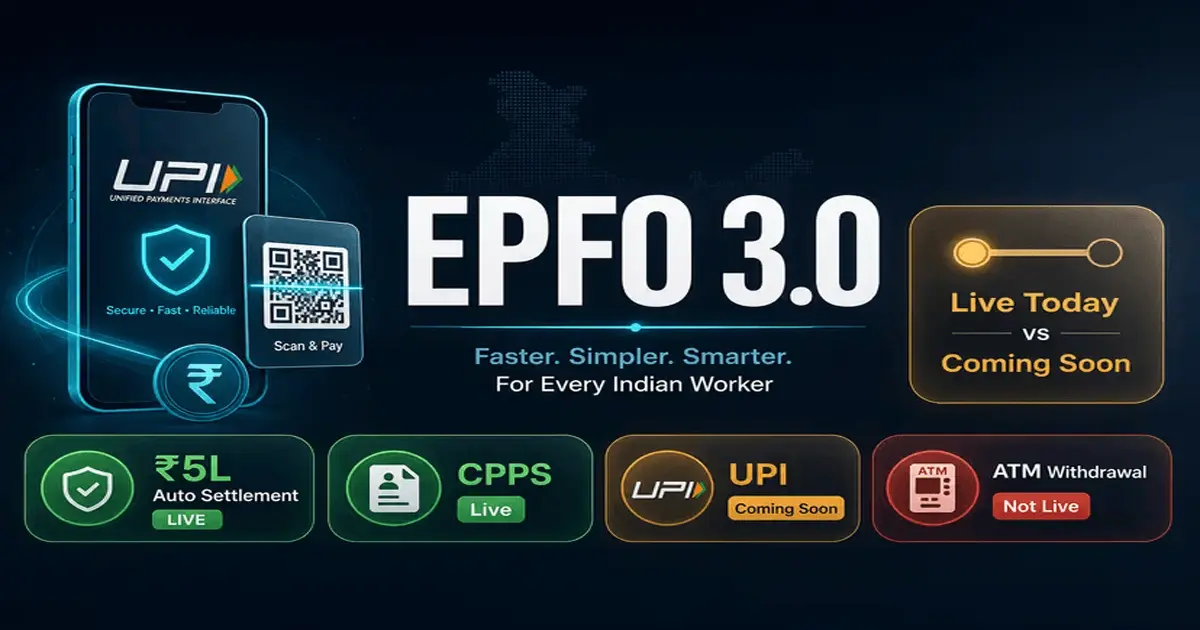
Quick answer: EPFO 3.0 is the government’s name for a phased digital transformation of the Employees’ Provident Fund Organisation — not a single app launch on one date. Several reforms grouped under this label are already live (Centralised Pension Payment System from 1 January 2025, auto-settlement of advance claims up to ₹5 lakh, simplified PF transfers for KYC-compliant members). The full core-banking platform and UPI-linked PF claim settlement are officially under development under the CITES 2.01 IT project and were not available to members as of 27 June 2026. You cannot withdraw PF through UPI or a dedicated PF ATM card today. Claims still go through the EPFO Member Portal or UMANG app with Aadhaar OTP.
Reviewed by Manjeeta Raj, Founder of PaisaPilotAI. This article separates officially live reforms from announced-but-pending features and social media misinformation. CBT-approved withdrawal rule changes from October 2025 require gazette notification under the EPF Scheme, 1952 before they become legally operative — verify current rules at epfindia.gov.in before acting.
Check your EPF corpus before planning a withdrawal → EPF Calculator — free, no login
If you have searched “EPFO 3.0 UPI withdrawal” in 2026, you are not alone. WhatsApp forwards, YouTube thumbnails, and finance blogs have created the impression that PF can now be withdrawn like a bank savings account — swipe at an ATM, tap on PhonePe, money in minutes.
Some of that is directionally aligned with where EPFO is headed. Much of it is simply wrong about what you can do today.
This guide maps every major EPFO 3.0 talking point to its official implementation status, explains what already changed for employees and payroll teams, and gives you a practical preparation checklist — without mixing parliamentary announcements with Twitter rumours.
What Is EPFO 3.0?
EPFO 3.0 is a member-centric digital transformation framework approved by EPFO’s Central Board of Trustees (CBT) to modernise provident fund services through industry-standard core banking infrastructure, phased IT rollout, and streamlined member-facing processes.
It is not one product you download. The Ministry of Labour and Employment uses “EPFO 3.0” to describe:
- Reforms already operational — faster auto-settlement, centralised pension payments, simplified transfers, employer-independent bank seeding.
- A future unified technology stack — hybrid core banking solution plus cloud-native modules for accounts, compliance, ERP, and a single customer experience (approved at the 238th CBT meeting, 13 October 2025).
- Planned capabilities such as multilingual self-service, faster automated claims, and instant withdrawals — described officially as part of the framework, but not all channels are live yet.
Think of EPFO 3.0 as a programme label covering both deployed improvements and the next-generation platform still being built under the Centralised IT Enabled System (CITES 2.01) project.
| Term | Plain-English meaning |
|---|---|
| EPFO 3.0 | Government’s umbrella name for EPFO’s current + upcoming digital reforms |
| CITES 2.01 | EPFO’s central IT modernisation project (hardware, databases, payments, ECR) |
| CBT | Central Board of Trustees — EPFO’s apex policy body |
| CPPS | Centralised Pension Payment System — live since 1 January 2025 |
| Auto-settlement | System-processed advance claims without manual EPFO officer review |
Why Is EPFO Introducing EPFO 3.0?
EPFO is modernising because its legacy decentralised IT could not scale to 30+ crore registered members, rising claim volumes, and expanded social security coverage — while members demanded bank-like speed and transparency.
Official statements point to four drivers:
- Volume pressure. EPFO processed record auto-settlement volumes in FY 2024–25 and FY 2025–26. Manual claim handling at 20+ days was generating grievances — delay in PF withdrawal remains among the top member complaints cited in CBT agenda documents.
- Employer dependency bottlenecks. Transfers and KYC approvals historically routed through employers caused delays. Reforms since January–April 2025 reduce that dependency for compliant accounts.
- Pensioner mobility. Decentralised pension disbursement forced pensioners to transfer Pension Payment Orders (PPOs) when they moved cities or banks. CPPS fixes that nationally.
- Future Labour Code coverage. The approved EPFO 3.0 framework explicitly targets scale for organised and unorganised workers as social security coverage expands — requiring core banking–grade infrastructure rather than incremental patches. Faster PF accumulation also depends on how your employer structures basic vs allowances; see our salary structure optimization guide if you are negotiating CTC components.
Union Labour Minister Dr. Mansukh Mandaviya, chairing the 238th CBT meeting, framed the October 2025 decisions as balancing ease of access with retirement security — including the proposed 25% minimum balance rule for partial withdrawals (CBT-approved; pending gazette notification).
Problems EPFO 3.0 Aims to Solve
EPFO 3.0 targets the chronic pain points members and employers report: slow withdrawals, transfer friction, pension portability, KYC rejections, and grievance backlogs.
| Problem (pre-reform) | Official reform direction | Status |
|---|---|---|
| Advance claims stuck in manual queues | Auto-settlement with higher limits | Live — ₹5 lakh cap (June 2025) |
| 20-day claim cycles for many cases | Target under 3 days for auto-eligible claims | Partially live for qualifying advances |
| Employer gatekeeping on transfers | Auto-trigger + reduced employer approval | Live for KYC-compliant UANs |
| Pension tied to one bank branch | CPPS — any bank, any branch | Live from 1 Jan 2025 |
| Bank seeding delayed 13+ days by employers | Employer approval removed post bank verification | Live (April 2025) |
| No instant digital payout channel | UPI claim settlement integration | Under development — not member-facing yet |
| Fragmented regional IT | CITES 2.01 centralisation + core banking | Rolling out in phases |
| High claim rejection from KYC mismatch | Self-correction for Aadhaar-verified UANs; simplified forms | Partially live |
The EPFO Citizen Charter and CBT agenda documents list recurring grievance themes: non-transfer of accumulations, KYC issues, passbook mismatches, and amounts not credited after settlement. EPFO 3.0 reforms directly address several of these — but KYC quality still determines whether automation helps you or blocks you.
Is EPFO 3.0 Officially Launched?
Question: Is EPFO 3.0 officially launched?
Short Answer: Partially — CPPS, ₹5 lakh auto-settlement, and simplified transfers are live; the full core-banking platform and UPI withdrawal are not publicly available as of 27 June 2026.
Why it matters: Treating EPFO 3.0 as fully launched leads members to skip portal-based claims and expect instant UPI payouts that do not exist yet.
Partially. EPFO 3.0 is not a single switch-on event. Multiple reforms branded under it are already operational. The full unified core-banking portal replacement and UPI withdrawal channel are not launched for public use as of 27 June 2026.
| Layer | Launch status | Official basis |
|---|---|---|
| CPPS (pension) | Live nationwide from 1 January 2025 | PIB Release ID 259297; CBT approval |
| Auto-settlement up to ₹5 lakh | Live (enhanced June 2025) | EPFO press release, 24 June 2025 |
| Simplified PF transfer (Jan 2025) | Live | EPFO press release, 19 January 2025 |
| Revamped Form 13 instant transfer | Live (April 2025) | EPFO press release, 25 April 2025 |
| Bank seeding without employer approval | Live (April 2025) | PIB, April 2025 |
| CBT withdrawal rule simplification (3 categories) | Approved Oct 2025 — pending gazette notification | PIB Release ID 2178522 |
| EPFO 3.0 core banking platform | Approved; phased implementation ongoing | PIB Release ID 2178522 |
| UPI PF claim settlement | Under development / testing — not live for members | PIB Release ID 2116804 (113th EC meeting) |
| ATM-style PF card withdrawal | No verified EPFO/PIB press release confirming rollout | Not listed in official Oct 2025 PIB release |
Bottom line: When someone says “EPFO 3.0 is here,” ask which feature they mean. Pension centralisation and ₹5 lakh auto-settlement are here. UPI tap-to-withdraw is not.
Features Available Today
Today, salaried members can already benefit from faster advance settlements, national pension portability, automated PF transfers (if KYC-complete), and online claims without visiting an EPFO office.
1. Auto-settlement of advance claims up to ₹5 lakh
EPFO raised the auto-settlement ceiling from ₹1 lakh to ₹5 lakh in June 2025. Eligible advance claims (illness, education, marriage, housing) process automatically — EPFO states disbursement within 72 hours / about 3 working days for qualifying cases.
In FY 2024–25, EPFO reported 2.34 crore advance claims settled through auto-mode (59% of all advance claims that year, per EPFO press release 24 June 2025). In the first two and a half months of FY 2025–26, EPFO stated that around 70% of advance claims processed in that window were settled in auto-mode.
Practical example: Priya (UAN 1012 3456 7890) with ₹3.2 lakh EPF balance files an online medical advance (Form 31) with complete KYC. Because the claim is within ₹5 lakh and passes system validations, it auto-settles in roughly 3 days — no employer attestation needed if she uses Composite Claim Form (Aadhaar).
2. Centralised Pension Payment System (CPPS)
From 1 January 2025, EPS pensioners receive pension through any scheduled bank branch in India. PPO transfer between regional offices is no longer required when a pensioner relocates or changes banks. PIB (Release ID 259297) stated the system would benefit more than 78 lakh EPS pensioners.
3. Simplified PF transfer on job change
Since 19 January 2025, EPFO removed employer routing for the majority of online transfer claims. EPFO's January 2025 press release projected that the revised process could allow the majority of annual online transfer claims — cited at roughly 1.30 crore filings — to reach EPFO without employer intervention.
For fully KYC-compliant UANs, EPFO’s official FAQ states members should not manually file transfer claims — an auto-trigger fires when the new employer’s first ECR contribution is received.
Practical example: Rohit switches from TCS Bangalore to Infosys Pune. His UAN has verified Aadhaar, PAN, bank account, and approved e-KYC. He shares the same UAN with Infosys HR. When November 2025 wages are uploaded via ECR, his old PF balance auto-transfers — no Form 13 needed.
4. Revamped Form 13 (April 2025)
Destination office approval was removed. Once the source (transferor) office approves, the account moves instantly to the new member ID — including taxable/non-taxable bifurcation for correct TDS calculation on taxable PF interest.
5. Bank account seeding without employer approval
From April 2025, after NPCI/bank verification, employer approval is no longer required to seed or change a bank account on UAN — removing an average 13-day employer delay EPFO identified in FY 2024–25.
6. Online claims via Member Portal and UMANG
Over 99% of claims are now filed online (PIB, March 2025). Composite Claim Form (Aadhaar) allows member-only authentication — no employer signature — for settlement, pension withdrawal benefit, and advances when KYC is complete.
7. WhatsApp grievance helpline (regional)
EPFO operates regional WhatsApp helpline numbers (Nirbadh initiative) for grievances and guidance — not for instant PF withdrawal. Numbers are listed on epfindia.gov.in. This is live today; it is not the same as a proposed future WhatsApp claim bot rumoured on social media.
Features Announced but Not Fully Rolled Out
Several high-visibility EPFO 3.0 features are approved or in development but not yet available to ordinary members — including the full core-banking portal, UPI settlement, CBT withdrawal rule changes, and multilingual self-service.
| Feature | Official status (27 Jun 2026) | What it is supposed to do |
|---|---|---|
| Full EPFO 3.0 core banking platform | CBT-approved Oct 2025; phased rollout ongoing | Unified account experience, national office service parity |
| UPI-linked PF claim settlement | EC reviewed progress; API integration with SBI/NPCI via CDAC under CITES 2.01 | Immediate credit to bank account through UPI rails after claim approval |
| “Instant withdrawals” (framework) | Announced as EPFO 3.0 outcome | Faster payout after eligibility checks — channel not fully deployed |
| Multilingual self-service | Part of approved digital framework | Vernacular access on portal (implementation timeline not officially dated) |
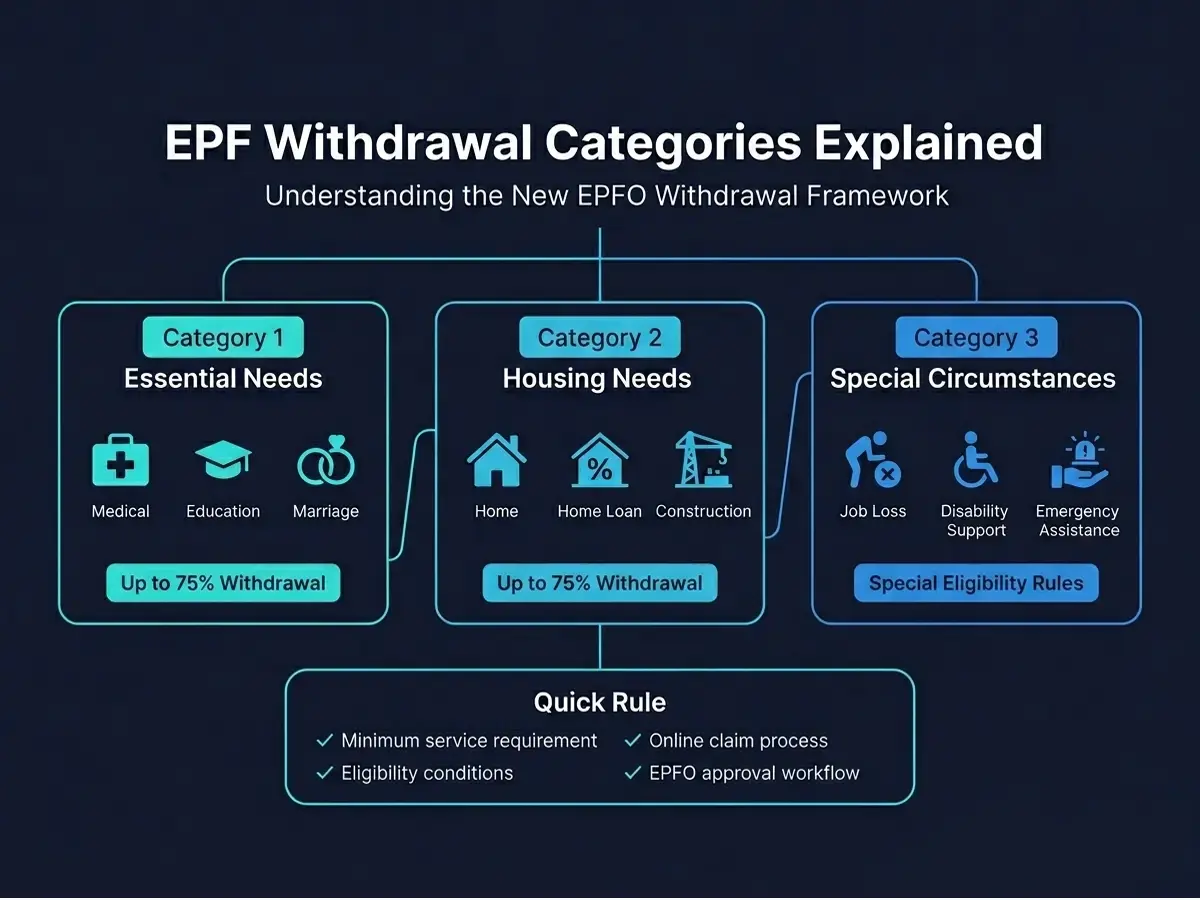
| 3-category withdrawal simplification | CBT approved 13 Oct 2025 | Merge 13 purposes into Essential Needs, Housing, Special Circumstances |
| 25% minimum balance on withdrawals | CBT approved | Requires EPF Scheme amendment via gazette |
| 12-month wait for full settlement after job loss | CBT approved | Requires gazette notification; current operative rule remains 2 months (Para 69(2)) |
| 36-month EPS withdrawal wait | CBT approved | Requires gazette notification; current operative rule remains 2 months |
| ATM / PF-linked debit card | Not confirmed in official PIB/EPFO press releases reviewed | Widely rumoured online — treat as unverified until gazette/EPFO notification |
Critical distinction: CBT approval ≠ immediate legal effect. Withdrawal rule changes must be notified under the Employees’ Provident Fund Scheme, 1952. Until then, operative withdrawal law follows existing paragraphs — see our EPF Withdrawal Rules guide for current vs proposed rules.
Can PF Be Withdrawn Using UPI?
Question: Can PF be withdrawn using UPI?
Short Answer: No — as of 27 June 2026, UPI-linked PF settlement is under development; withdrawals must be filed on the EPFO Member Portal or UMANG app with payment to your seeded bank account.
Why it matters: Viral posts claiming BHIM or PhonePe PF withdrawal are misinformation and can delay genuine emergency claims filed the correct way.
No — not as of 27 June 2026. EPFO is developing UPI-based claim settlement under CITES 2.01, but members must still withdraw through the EPFO Member Portal, UMANG app, or physical forms. Payment goes only to the bank account seeded on UAN after standard claim processing.
What EPFO has officially said
The 113th Executive Committee meeting (PIB Release ID 2116804) reviewed “Seamless PF claim settlement via UPI” — immediate credit to bank accounts through the UPI platform. Development of API and system integration with SBI and NPCI is being done by CDAC as technology partner, aligned with CITES 2.01.
The October 2025 CBT framework (PIB Release ID 2178522) lists “instant withdrawals” among future EPFO 3.0 outcomes — without specifying a UPI app name or public launch date.
What is NOT official
- Specific caps like ₹25,000 per UPI transaction appear in media reports citing unnamed officials — not verified in EPFO press releases or PIB documents reviewed for this article.
- Claims that you can open BHIM and withdraw PF today are misinformation.
How withdrawal works now
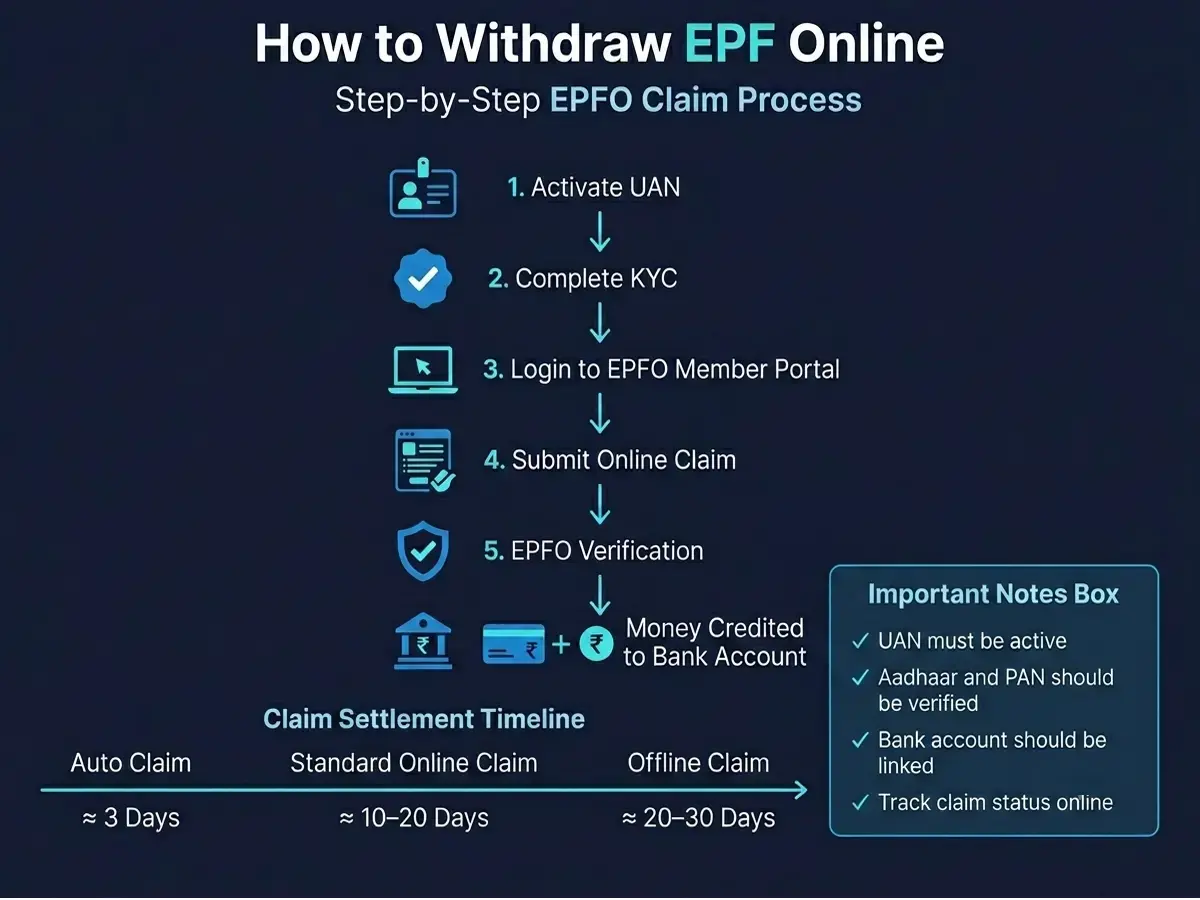
- Log in at unifiedportal-mem.epfindia.gov.in with UAN.
- File Form 19 / 10C / 31 (or composite form) online.
- Authenticate with Aadhaar OTP.
- EPFO credits your seeded bank account — typically 3 days for auto-eligible advances, longer for other claims.
Example: Ankit needs ₹1.5 lakh for a medical advance. He cannot use GPay to pull PF. He files Form 31 online; if auto-settlement criteria match, ₹1.5 lakh hits his HDFC account linked to UAN within ~72 hours.
Can PF Be Withdrawn Through ATM?
Question: Can PF be withdrawn through ATM?
Short Answer: No — EPFO has not launched a PF-linked ATM card product in any official press release reviewed here; cash access requires a settled claim credited to your bank account first.
Why it matters: Planning liquidity around a non-existent ATM channel can leave you without funds during a real emergency.
No — not through any EPFO-issued PF ATM card as of 27 June 2026. There is no official EPFO or PIB press release in the sources reviewed for this article confirming an ATM card product launch.
Separating rumour from official record
Social posts describe swiping a “PF ATM card” at any bank ATM for 50% of balance. That narrative is not backed by verified government notifications as of the last fact-check date below.
The October 2025 PIB release on EPFO 3.0 mentions instant withdrawals as a framework goal — without describing ATM cards, daily limits, or card issuance logistics.
What you can do today
After a normal online claim is settled, money arrives in your bank account. You may then withdraw cash from your bank’s ATM using your regular debit card — that is your bank balance, not a direct EPFO ATM channel.
Until EPFO publishes an official notification naming ATM access, assume ATM PF withdrawal is not available.
Will Claim Settlement Become Instant?
Partially — for qualifying advance claims, yes; for all claim types, no.
| Claim type | Typical settlement today | “Instant” status |
|---|---|---|
| Auto-eligible advance (≤ ₹5 lakh, validations pass) | ~3 working days / 72 hours | Live — this is EPFO’s current fastest path |
| Standard online final settlement | 10–20 working days (varies) | Not instant |
| Claims needing employer/date-of-exit resolution | Longer; may stall | Not instant |
| Future UPI settlement rail | Not live | Intended to speed payout after approval — not skip eligibility rules |
Minister of State Shobha Karandlaje, in a Rajya Sabha written reply (12 February 2026, as reported in official parliamentary proceedings), stated that claims clearing risk-management validations are designed for auto-mode processing, reducing manual settlement time from up to 20 days to under 3 days.
Important: Faster settlement does not mean faster eligibility. You still need correct date of exit, service period, KYC, and merged accounts. A rejected claim settles in zero days — because no money moves.
Will Employer Approval Still Be Required?
It depends on the transaction — increasingly no for KYC-compliant online claims and transfers, but employers remain central to monthly compliance.
| Action | Employer approval needed? (27 Jun 2026) |
|---|---|
| Online advance / composite claim (Aadhaar form, full KYC) | No employer attestation |
| PF transfer — KYC-compliant UAN | No — auto-trigger on new ECR |
| PF transfer — manual Form 13 | Source office approval only; destination approval removed (Apr 2025) |
| Bank account seeding post NPCI verification | No employer approval (Apr 2025) |
| e-KYC approval on UAN | Yes — employer must approve seeded Aadhaar/PAN/bank in many cases |
| Monthly ECR / wage upload | Yes — employer responsibility |
| Date of exit entry | Yes — employer must mark exit; missing DOE blocks claims |
Payroll action item: HR teams should approve pending e-KYC within days, not weeks. A fully verified UAN is the single biggest enabler of EPFO 3.0 automation for your employees.
If employer approval delays block a legitimate claim beyond 10 days, EPFO can process in certain cases — raise grievance at epfigms.gov.in. See common rejection triggers in our EPF Withdrawal Rules guide.
What Changes for Employees?
Employees gain faster access on compliant accounts, less transfer paperwork, and national pension portability for family members — but must keep KYC flawless to unlock automation.
Faster money in genuine emergencies
Auto-settlement up to ₹5 lakh covers most mid-career partial withdrawal needs. A ₹4 lakh housing advance that once waited weeks in a regional office queue can clear in days if validations pass.
Job changes without transfer anxiety
If your UAN is KYC-complete, you should not manually file Form 13 on every job change. Share your UAN on day one at the new employer; verify the auto-transfer in your passbook after the first contribution month.
Pensioners in your family
Parents receiving EPS pension benefit from CPPS — any bank, anywhere. Digital Life Certificate via Jeevan Pramaan (including FAT on UMANG) reduces branch visits.
Proposed — not yet law
CBT-approved changes would allow wider partial withdrawals with a 25% floor, 12-month uniform service, and longer waits for full settlement/EPS — pending gazette. Do not plan finances assuming these are already operative.
Tax rules unchanged
EPFO 3.0 modernises process, not tax law. Withdrawal before 5 continuous years of service remains taxable with TDS above ₹50,000 (with PAN). Use our Old vs New Tax Regime guide and Tax Saving guide when modelling post-withdrawal income.
What Changes for Employers and Payroll Teams?
From payroll operations: HR teams that batch-approve e-KYC requests weekly create a one-week delay in employee claims without realising it. Members who filed Friday morning wait until next Friday for employer e-KYC approval before the auto-settlement trigger fires. The fix is daily e-KYC queue clearance — it takes under 10 minutes per batch and eliminates the most common "why is my claim stuck" complaint payroll teams receive.
From compliance managers: The date of exit field is the single biggest operational blocker for final settlement claims. When an employee resigns and the employer's payroll team forgets to update the date of exit in the ECR system, the EPFO settlement claim stalls indefinitely. Most large IT companies have automated this through their HRMS-to-ECR integration; smaller companies still do it manually and frequently miss the update window.
Employers shift from gatekeepers to data accuracy partners — ECR quality and timely KYC approval determine whether employees experience EPFO 3.0 benefits.
| Area | Employer impact |
|---|---|
| ECR filing | Re-engineered 4-step module (upload → validate → challan → pay) with real-time validations — errors delay passbook updates and auto-transfers |
| e-KYC approval | Still required for seeded documents — bottleneck if delayed |
| Transfer claims | Far fewer manual transfer approvals for compliant employees |
| Date of exit | Must be entered promptly on resignation — missing DOE is a top claim blocker |
| Vishwas Scheme (Oct 2025) | Reduced penal damages for delayed remittances — litigation settlement window for employers |
| Grievance volume | Accurate reporting expected to reduce EPFO member grievances over time |
| Form 12BB / TDS alignment | Employees' investment declarations still drive monthly TDS — see Form 12BB guide for HR coordination |
Example: A 500-employee IT firm batch-approves e-KYC every Friday, validates DOE within 48 hours of exit, and runs pre-checks on ECR before upload. Employees experience auto-transfers and 3-day advances. A firm that ignores e-KYC queues creates “EPFO 3.0 doesn’t work” complaints — when the issue is internal HR latency.
KYC Requirements Employees Should Complete Immediately
Complete, matched KYC on UAN is the non-negotiable prerequisite for every EPFO 3.0 automation — Aadhaar, PAN, bank account, mobile, and employer-approved e-KYC must align exactly.
| KYC element | Why it matters | Action |
|---|---|---|
| UAN activation | Gateway to all online services | Activate at unifiedportal-mem.epfindia.gov.in |
| Aadhaar seeded + verified | Aadhaar OTP for claims; auto-transfer trigger | Link on portal; ensure employer approves e-KYC |
| PAN seeded | TDS calculation on pre-5-year withdrawals | Match name exactly with EPFO records |
| Bank account + IFSC | Only seeded account receives payment | Seed via portal; NPCI name match required |
| Mobile linked to Aadhaar | OTP delivery | Update with UIDAI if changed |
| Employer e-KYC approval | Blocks claim submission if pending | Follow up with HR |
| Date of exit (ex-employees) | Required for settlement claims | Ask previous employer to update |
| Nominee (e-Nomination) | Protects family | Complete online under Manage → e-Nomination |
Name mismatch example: EPFO shows “KUMAR RAHUL” but Aadhaar shows “Rahul Kumar” — claim rejected until corrected via profile update (Aadhaar-verified UANs can self-correct in many cases). For a focused fix list, read EPF Claim Rejected? 9 Common Reasons and How to Fix Them.
What Employees Should Do Today to Prepare
Do not wait for UPI launch headlines. Fix KYC now, understand current withdrawal rules, and use live automation already deployed.
- Log in and audit UAN profile today. Check KYC badges — green is not cosmetic; it controls automation.
- Confirm passbook matches last 3 months’ salary slips. Revamped ECR posting occasionally delays visibility — escalate with employer if contributions missing. If you just need a quick number rather than the full passbook, see our EPF balance check guide for the missed-call and SMS shortcuts.
- Seed bank account with name match. If changing banks, update before filing a claim — mid-claim bank changes bounce payments.
- On job change — transfer, don’t withdraw unless you truly need cash. Protect 5-year tax continuity. Read EPF Withdrawal Rules.
- Use auto-settlement path for advances. File online composite/Aadhaar forms; keep claims under ₹5 lakh and within existing service rules for fastest processing.
- Track claims on portal / UMANG / SMS
EPFOHO UAN ENGto 7738299899.
- Bookmark epfindia.gov.in for launch notifications — not WhatsApp forwards.
- Plan retirement stack holistically — EPF + gratuity + tax. Use Gratuity guide and Form 16 guide.
Expected Rollout Timeline
EPFO has not published a single official calendar date for full EPFO 3.0 or UPI withdrawal launch. Implementation is explicitly phased.
| Period | Official milestone |
|---|---|
| Oct 2024 | CPPS pilots (Karnal, Jammu, Srinagar; then 24 ROs) |
| 1 Jan 2025 | CPPS nationwide launch |
| 19 Jan 2025 | Simplified PF transfer process |
| 25 Apr 2025 | Revamped Form 13 — instant transfer post source approval |
| Apr 2025 | Bank seeding without employer approval |
| 13 Oct 2025 | 238th CBT — EPFO 3.0 framework + withdrawal reforms approved |
| 24 Jun 2025 | Auto-settlement limit raised to ₹5 lakh |
| 2025–26 | CITES 2.01 modules tested (EC meetings) — UPI integration in progress |
| Feb 2026 | Parliament updated on auto-settlement performance & EPFO 3.0 scope |
| 27 Jun 2026 (today) | UPI member withdrawal not live; full platform still rolling out |
Do not rely on unofficial dates (April 2026, “next month,” etc.) circulated in media. EPFO’s Executive Committee stated modules were undergoing rigorous testing with deployment “in coming months” — without binding public deadlines.
Myths vs Facts
Social media exaggerates EPFO 3.0. This table separates verified official facts from common rumours.
| Myth | Fact |
|---|---|
| “EPFO 3.0 launched — withdraw PF on UPI today” | False. UPI settlement is under development (PIB EC meeting). Withdraw via portal/UMANG only. |
| “PF ATM cards are being dispatched” | Unverified. No official EPFO/PIB release reviewed confirms ATM card issuance. |
| “All claims are now instant” | False. Auto-mode covers qualifying advances ≤ ₹5L; many claim types still take days to weeks. |
| “Employer approval is completely gone” | Misleading. Gone for many online claims/transfers if KYC-complete — employers still upload ECR, approve e-KYC, mark exit. |
| “New 75% / 25% withdrawal rules are live” | Mostly false legally. CBT approved Oct 2025; gazette notification pending for scheme amendment. |
| “EPFO 3.0 means higher PF interest” | False. Interest is set by CBT annually (8.25% for FY 2023–24 and 2024–25) — separate from EPFO 3.0 IT project. |
| “WhatsApp par PF nikal lo” | False for withdrawal. Regional WhatsApp lines are grievance helplines, not payout channels. |
| “KYC optional under new system” | False. Automation requires stronger KYC — weak KYC means manual delays. |
| “EPFO 3.0 replaces UAN” | False. UAN remains the universal identifier. |
| “Pensioners must still transfer PPO to new city” | False since CPPS (Jan 2025). Pension from any bank branch nationally. |
Common Mistakes
These errors block EPFO 3.0 automation and fuel “the system is broken” complaints — every one is preventable.
Aadhaar not linked
Without verified Aadhaar, you lose Composite Claim Form (Aadhaar), Aadhaar OTP filing, and auto-transfer triggers. Link and get employer e-KYC approval first.
PAN mismatch
PAN name mismatch triggers TDS and validation failures on pre-5-year settlements. Align PAN with EPFO legal name before large withdrawals.
Bank account mismatch
NPCI name match failures are a top rejection reason. The account shown on your UAN portal is the only payout account — verify last 4 digits at claim time. See EPF Claim Rejected? 9 Common Reasons and How to Fix Them before re-filing.
Incomplete KYC
Partial KYC produces the worst outcome: you hear about EPFO 3.0 speed, but your claim routes manual. Audit all four: Aadhaar, PAN, bank, mobile. Most rejections trace back to these — see EPF Claim Rejected? 9 Common Reasons and How to Fix Them.
Assuming UPI withdrawals are already available
Members cancel job offers or plan expenses around fake UPI launch dates. Confirm on epfindia.gov.in — as of 27 June 2026, UPI PF withdrawal is not operational.
Assuming ATM withdrawals are already available
Do not apply for loans expecting ATM PF access. Settle via official online claim → bank credit → your debit card if needed.
Assuming all claims become instant automatically
Auto-settlement requires eligibility, merged accounts, correct DOJ/DOE, PAN where applicable, and risk checks. A ₹4.8 lakh advance with a data conflict will not auto-settle just because the limit is ₹5 lakh.
Withdrawing on every job change
Automation makes withdrawal easier — which makes this mistake costlier. You lose compounding at 8.25% and break the 5-year tax window. Transfer instead.
Ignoring date of exit
Previous employer didn’t mark exit? Final settlement stalls regardless of EPFO 3.0. Chase HR or raise EPFiGMS grievance.