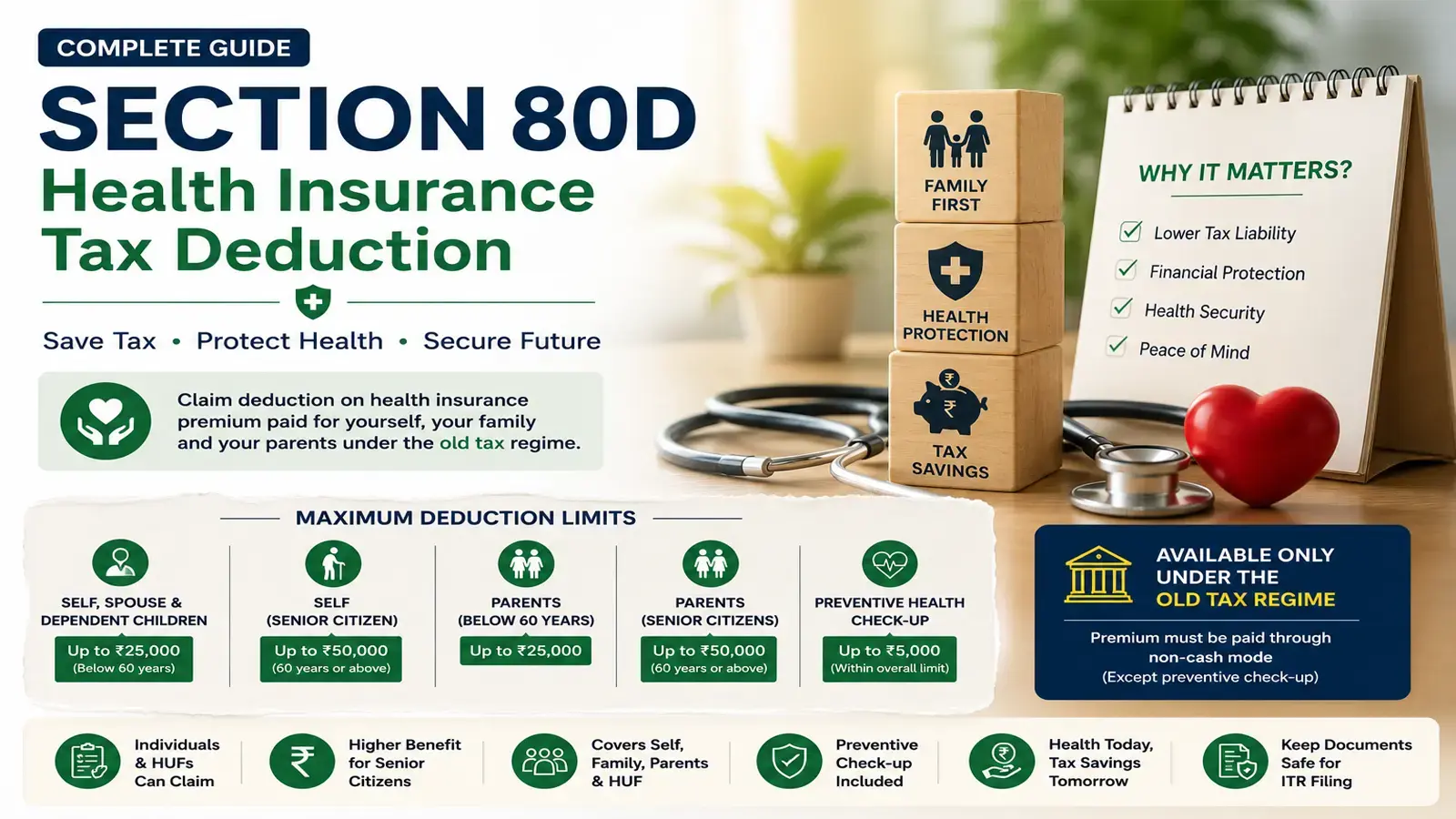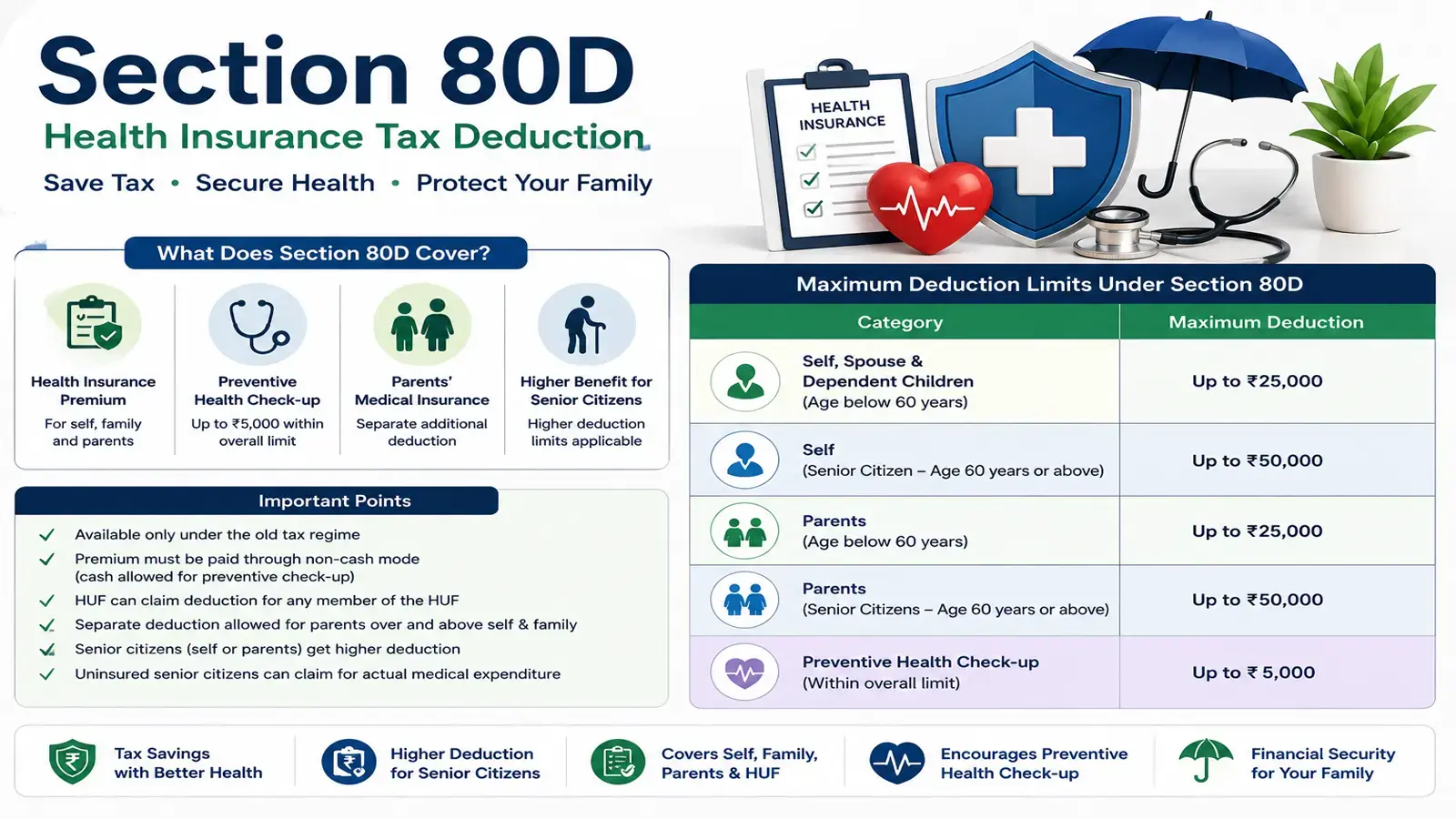
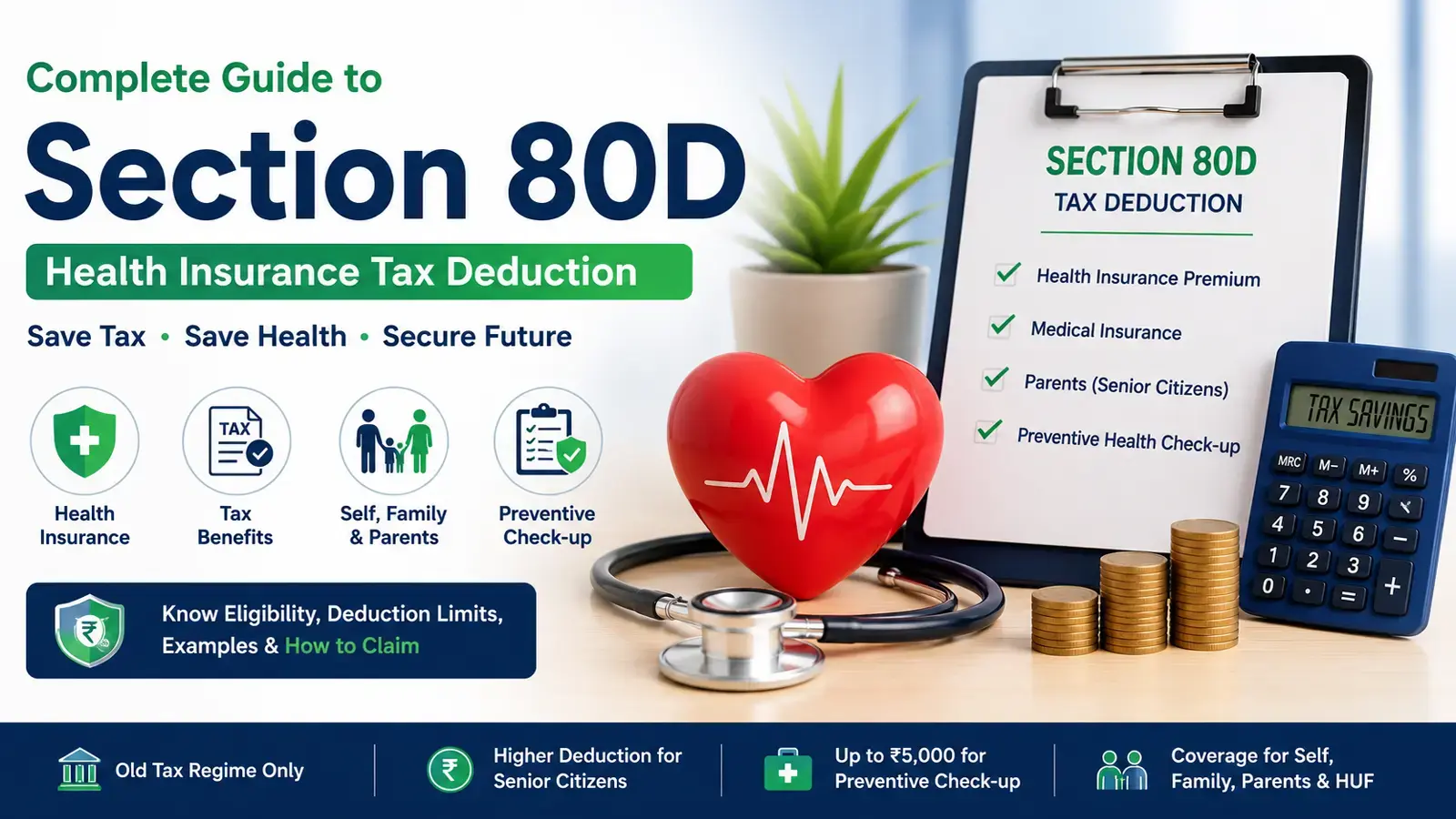
Quick answer: Section 80D of the Income Tax Act, 1961 lets individuals and Hindu Undivided Families (HUFs) claim a deduction for health insurance premiums paid for themselves, their family, and their parents. An individual can generally claim up to ₹25,000 for premiums paid for self, spouse, and dependent children, and a further amount for parents — higher if the parents are senior citizens. A smaller amount within these limits can also cover preventive health check-ups. This deduction is available only under the old tax regime — verify the latest limits at incometax.gov.in before filing.
Section 80D at a Glance
What is the Section 80D deduction limit? An individual can generally claim up to ₹25,000 per financial year for health insurance premiums paid for self, spouse, and dependent children. A higher limit applies where the person insured — self or parents — is a senior citizen. These are the limits applicable under current rules; always confirm the latest figures before filing your return, since limits are set through the Finance Act and can be revised.
Who is eligible for Section 80D deduction? Only individuals and HUFs can claim it. Companies, partnership firms, and LLPs are not eligible, and — like Section 80C — it applies only if you choose the old tax regime.
Can I claim Section 80D under the new tax regime? No. Section 80D deduction is not available under the new tax regime, regardless of how much premium you actually pay.
Does Section 80D cover my parents' health insurance too? Yes. Premium paid for parents is claimed as a separate, additional amount over and above what you claim for yourself and your family — the limit for parents is higher if they are senior citizens.
Can cash payment be used to claim Section 80D? Generally no — premium paid in cash is not eligible for deduction, except for the specific preventive health check-up component, which can be paid in cash or any other mode.
Not sure whether the old regime still makes sense for you once you factor in health insurance? Compare both regimes properly using the Old vs New Tax Regime guide, or see how 80D stacks with other deductions in our Section 80C guide and Best Ways to Save Tax.
Section 80D Quick Summary
| Aspect | Details |
|---|---|
| Purpose | Deduction for health insurance premium and related medical expenditure |
| Eligible Taxpayers | Individuals and HUFs |
| Maximum Deduction | Up to ₹75,000–₹1,00,000 combined, depending on age |
| Parents Covered | Yes, as a separate additional limit |
| Senior Citizen Benefit | Higher limit of ₹50,000 (vs ₹25,000) |
| Preventive Health Check-up | Up to ₹5,000, within the overall limit |
| Cash Payment Allowed? | No, except for preventive health check-up |
| Old vs New Regime | Available only under the old tax regime |
Section 80D in One Minute
- Section 80D gives a tax deduction for health insurance premium and related medical expenses.
- Only individuals and HUFs can claim it — companies, LLPs, and firms cannot.
- Self, spouse, and dependent children: deduction up to ₹25,000 (₹50,000 if a senior citizen).
- Parents: a separate, additional deduction, higher if they are senior citizens.
- Senior citizen limit is ₹50,000; non-senior limit is ₹25,000.
- Preventive health check-up: up to ₹5,000, within the overall limit, not extra.
- Cash payment is not allowed for premium, except for preventive check-ups.
- Available only under the old tax regime — not the new tax regime.
Key Takeaways
| Point | Detail |
|---|---|
| Who can claim | Individuals and HUFs only |
| Regime | Available only under the old tax regime |
| Self, spouse, dependent children | Deduction up to ₹25,000 (higher if self is a senior citizen) |
| Parents | Separate additional deduction, higher if parents are senior citizens |
| Preventive health check-up | Covered within the overall limit, subject to an internal cap |
| Cash payment | Not eligible, except for preventive health check-up |
| HUF | Can claim for premium paid for any member of the HUF |
| Differs from Section 80C | 80C covers investments/specified expenses; 80D covers health insurance and related medical expenditure only |
| Differs from Section 80DDB | 80DDB covers actual treatment cost of specified diseases, not insurance premium |
Introduction
Most salaried employees know they should have health insurance. Far fewer realise that paying that premium can also reduce their income tax — sometimes quite significantly, once you add up what you pay for yourself, your family, and your parents.
Section 80D of the Income Tax Act, 1961 is the provision that makes this possible. It is one of the most useful deductions available to Indian taxpayers, precisely because health insurance is something most people already need, regardless of any tax benefit attached to it.
This guide explains Section 80D in plain language — who can claim it, exactly how much you can claim, how the rules differ for parents and senior citizens, how it interacts with the old and new tax regimes, and how to actually claim it correctly while filing your return.
Because tax provisions are revised from time to time through the Finance Act, we have avoided tying this guide to any single financial year. The limits described below reflect the latest officially applicable rules at the time of writing — always cross-check the current figures on the Income Tax Department's official website before filing, especially if you are reading this after a new Union Budget.
What Is the Maximum Deduction Under Section 80D?
An individual can generally claim up to ₹25,000 for health insurance premium paid for self, spouse, and dependent children — rising to ₹50,000 if a senior citizen is insured. A separate, additional deduction of up to ₹25,000 (or ₹50,000 for senior citizen parents) applies for parents, taking the combined maximum as high as ₹75,000–₹1,00,000 in a year.
What Is Section 80D?
Section 80D is a section of the Income Tax Act, 1961 that allows a deduction from your total income for money spent on health insurance premiums, and certain related medical expenditure, for yourself and your family.
In simple terms: when you pay a premium for a health insurance policy — for yourself, your spouse, your children, or your parents — the government allows you to reduce your taxable income by that amount, up to a specified limit.
This is different from a straightforward insurance payout. Section 80D does not pay you anything directly. It simply reduces the income on which your tax is calculated, which in turn reduces the tax you owe for that year.
Section 80D deduction is available only to individuals and Hindu Undivided Families (HUFs), and only under the old tax regime. If you are still deciding which regime suits you, our Old vs New Tax Regime guide walks through this with salary-wise examples.
Who Can Claim Section 80D Deduction?
Only individuals and HUFs can claim a deduction under Section 80D. Companies, partnership firms, and LLPs cannot use this section at all.
| Taxpayer Type | Can Claim Section 80D? |
|---|---|
| Salaried individual | Yes |
| Self-employed individual | Yes |
| Hindu Undivided Family (HUF) | Yes, for premium paid for any member of the HUF |
| Partnership firm | No |
| Private or public company | No |
| LLP | No |
A few points worth keeping in mind:
- You must have chosen the old tax regime for the financial year to claim this deduction.
- For an individual, the deduction covers premium paid for self, spouse, and dependent children, and separately for parents (whether or not the parents are dependent on the taxpayer).
- Premium paid for siblings, in-laws, or non-dependent children does not qualify under Section 80D.
- For an HUF, the deduction covers premium paid for the health insurance of any member of the HUF.
Who Cannot Claim Section 80D?
- ❌ Companies
- ❌ LLPs
- ❌ Partnership Firms
- ❌ Taxpayers opting for the New Tax Regime
- ✅ Individuals
- ✅ Hindu Undivided Families (HUFs)
Section 80D Eligibility: What Exactly Is Covered?
Section 80D covers more than just a standard health insurance premium. The provision recognises several related categories of payment:
- Health insurance premium — paid under a policy approved by the Insurance Regulatory and Development Authority of India (IRDAI), covering self, family, or parents.
- Contribution to the Central Government Health Scheme (CGHS) or other schemes notified by the Central Government, for government employees.
- Preventive health check-up expenses — for self, family, and parents, within the overall limit.
- Medical expenditure incurred on a senior citizen who is not covered by any health insurance policy — this is a specific provision that allows a deduction even without an insurance policy, provided the person is a senior citizen and has no health cover.
Section 80D Deduction Limits
Section 80D deduction limits depend on two things: whose premium you are paying, and whether that person is a senior citizen. The deduction for your own family and the deduction for your parents are separate and additive — you are not required to choose between them.
Deduction Limit Table (Individual Taxpayer)
| Category | Age of Person Insured | Maximum Deduction |
|---|---|---|
| Self, spouse, and dependent children | Below 60 years | Up to ₹25,000 |
| Self, spouse, and dependent children | 60 years or above (senior citizen) | Up to ₹50,000 |
| Parents (father, mother, or both) | Below 60 years | Up to ₹25,000 (separate from the above) |
| Parents (father, mother, or both) | 60 years or above (senior citizen) | Up to ₹50,000 (separate from the above) |
Because the limit for self/family and the limit for parents are separate, the maximum possible deduction for an individual under Section 80D can go up to ₹75,000 in a year — ₹25,000 for a taxpayer below 60 insuring self and family, plus ₹50,000 for senior citizen parents. If the taxpayer is also a senior citizen, the maximum theoretical total rises to ₹1,00,000.
These figures reflect the limits applicable under current rules. Deduction limits are set through the Finance Act and have been revised in the past — always verify the latest limit on the Income Tax Department's official website before relying on any specific number while filing.
Deduction Limit for HUF
An HUF can claim a deduction of up to ₹25,000 for premium paid on the health insurance of any member of the HUF, or up to ₹50,000 if the member insured is a senior citizen.
Deduction for Medical Expenditure on Uninsured Senior Citizens
If a senior citizen (self or parent) does not have any health insurance policy, the actual medical expenditure incurred on their treatment can be claimed as a deduction, within the same overall limit that would otherwise apply (₹50,000). This provision exists specifically to help taxpayers whose elderly parents may not be insurable, or who choose not to take a policy for other reasons.
Section 80D Deduction: Self, Family, Parents, and Senior Citizens
Self, Spouse, and Dependent Children
The base deduction covers premium paid for a policy that insures you, your spouse, and your dependent children. It does not matter how many people are covered under the policy — the deduction is capped at the limit applicable to the eldest insured person's age band (₹25,000, or ₹50,000 if the taxpayer or spouse is a senior citizen).
Parents
Premium paid for your parents' health insurance is claimed separately, regardless of whether your parents are financially dependent on you. This is a common point of confusion — many taxpayers assume "dependent" status matters here the way it does for children, but for parents, Section 80D allows the claim as long as you are the one who actually paid the premium.
Senior Citizens
A person is treated as a senior citizen under the Income Tax Act if they are 60 years of age or above at any time during the relevant financial year. If either the taxpayer (for the self/family category) or the parent (for the parents' category) is a senior citizen, the higher ₹50,000 limit applies to that respective category.
HUF
As noted above, an HUF can claim a deduction for premium paid on the health insurance of any of its members, subject to the same ₹25,000/₹50,000 structure based on the insured member's age.
Preventive Health Check-up Deduction Under Section 80D
A deduction of up to ₹5,000 is available within the overall Section 80D limit for expenses incurred on preventive health check-ups, for self, spouse, dependent children, and parents.
This is not an additional amount over and above the ₹25,000/₹50,000 limits — it sits within them. In other words, if you spend ₹4,000 on a preventive health check-up and ₹22,000 on insurance premium in the same year, your total claimable amount under the ₹25,000 limit is ₹26,000 — but capped at ₹25,000, since the check-up amount is not an extra bucket.
Preventive health check-up expenses can be paid in cash — this is the one specific exception to the general rule that cash-paid premiums are not eligible under Section 80D.
Eligible Payment Methods Under Section 80D
Not every payment method qualifies for Section 80D deduction. This is one of the more frequently missed rules.
| Payment Method | Eligible for Section 80D? |
|---|---|
| UPI | Yes |
| Net Banking | Yes |
| NEFT / RTGS | Yes |
| Debit Card | Yes |
| Credit Card | Yes |
| Cheque | Yes |
| Cash — for health insurance premium | No |
| Cash — for preventive health check-up only | Yes |
The reason cash is disallowed for premium payments is straightforward: the provision requires premium to be paid through a traceable, non-cash mode, so that the payment can be verified against the insurer's records. Preventive health check-ups are the sole carve-out where cash remains acceptable.
Section 80D Under the Old Tax Regime
Section 80D deduction is available in full under the old tax regime, exactly as described in the sections above — subject to the applicable limits based on age and relationship.
If you pay health insurance premium for yourself, your family, and your senior citizen parents, and also incur a preventive health check-up expense, the old regime lets you claim all of these together, subject to the respective caps.
This makes Section 80D one of several deductions — alongside Section 80C, HRA exemption, and home loan interest — that only make sense to plan around if you are filing under the old regime.
Section 80D Under the New Tax Regime
Section 80D deduction is not available under the new tax regime. The new tax regime, which offers lower slab rates in exchange for removing most deductions and exemptions, does not permit a Section 80D claim regardless of how much premium you actually pay.
Old vs New Regime: Section 80D Availability
| Feature | Old Tax Regime | New Tax Regime |
|---|---|---|
| Section 80D deduction | Available (up to applicable limits) | Not available |
| Section 80C deduction | Available (up to ₹1.5 lakh) | Not available |
| HRA exemption | Available | Not available |
| Standard deduction | Available | Available |
| Tax slab rates | Generally higher | Generally lower |
This means the decision to buy health insurance should not change between regimes — insurance is a genuine financial need regardless of tax treatment — but the tax benefit of doing so only materialises if you file under the old regime.
If you are unsure which regime works out cheaper once your realistic 80C, 80D, and HRA claims are added up, our Old vs New Tax Regime guide covers this comparison with worked examples, and the Section 87A rebate guide explains how a separate rebate can affect your final tax liability under either regime.
Section 80C vs Section 80D
Section 80C and Section 80D are frequently claimed together, but they cover entirely different things.
| Feature | Section 80C | Section 80D |
|---|---|---|
| Purpose | Investments and specified expenses (PPF, EPF, ELSS, life insurance, tuition fees, etc.) | Health insurance premium and related medical expenditure |
| Maximum limit | ₹1,50,000 | Up to ₹75,000–₹1,00,000 combined (self/family + parents, depending on age) |
| Applicable regime | Old regime only | Old regime only |
| Can both be claimed together? | Yes | Yes, as fully separate limits |
| Common instruments/categories | PPF, EPF, ELSS, NSC, life insurance premium, tuition fees | Health insurance premium, preventive check-up, CGHS contribution |
Since these are separate, non-overlapping limits, using both fully can meaningfully reduce your taxable income under the old regime. For a complete list of eligible options under 80C, see our dedicated Section 80C guide, and for a broader roundup of tax-saving strategies, see Best Ways to Save Tax.
Section 80D vs Section 80DDB
Section 80D and Section 80DDB are both health-related deductions, but they apply in very different situations.
| Feature | Section 80D | Section 80DDB |
|---|---|---|
| What it covers | Health insurance premium, preventive check-up, and medical expenditure on uninsured senior citizens | Actual expenditure incurred on the medical treatment of specified diseases |
| Requires insurance? | Generally yes (except the uninsured senior citizen provision) | No — it covers actual treatment cost, insured or not |
| Who can be covered | Self, spouse, dependent children, parents (any age) | Self or specified dependent relatives, for specified diseases only |
| Nature of deduction | Premium paid, subject to age-based limits | Actual amount spent on treatment, subject to a cap and reduced by any insurance/reimbursement received |
| Documentation | Premium receipt, payment proof | Prescription from a specified specialist, as prescribed under the Income Tax Rules |
In short: Section 80D is about paying for protection in advance (insurance); Section 80DDB is about claiming relief for the actual cost of treating specific serious illnesses after the fact. A taxpayer could potentially claim both in the same year if they meet the respective conditions — they are not mutually exclusive, since they address different financial situations.
Real-Life Examples
Example 1: Young Salaried Employee Insuring Self and Spouse
Rohan, 28, pays ₹18,000 as an annual premium for a family floater policy covering himself and his spouse. Neither is a senior citizen.
- Deduction claimed under Section 80D: ₹18,000 (full amount, within the ₹25,000 limit)
- Remaining room in this category: ₹7,000, which he could use for a preventive health check-up if needed
Example 2: Employee Also Insuring Senior Citizen Parents
Meera, 35, pays ₹22,000 for her own family's health insurance and ₹38,000 for a policy covering her senior citizen parents.
- Self/family deduction: ₹22,000 (within the ₹25,000 limit)
- Parents' deduction: ₹38,000 (within the ₹50,000 limit, since parents are senior citizens)
- Total Section 80D deduction: ₹60,000
Example 3: Preventive Health Check-up Within the Limit
Arjun pays ₹21,000 as premium for his family and spends ₹6,000 on preventive health check-ups for himself and his spouse in the same year.
- Premium: ₹21,000
- Preventive check-up eligible: capped at ₹5,000 (even though he spent ₹6,000)
- Total: ₹26,000, but the overall Section 80D limit for this category is ₹25,000
- Deduction allowed: ₹25,000 — the extra ₹1,000 gives no additional benefit
Example 4: Senior Citizen Taxpayer With Uninsured Parent
Suresh, 62, is himself a senior citizen and pays ₹40,000 in premium for his own health cover. His 85-year-old mother has no health insurance, and Suresh spends ₹15,000 on her medical treatment during the year.
- Self deduction (senior citizen limit): ₹40,000 (within ₹50,000)
- Parent's medical expenditure (uninsured senior citizen provision): ₹15,000 (within the ₹50,000 limit for senior citizen parents)
- Total Section 80D deduction: ₹55,000
Example 5: Combining Section 80C and Section 80D
Priya claims ₹1,50,000 under Section 80C (EPF, PPF, and life insurance) and ₹45,000 under Section 80D (₹20,000 for herself and her spouse, ₹25,000 for her non-senior-citizen parents).
- Section 80C deduction: ₹1,50,000
- Section 80D deduction: ₹45,000
- Combined deduction from these two sections alone: ₹1,95,000, before accounting for any other deductions like HRA or home loan interest
Calculation Example: Tax Impact of Section 80D
Assume a salaried individual under the old regime has a taxable income of ₹9,00,000 before claiming any Section 80D deduction, and claims ₹55,000 under Section 80D (own family plus senior citizen parents).
Claiming the full ₹55,000 reduces taxable income to ₹8,45,000. The exact rupee saving depends on which income slab that ₹55,000 falls into, since India's slab system taxes different portions of income at different rates.
Please verify current slab rates on the Income Tax Department's website before estimating your own tax saving, since slab rates and thresholds can change with each Union Budget.
Common Mistakes to Avoid
- Paying premium in cash and still expecting to claim it — only preventive health check-up expenses can be paid in cash under Section 80D.
- Assuming parents must be financially dependent — this condition does not apply to the parents' category under Section 80D; you can claim it as long as you paid the premium.
- Forgetting that preventive check-up is within the limit, not additional to it — a common source of over-claiming.
- Assuming Section 80D works under the new tax regime — it does not, regardless of the amount paid.
- Not checking the age of the insured person each year — if a parent or spouse crosses 60 during the year, the higher limit may apply, and taxpayers often continue claiming the lower limit out of habit.
- Confusing Section 80D with Section 80DDB — these cover very different situations and have different documentation requirements.
- Not retaining premium payment proof — insurers issue a premium payment receipt or certificate; this should be kept safely for both employer declaration and ITR filing.
How to Claim Section 80D While Filing ITR
Claiming Section 80D generally follows the same two-stage process as other Chapter VI-A deductions — once during the year through your employer, and again while filing your Income Tax Return (ITR).