Old Regime vs New Regime Eligibility
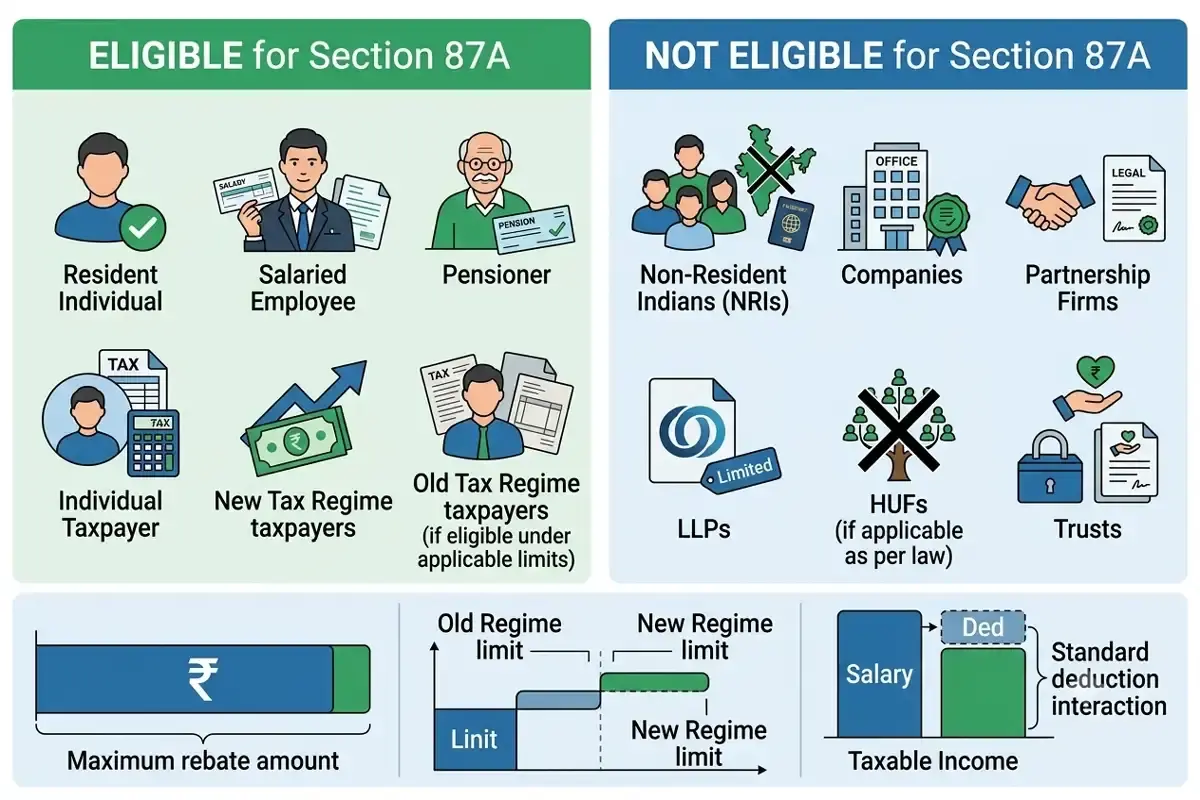
Section 87A is available under both the old and new tax regimes — but with very different thresholds and maximum rebate amounts.
A common misconception is that Section 87A is a new regime-only benefit. It existed before the new regime and continues under both regimes.
| Regime | Total income limit | Max rebate | Tax on income at limit | Net tax after rebate |
|---|
| New regime (FY 2025-26) | ₹12,00,000 | ₹60,000 | ₹60,000 | ₹0 |
| Old regime (FY 2025-26) | ₹5,00,000 | ₹12,500 | ₹12,500 | ₹0 |
Tax on ₹5 lakh under old regime = 5% × (₹5,00,000 − ₹2,50,000) = ₹12,500. The rebate exactly covers this. Net payable: ₹0.
Tax on ₹12 lakh under new regime = [5% × ₹4L] + [10% × ₹4L] = ₹20,000 + ₹40,000 = ₹60,000. The rebate exactly covers this. Net payable: ₹0.
The Finance Act 2025 enhanced the new regime rebate from ₹7 lakh / ₹25,000 (FY 2024-25) to ₹12 lakh / ₹60,000 (FY 2025-26). The old regime limit of ₹5 lakh / ₹12,500 was not changed.
This means the rebate benefit under the new regime is now significantly more valuable than under the old regime — which is one reason the government has been nudging taxpayers toward the new regime.
Is Income Up to ₹12 Lakh Really Tax Free?
Yes — but only if all of the following are true:
- You are a resident individual.
- You opt for the new tax regime.
- Your total income (all heads combined) does not exceed ₹12,00,000.
- Your total income does not include STCG u/s 111A, LTCG u/s 112A, or any other income taxable at special rates under Chapter XII of the Income Tax Act.
If all four conditions are met, tax = ₹0 and cess = ₹0.
Most discussions online skip conditions 3 and 4. This creates confusion when a salaried employee also earns mutual fund returns, bank interest, or freelance income that pushes total income above ₹12 lakh.
What total income includes:
Total income is not just salary. It is the sum of income from all five heads:
- Salaries
- House property (rental income or deemed rent)
- Business/profession
- Capital gains (including STCG and LTCG)
- Other sources (interest, dividends, etc.)
A salaried employee with gross salary ₹11 lakh, bank interest of ₹80,000, and a small freelance project bringing ₹50,000 has:
- Total income (before standard deduction): ₹12,30,000
- Less standard deduction: ₹75,000
- Total income: ₹11,55,000
This is below ₹12 lakh, so the rebate applies. But if the freelance work brings ₹1.5 lakh instead, total income crosses ₹12 lakh and the rebate is lost entirely.
From ITR filing season: A significant number of refund claims arise each July because employees assume their only income is salary. Bank interest, dividends above ₹5,000 from mutual funds, and small rental income all enter total income and can push the figure above ₹12 lakh without the employee realising it until they open their AIS.
Why Is ₹12.75 Lakh Being Discussed?
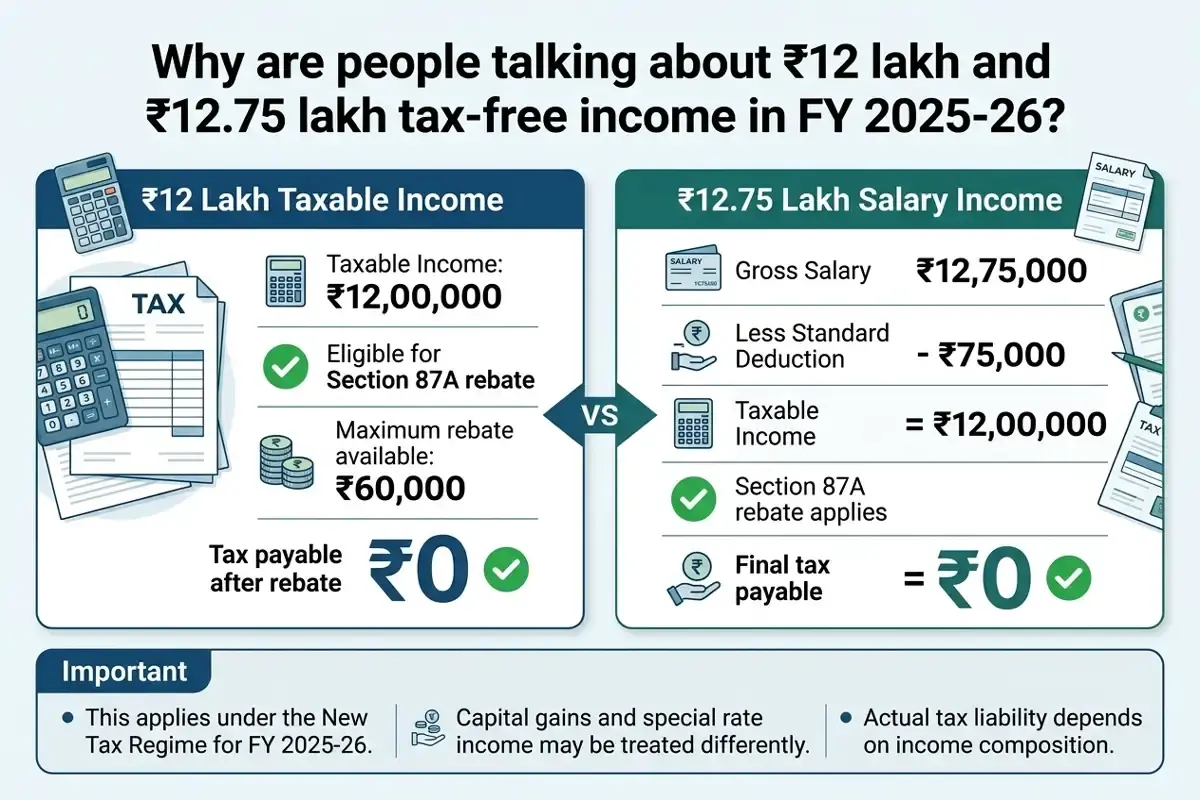
Because salaried employees get a standard deduction of ₹75,000 under the new regime, which means a gross salary of ₹12,75,000 produces exactly ₹12,00,000 in total income — the precise threshold for the Section 87A rebate.
The logic:
| Step | Amount |
|---|
| Gross salary | ₹12,75,000 |
| Less: Standard deduction (Section 16(ia)) | ₹75,000 |
| Total income | ₹12,00,000 |
| Tax under new regime slabs | ₹60,000 |
| Rebate u/s 87A | ₹60,000 |
| Tax after rebate | ₹0 |
| Health & Education Cess (4% on ₹0) | ₹0 |
| Total tax payable | ₹0 |
This is why the ₹12.75 lakh figure is quoted specifically for salaried employees.
₹12 lakh is the statutory income threshold for Section 87A under the new regime — this applies to all eligible resident individuals.
₹12.75 lakh is the effective gross salary threshold for salaried employees — because the standard deduction bridges the ₹75,000 gap.
These are two different numbers describing the same zero-tax outcome. A freelancer, professional, or retired person without salary income has a gross income threshold of ₹12 lakh, not ₹12.75 lakh.
One more condition that must hold: The salaried employee should have no other income sources that add to total income beyond ₹12 lakh after the standard deduction.
Standard Deduction Interaction with Section 87A
The standard deduction of ₹75,000 (new regime, salaried employees) and ₹50,000 (old regime) reduces gross salary income before arriving at total income. The Section 87A threshold is applied to total income after this deduction.
Standard deduction is available under:
- Section 16(ia) of the Income Tax Act, 1961
- ₹75,000 under the new regime (Finance (No. 2) Act 2024 raised it from ₹50,000 to ₹75,000 for new regime)
- ₹50,000 under the old regime (unchanged)
This is why the two breakeven points differ:
| Regime | Standard deduction | Gross salary breakeven for ₹0 tax |
|---|
| New regime | ₹75,000 | ₹12,75,000 |
| Old regime | ₹50,000 | ₹5,50,000 (plus deductions used — see below) |
Under the old regime, the ₹5 lakh threshold for Section 87A is much lower. A salaried employee on old regime with no deductions beyond standard deduction can have gross salary up to ₹5,50,000 and pay zero tax.
With old regime deductions (80C ₹1.5L, 80D ₹25K, HRA etc.), many employees effectively pay zero tax at higher incomes — but this is through the combined effect of deductions, not Section 87A alone.
The standard deduction reduces income on which tax is computed. It is not part of the Section 87A mechanism itself. The rebate kicks in at the final total income figure, after all deductions are applied.
Marginal Relief: What Happens When Income Is Just Above ₹12 Lakh?
If your total income slightly exceeds ₹12 lakh, marginal relief prevents you from paying more tax than the amount by which your income exceeds ₹12 lakh.
Without marginal relief, the tax cliff would be absurd. Someone earning ₹12,00,001 would owe approximately ₹62,400 (tax + cess) simply because they earned ₹1 more than the threshold. Marginal relief smooths this.
How marginal relief works:
The formula: Tax payable with marginal relief = Minimum of (regular tax including cess) OR (excess income above threshold + tax on threshold with rebate)
Since tax on ₹12 lakh with rebate = ₹0, the formula simplifies to:
Tax payable ≤ (Total income − ₹12,00,000)
| Total income | Tax without marginal relief (incl. cess) | Excess above ₹12L | Net tax with marginal relief |
|---|
| ₹12,00,000 | ₹0 (rebate applies) | — | ₹0 |
| ₹12,10,000 | ₹63,960 | ₹10,000 | ₹10,000 |
| ₹12,25,000 | ₹66,300 | ₹25,000 | ₹25,000 |
| ₹12,50,000 | ₹70,200 | ₹50,000 | ₹50,000 |
| ₹13,00,000 | ₹77,220 | ₹1,00,000 | ₹77,220 (no marginal relief — regular tax is lower) |
At ₹13 lakh total income, regular tax (₹77,220) is less than the excess income (₹1,00,000) above ₹12 lakh. So marginal relief no longer provides any benefit — you pay the regular tax.
The practical takeaway for salaried employees:
A salaried employee with gross salary of ₹13,00,000:
- Total income after standard deduction: ₹12,25,000
- Tax with marginal relief: ₹25,000
- Effective rate: ₹25,000 ÷ ₹13,00,000 = 1.9%
Compare that to ₹12,75,000 gross salary with ₹0 tax. Earning ₹25,000 more results in ₹25,000 additional tax — a 100% marginal rate on that extra ₹25,000.
This is mathematically the intent of marginal relief: to prevent your take-home from actually going down when you earn slightly more.
From payroll teams: Marginal relief is one of the least-explained concepts when HR teams communicate Section 87A to employees. Most employees near the ₹12.75L threshold don't realise that earning ₹1 to ₹2 lakh more in gross salary doesn't catastrophically increase their tax — it increases tax by exactly the amount of additional income, until regular tax calculations become cheaper.
Does Section 87A Apply to Short-Term Capital Gains (STCG)?
No. Section 87A rebate does not offset tax computed on Short-Term Capital Gains (STCG) taxable under Section 111A of the Income Tax Act.
This is one of the most common errors in tax planning — and one that became a source of significant confusion starting AY 2024-25 when the Income Tax Department's online ITR utility began actively blocking the rebate on STCG.
Section 111A STCG — the facts for FY 2025-26:
- Applies to: STCG on listed equity shares, equity-oriented mutual funds, and units of business trusts, where Securities Transaction Tax (STT) is paid.
- Tax rate: 20% (raised from 15% by Finance (No. 2) Act 2024 for transfers on or after 23 July 2024).
- Section 87A rebate: NOT available against this tax.
This restriction was formally codified in the Finance (No. 2) Act 2024, which inserted a proviso to Section 87A specifying that the rebate cannot be applied against tax computed at special rates under Chapter XII of the Income Tax Act.
Practical impact:
Suppose a resident individual has:
- Salary income (after standard deduction): ₹10 lakh
- STCG u/s 111A: ₹1.5 lakh
- Total income: ₹11.5 lakh (within ₹12L threshold)
Tax computation:
| Income component | Tax |
|---|
| Salary ₹10L at new regime slabs | ₹30,000 (₹20K + ₹10K) |
| STCG ₹1.5L at 20% | ₹30,000 |
| Total tax | ₹60,000 |
| Section 87A rebate (against salary portion only) | ₹30,000 |
| STCG tax (rebate not applicable) | ₹30,000 |
| Cess 4% on ₹30,000 | ₹1,200 |
| Total payable | ₹31,200 |
The ₹30,000 rebate capacity against salary tax is used. But the rebate cannot be carried over to offset STCG tax. The remaining ₹30,000 rebate capacity is forfeited.
The lesson: having total income under ₹12 lakh does not make STCG tax-free. The rebate only covers slab-rated income.
Does Section 87A Apply to Long-Term Capital Gains (LTCG)?
No. Section 87A does not apply to LTCG taxable under Section 112A or Section 112.
| LTCG type | Tax rate (FY 2025-26) | 87A rebate available? |
|---|
| LTCG u/s 112A — listed equity, equity MF, STT paid (above ₹1.25L) | 12.5% | ❌ No |
| LTCG u/s 112 — other assets (unlisted equity, debt, property, etc.) | 12.5% (without indexation, Finance (No. 2) Act 2024) | ❌ No |
Finance (No. 2) Act 2024 (Budget July 2024) made notable changes effective 23 July 2024:
- LTCG u/s 112A rate increased from 10% to 12.5%.
- LTCG u/s 112A exemption increased from ₹1 lakh to ₹1.25 lakh per year.
- Indexation benefit removed for most LTCG.
None of these changes made LTCG eligible for Section 87A. The Finance (No. 2) Act 2024 proviso to Section 87A expressly excludes all Chapter XII income (which includes Sections 111A, 112, and 112A) from rebate eligibility.
Practical impact for investors with salary income:
A salaried employee with gross salary ₹10L and LTCG of ₹2.5L from mutual funds redeemed after 12 months:
- Total income after standard deduction: ₹9.25L + ₹2.5L = ₹11.75L (below ₹12L)
- Tax on ₹9.25L salary: ₹22,500
- LTCG above ₹1.25L: ₹1.25L taxable at 12.5% = ₹15,625
- Section 87A rebate: ₹22,500 (against salary tax only; total income ≤ ₹12L allows this)
- LTCG tax: ₹15,625 (rebate NOT applicable)
- Cess on ₹15,625: ₹625
- Total tax: ₹16,250
The rebate removes the salary tax. The LTCG tax must still be paid.
Special Rate Income: When Section 87A Cannot Help
Any income taxable at special rates under Chapter XII of the Income Tax Act falls outside the scope of Section 87A. The rebate is only effective against slab-rated income.
Chapter XII includes multiple provisions beyond just STCG and LTCG. Relevant ones for individual taxpayers:
| Income type | Section | Tax rate | 87A available? |
|---|
| STCG on equity/MF (STT paid) | 111A | 20% | ❌ No |
| LTCG on equity/MF above ₹1.25L (STT paid) | 112A | 12.5% | ❌ No |
| LTCG on other assets | 112 | 12.5% (no indexation) | ❌ No |
| Winnings (lottery, games, puzzles) | 115BB | 30% | ❌ No |
| Casual income | 115BB | 30% | ❌ No |
| Salary, interest, rental, business income | Slab rates | 0–30% | ✅ Yes (if total income ≤ ₹12L) |
The rebate is most useful for people whose income is entirely from salary, interest, or other slab-rated sources. The moment special-rate income enters the picture, it can drain tax that the rebate cannot offset.
Resident vs Non-Resident: Who Is Excluded from Section 87A?
Non-Resident Indians (NRIs) cannot claim Section 87A, regardless of the level of their Indian income.
Section 87A explicitly restricts the rebate to "assessee, being an individual resident in India." Residency for this purpose follows Section 6 of the Income Tax Act:
- Resident and Ordinarily Resident (ROR): Present in India for 182+ days in the tax year. Or 60+ days in the year and 365+ days in the preceding 4 years. Fully eligible for Section 87A.
- Resident but Not Ordinarily Resident (RNOR): Technically "resident in India" under Section 6. Eligible for Section 87A (the statute says "resident in India," which includes RNOR).
- Non-Resident (NRI): Does not meet the Section 6 residence conditions. Not eligible for Section 87A.
This is important for:
- Employees on international assignments who may become NRIs mid-year
- Indian citizens with foreign income who are classified as NRIs
- Returning NRIs who become ROR but were NRI in the preceding year
If an NRI has Indian income below ₹12 lakh (say, rental income or FD interest), they still pay tax on it — usually at flat rates for certain income types, and without any Section 87A offset.
For individuals returning to India from abroad: your residential status depends on actual days of presence in India during the financial year. If you became a resident in FY 2025-26 (April 2025 to March 2026), you can claim Section 87A for that year. If you were NRI for the full year, you cannot.
Common Mistakes Taxpayers Make with Section 87A
Mistake 1: Assuming ₹12.75 lakh is the threshold for everyone.
It is not. ₹12.75 lakh applies specifically to salaried individuals under the new regime, because the standard deduction of ₹75,000 brings their taxable income to ₹12 lakh. Self-employed professionals, freelancers, and pensioners (without salary) do not get the standard deduction — their threshold is ₹12 lakh gross.
Mistake 2: Assuming STCG from mutual funds is covered.
A very common error during ITR filing season. Employees who redeemed equity mutual funds during the year assume the rebate covers all tax. It does not cover STCG tax. The STCG portion must be paid regardless of total income level.
Mistake 3: Ignoring other income sources.
Bank interest, dividends, rental income, and part-time freelance work all count toward total income. An employee with ₹12.75L gross salary and ₹30,000 in bank interest has total income of ₹12,30,000 (after standard deduction) — above the ₹12L threshold. No rebate. Tax payable with marginal relief = ₹30,000.
Mistake 4: Applying the Section 87A rebate under the new regime to old regime tax.
The new regime threshold of ₹12 lakh and ₹60,000 rebate is exclusive to Section 115BAC (the new regime). If you opt for the old regime, Section 87A applies only up to ₹5 lakh total income with a ₹12,500 maximum rebate.
Mistake 5: Manually computing the rebate in ITR.
Section 87A rebate is applied automatically by the ITR filing utility on the Income Tax Department's portal (incometax.gov.in). You do not need to claim it separately. However, verify the utility has applied it correctly by checking the tax computation summary in Schedule TTI of your ITR.
Mistake 6: Assuming NRIs can use the new ₹12L threshold.
NRIs cannot claim Section 87A at all. This applies whether they are earning ₹3 lakh or ₹15 lakh in Indian income.
Who Should Care About This
Salaried employees with gross salary between ₹12 lakh and ₹15 lakh
This group benefits most directly from understanding Section 87A and marginal relief. A ₹12.75L earner pays zero tax. A ₹13L earner pays ₹25,000 with marginal relief. A ₹14L earner pays regular tax of approximately ₹50,900 (₹30,000 + 15% × ₹2L = ₹60,000 − no rebate + cess). Knowing these breakpoints helps with salary negotiation and structure.
Investors with equity holdings alongside salary income
If your salary brings you close to ₹12 lakh and you redeem equity mutual funds during the year, the STCG can push your total income above the threshold while also attracting a 20% special rate tax that the rebate cannot offset. Timing of redemptions matters.
HR and payroll professionals
Many employees ask HR whether they will pay tax this year. Correctly explaining the ₹12L / ₹12.75L distinction — and its conditions — prevents misinformation in the workforce.
Self-employed professionals and freelancers
The standard deduction does not apply to you. Your Section 87A threshold under the new regime is ₹12 lakh of net total income, not ₹12.75 lakh. Factor this in when structuring invoices and expenses.
Employees considering switching regimes
If you are on the old regime and earning below ₹5 lakh (after deductions), you already get the old regime Section 87A benefit. But if your deductions are modest and your income is above ₹5 lakh, switching to the new regime with the ₹12 lakh threshold may produce a better outcome. Compare using actual numbers — see our Old vs New Tax Regime guide.
Practical Salary Examples for FY 2025-26
All examples below use the new tax regime, salaried employee with no STCG/LTCG.
Example 1: Gross salary ₹10 lakh — Well within the rebate limit
| Step | Amount |
|---|
| Gross salary | ₹10,00,000 |
| Standard deduction | ₹75,000 |
| Total income | ₹9,25,000 |
| Tax: 5% on ₹4L–₹8L | ₹20,000 |
| Tax: 10% on ₹8L–₹9.25L | ₹12,500 |
| Total tax | ₹32,500 |
| Section 87A rebate | ₹32,500 |
| Net tax | ₹0 |
| Cess | ₹0 |
| Total payable | ₹0 |
Example 2: Gross salary ₹12.75 lakh — Exactly at the threshold
| Step | Amount |
|---|
| Gross salary | ₹12,75,000 |
| Standard deduction | ₹75,000 |
| Total income | ₹12,00,000 |
| Tax: 5% on ₹4L–₹8L | ₹20,000 |
| Tax: 10% on ₹8L–₹12L | ₹40,000 |
| Total tax | ₹60,000 |
| Section 87A rebate | ₹60,000 |
| Net tax | ₹0 |
| Cess | ₹0 |
| Total payable | ₹0 |
Example 3: Gross salary ₹13 lakh — Above threshold, marginal relief kicks in
| Step | Amount |
|---|
| Gross salary | ₹13,00,000 |
| Standard deduction | ₹75,000 |
| Total income | ₹12,25,000 |
| Tax: 5% on ₹4L–₹8L | ₹20,000 |
| Tax: 10% on ₹8L–₹12L | ₹40,000 |
| Tax: 15% on ₹12L–₹12.25L | ₹3,750 |
| Total tax | ₹63,750 |
| Add cess 4% | ₹2,550 |
| Total including cess | ₹66,300 |
| Excess above ₹12L | ₹25,000 |
| Marginal relief | ₹41,300 |
| Net payable with marginal relief | ₹25,000 |
Example 4: Gross salary ₹15 lakh — Regular tax applies, no marginal relief needed
| Step | Amount |
|---|
| Gross salary | ₹15,00,000 |
| Standard deduction | ₹75,000 |
| Total income | ₹14,25,000 |
| Tax: 5% on ₹4L–₹8L | ₹20,000 |
| Tax: 10% on ₹8L–₹12L | ₹40,000 |
| Tax: 15% on ₹12L–₹14.25L | ₹33,750 |
| Total tax | ₹93,750 |
| Add cess 4% | ₹3,750 |
| Total payable | ₹97,500 |
| Section 87A rebate | ₹0 (income > ₹12L) |
Example 5: Gross salary ₹12 lakh with bank interest ₹1 lakh — Crosses the line
| Step | Amount |
|---|
| Gross salary | ₹12,00,000 |
| Standard deduction | ₹75,000 |
| Income from salary | ₹11,25,000 |
| Add: Bank interest | ₹1,00,000 |
| Total income | ₹12,25,000 |
| No Section 87A rebate (above ₹12L) | — |
| Tax with marginal relief | ₹25,000 |
| Total payable | ₹25,000 |
This example illustrates a key risk: an employee believing their ₹12L salary makes them tax-free, unaware that ₹1 lakh in bank interest pushes total income above the rebate threshold. Check your AIS for all interest credits — see our AIS vs Form 16 guide to understand what the Income Tax Department already knows about your income.
Real Filing Scenarios
Scenario A: Software engineer, ₹12.75L salary, redeemed MF during the year
Aditya has gross salary ₹12,75,000 and redeemed equity mutual funds, earning STCG of ₹90,000 (STT paid, held less than 12 months).
Total income = ₹12,75,000 − ₹75,000 (std deduction) + ₹90,000 (STCG) = ₹12,90,000.
- Income exceeds ₹12L → no Section 87A rebate.
- Tax on slab-rated salary income (₹12,00,000):
- 5% on ₹4L–₹8L: ₹20,000
- 10% on ₹8L–₹12L: ₹40,000
- Salary tax: ₹60,000
- STCG ₹90,000 at 20% u/s 111A: ₹18,000
- Total tax: ₹78,000
- Cess 4% on ₹78,000: ₹3,120
- Total payable: ₹81,120
If Aditya had waited until after April 1, 2026, to redeem, his STCG would fall in FY 2026-27. In FY 2025-26 his salary alone would have been exactly ₹12L taxable — giving ₹0 tax. Timing of capital gains redemption is therefore directly relevant to Section 87A eligibility.
Scenario B: Manager, ₹11.5L salary, freelance income ₹80,000
Priya works as a manager earning ₹11,50,000 gross, and does a consulting project earning ₹80,000.
Total income = (₹11,50,000 − ₹75,000) + ₹80,000 = ₹10,75,000 + ₹80,000 = ₹11,55,000.
- Within ₹12L → Section 87A rebate available.
- Tax on ₹11,55,000:
- ₹4-8L: ₹20,000
- ₹8-11.55L: 10% × ₹3,55,000 = ₹35,500
- Total = ₹55,500
- Rebate = ₹55,500 (less than ₹60,000 cap → full offset)
- Total payable: ₹0
Priya benefits from Section 87A even with freelance income, because total income remains below ₹12L.
Scenario C: NRI working in India for part of the year
Rohan was NRI for the first 6 months of FY 2025-26 and became a resident from October 2025 onwards. His total days in India during FY 2025-26 = 165 days.
With 165 days, he does not meet the 182-day threshold for full residential status. He may be classified as NRI for FY 2025-26 depending on the preceding years' count. If classified as NRI, Section 87A does not apply to him regardless of income amount.
This scenario is common for employees on short-term foreign assignments. Confirm residential status with a CA before filing — see our Form 16 guide for how residential status affects Form 16 and ITR.
Myths vs Facts: Section 87A in FY 2025-26
| Myth | Fact |
|---|
| "₹12.75 lakh is the official threshold under Section 87A" | False. The statutory threshold is ₹12,00,000 of total income. ₹12.75 lakh is the gross salary breakeven for salaried employees who get the ₹75,000 standard deduction. |
| "Section 87A rebate covers STCG from equity mutual funds" | False. Section 87A does not offset tax on STCG u/s 111A (20%) or any special-rate income under Chapter XII. This is codified in the Finance (No. 2) Act 2024. |
| "Section 87A only exists under the new tax regime" | False. Section 87A is available under both regimes — but with a ₹5,00,000 threshold and ₹12,500 cap under the old regime. |
| "NRIs can claim Section 87A if their Indian income is below ₹12 lakh" | False. Section 87A restricts eligibility to "individual resident in India." NRIs are excluded at the eligibility stage. |
| "Any income up to ₹12 lakh is tax-free under the new regime" | False. Only slab-rated income is tax-free via the rebate. Special-rate income (STCG, LTCG, lottery winnings) still attracts tax. |
| "You need to manually claim Section 87A in ITR" | False. The ITR filing utility on incometax.gov.in applies the rebate automatically. Verify in Schedule TTI of your filed return. |
| "Marginal relief makes income between ₹12L and ₹13L completely tax-free" | False. Marginal relief limits tax to the amount by which income exceeds ₹12L — so ₹12.25L income has a tax of ₹25,000. Tax-free it is not, but the liability is capped fairly. |
| "HUFs can claim Section 87A" | False. Section 87A is restricted to individuals only. HUFs are ineligible. |
| "Interest income up to ₹12L total is tax-free for salaried employees" | False. Interest income adds to total income. If salary + interest together exceed ₹12L (after standard deduction), the rebate does not apply. |
| "Section 87A will make your tax ₹0 even if you earned ₹15L and invested in 80C" | False. Section 87A operates after tax is computed on total income. It only applies if total income (after 80C and other deductions) ≤ ₹12L. At ₹15L gross with ₹1.5L 80C, total income is ₹13.5L (after standard deduction and 80C) — above the ₹12L threshold. |
Frequently Asked Questions
Is income up to ₹12 lakh tax free in FY 2025-26?
Yes, for resident individuals with total income not exceeding ₹12,00,000, opting for the new tax regime, with no special-rate income (STCG, LTCG, etc.). The tax computed under new regime slabs on ₹12 lakh is exactly ₹60,000, and Section 87A provides a ₹60,000 rebate — resulting in zero tax and zero cess.
Under the old regime, total income up to ₹5,00,000 attracts zero tax through a ₹12,500 rebate.
Why are people talking about ₹12.75 lakh being tax free?
Because salaried employees are entitled to a standard deduction of ₹75,000 under the new regime. This reduces gross salary of ₹12,75,000 to ₹12,00,000 in taxable income — the exact threshold for the Section 87A rebate. The ₹12.75 lakh figure applies only to salaried employees under the new regime. Non-salaried individuals have an effective threshold of ₹12,00,000 gross.
Can NRIs claim Section 87A rebate?
No. Section 87A explicitly limits eligibility to "assessee, being an individual resident in India." Non-Resident Indians (NRIs) are excluded regardless of their Indian income amount. Resident but Not Ordinarily Resident (RNOR) individuals are still technically "resident in India" and can claim the rebate.
Does Section 87A apply to capital gains income?
Not to special-rate capital gains. Section 87A rebate cannot be applied against tax computed on STCG u/s 111A or LTCG u/s 112A (or any other Chapter XII income). This was formally codified in the Finance (No. 2) Act 2024. The rebate applies only against slab-rated income tax.
Does STCG under Section 111A qualify for Section 87A?
No. STCG on equity shares and equity-oriented mutual funds (STT paid), taxable at 20% under Section 111A, does not qualify for the Section 87A rebate. Even if total income is below ₹12 lakh, the rebate offsets only the slab-rate portion of tax — the STCG tax must be paid separately.
Does LTCG under Section 112A qualify for Section 87A?
No. LTCG above ₹1.25 lakh on listed equity shares and equity-oriented mutual funds, taxable at 12.5% under Section 112A, is outside the scope of Section 87A. The Finance (No. 2) Act 2024 proviso to Section 87A explicitly excludes Chapter XII income.
Is Section 87A rebate automatic in ITR?
Yes. The Income Tax Department's ITR filing utility (incometax.gov.in) applies the Section 87A rebate automatically when computing tax liability. You do not need to enter a separate claim. After filing, verify that the rebate appears correctly in Schedule TTI (Tax on Total Income) of your ITR.
Does standard deduction count toward the ₹12 lakh limit?
Standard deduction reduces your total income. The ₹12 lakh threshold is applied to total income after all deductions including standard deduction. So a salaried employee with ₹12,75,000 gross salary deducts ₹75,000, arrives at ₹12,00,000 total income, and qualifies for the rebate.
Is Section 87A available in the old tax regime?
Yes, but with much lower limits. Under the old regime, Section 87A gives a maximum rebate of ₹12,500 for total income up to ₹5,00,000. This was not changed by Finance Act 2025. The significantly enhanced ₹60,000 rebate up to ₹12 lakh applies only under the new tax regime (Section 115BAC).
What is marginal relief under Section 87A?
Marginal relief prevents a situation where earning slightly more than ₹12 lakh results in a tax bill larger than the excess income itself. When total income slightly exceeds ₹12 lakh, the tax payable is capped at the excess amount above ₹12 lakh (since tax on ₹12 lakh with rebate = ₹0). For example, total income of ₹12,10,000 results in tax of ₹10,000 — not the ₹63,960 that would otherwise apply. Marginal relief tapers off as income increases beyond ₹13 lakh, where regular tax becomes cheaper than the excess income.
Understanding Section 87A is one part of tax planning. The other parts:
- To compare whether the old or new regime is better for your specific income: Old vs New Tax Regime — Which Is Better for Salaried Employees
- To reduce taxable income below ₹12 lakh through legal deductions: Best Ways to Save Tax on Salary Income
- To structure your CTC to maximise Section 87A benefit: Salary Structure Optimization
- To verify that your Form 16 correctly reflects the Section 87A rebate applied by your employer: How to Read Form 16 and File ITR
- To check your full income picture before finalising your ITR: AIS vs Form 16 — Which to Trust
Sources Used
All facts in this article are drawn from official Government of India sources:
- Income Tax Act, 1961 — Section 87A (as amended)
- Finance Act 2025 — Amended Section 87A threshold (new regime: ₹12L / ₹60,000); revised new regime slabs effective AY 2026-27
- Finance (No. 2) Act 2024 — Inserted proviso to Section 87A excluding Chapter XII income; revised capital gains rates (STCG u/s 111A: 15%→20%; LTCG u/s 112A: 10%→12.5%; exemption ₹1L→₹1.25L); standard deduction for new regime raised to ₹75,000
- Union Budget 2025-26 Memorandum and Explanatory Notes — Clause-by-clause explanation of Finance Act 2025 amendments
- Income Tax Rules, 1962 — Rule 26C — Standard deduction; Section 16(ia)
- Income Tax Department — Income Tax Portal — ITR utility rebate computation; Schedule TTI
- CBDT Notifications and Circulars — Official clarifications on rebate computation and ITR utility handling
Disclaimer
This article is for general information and educational purposes only. It is not tax advice, legal advice, or a substitute for professional consultation. Tax rules, thresholds, and interpretations change — always verify current provisions on incometax.gov.in or consult a qualified Chartered Accountant before making filing decisions or financial plans. PaisaPilotAI is not affiliated with the Income Tax Department, CBDT, or the Government of India.
Last Fact Checked
27 June 2026 — Manjeeta Raj, Founder, PaisaPilotAI.
Verified against Finance Act 2025, Finance (No. 2) Act 2024, and Section 87A of the Income Tax Act, 1961 (as in force for AY 2026-27). Section 87A threshold for new regime confirmed at ₹12,00,000 with maximum rebate ₹60,000. Standard deduction for salaried employees under new regime confirmed at ₹75,000. STCG and LTCG exclusion from Section 87A confirmed via Finance (No. 2) Act 2024 proviso.
Related reading: Old vs New Tax Regime · Best Ways to Save Tax · Salary Structure Optimization · How to Read Form 16 · AIS vs Form 16