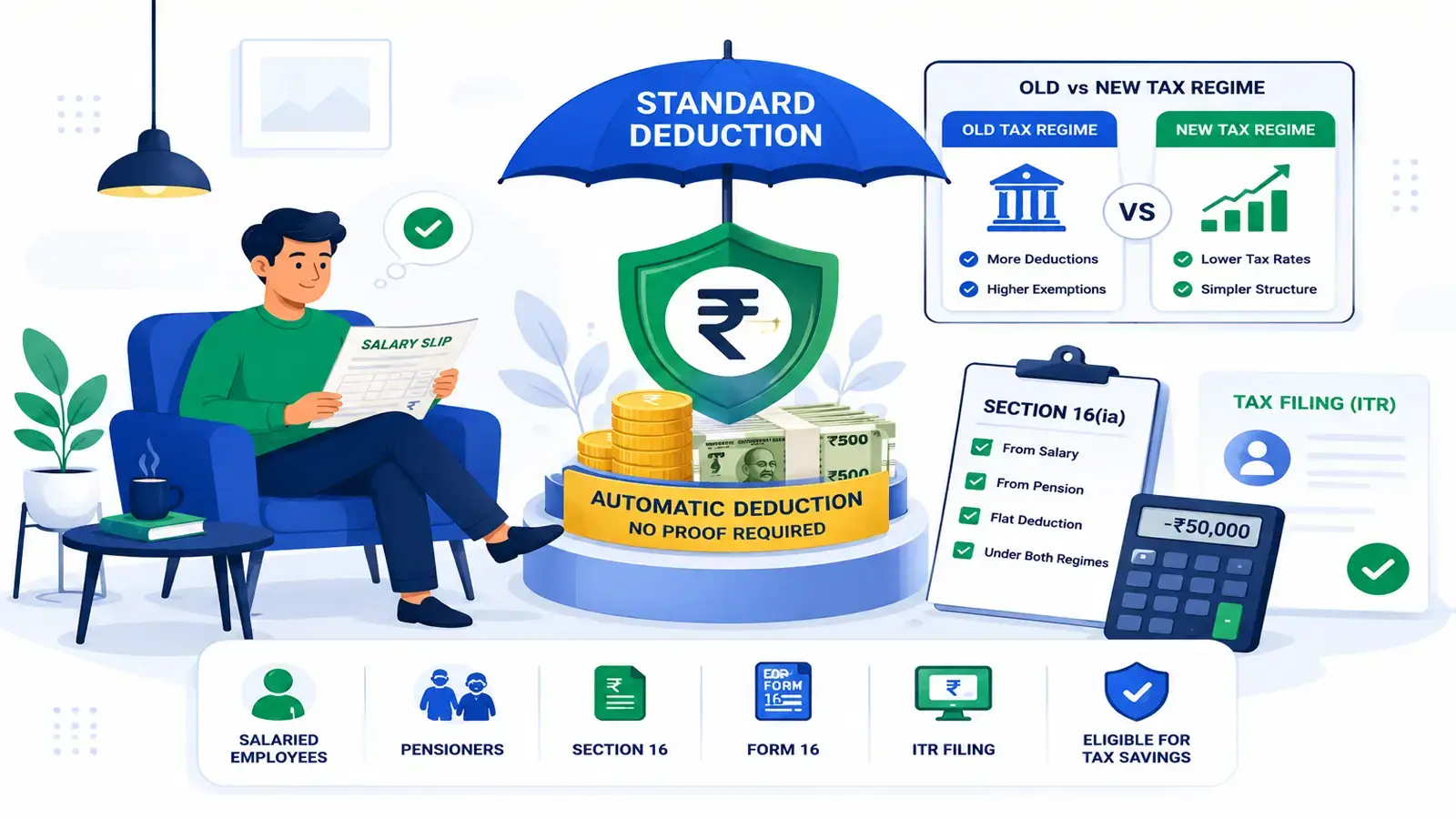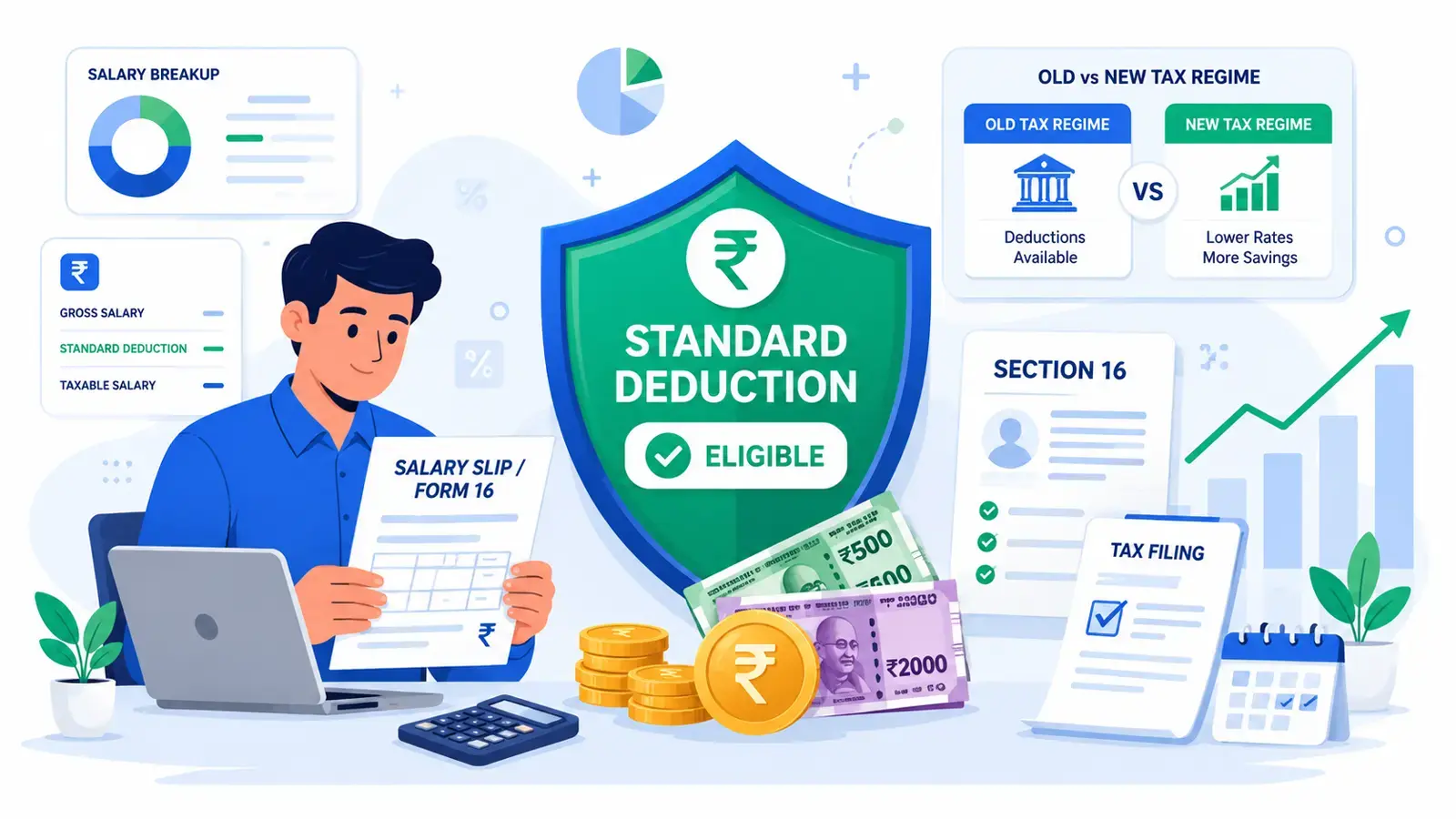
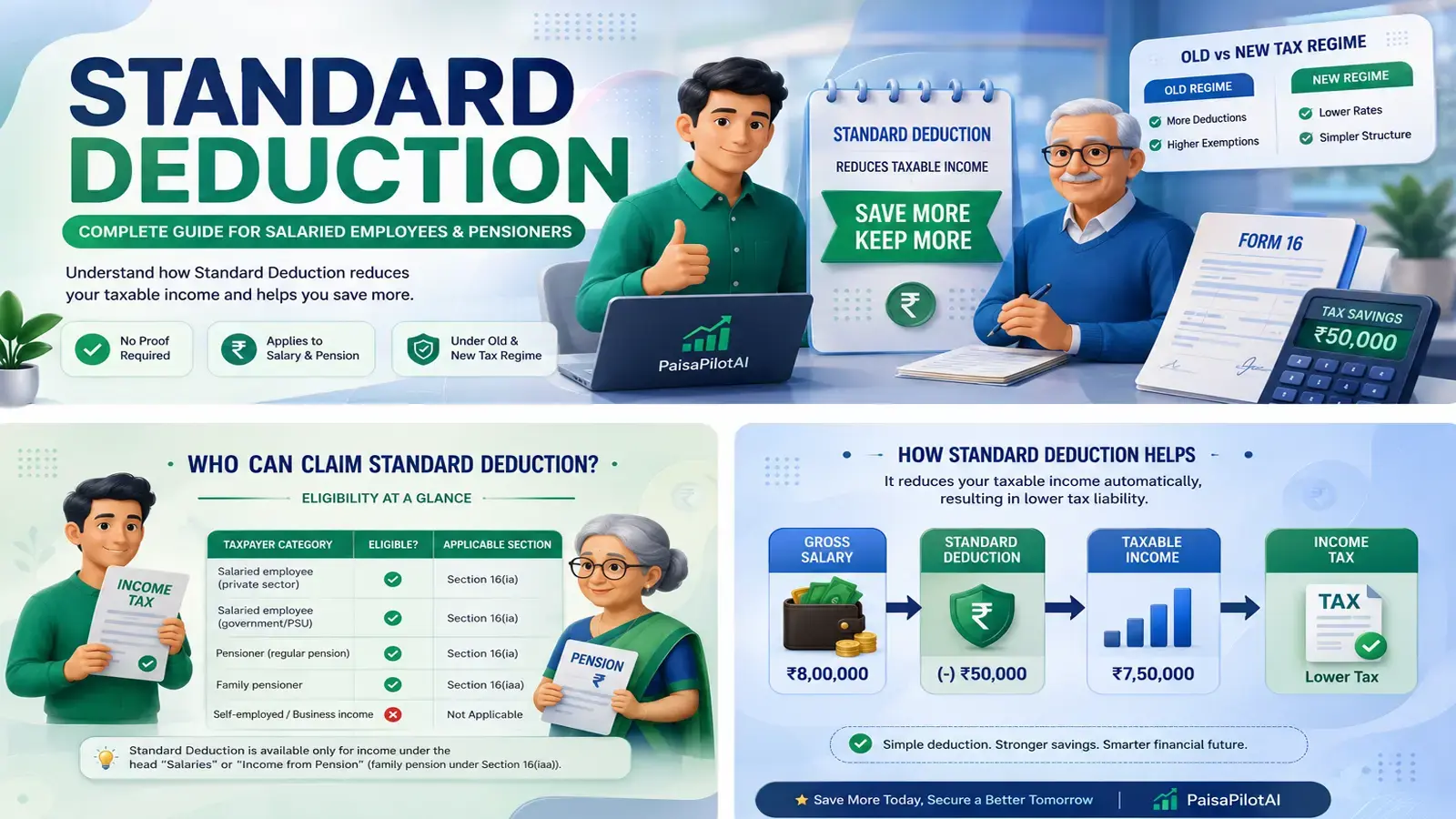
Quick answer: Standard deduction is a flat amount that salaried employees and pensioners can subtract from their salary or pension income before tax is calculated — no bills, receipts, or proof required. It is available under Section 16(ia) of the Income Tax Act, 1961, and applies under both the old and new tax regimes, though the exact amount differs between the two. Family pension gets a separate, smaller standard deduction under a different provision. Always verify the current applicable amount on the official Income Tax Department website, since this figure is set through the Finance Act and can change.
Is standard deduction available under the new tax regime? Yes — one of the few deductions available under both the old and new tax regime.
Do pensioners get standard deduction? Yes, regular pension is taxed as "Salaries" and gets the same treatment as active salary income.
Does family pension get the same standard deduction? No — it's taxed under "Income from Other Sources" and gets a separate deduction under Section 16(iaa).
Can I claim standard deduction more than once if I changed jobs? No, only once per year, regardless of employer count.
Standard Deduction Quick Summary
| Aspect | Details |
|---|---|
| What it is | A flat deduction from salary or pension income, no proof needed |
| Governing provision | Section 16(ia) of the Income Tax Act, 1961 (Section 16(iaa) for family pension) |
| Who can claim | Salaried employees and pensioners (including family pensioners, under a separate provision) |
| Proof required | None — it is automatic |
| Available under old regime | Yes |
| Available under new regime | Yes |
| Capped at income level | Yes — cannot exceed the actual salary or pension received |
| Applies to business income | No — only to income taxed under "Salaries" |
Deduction amounts are periodically revised through the Union Budget, so treat any rupee figure in this guide as "the amount applicable under current rules" and cross-check it against the Income Tax Department's official portal before filing.
Introduction
If you're a salaried employee or a pensioner in India, there's a good chance you've already benefited from standard deduction without fully realising what it does. It's the one deduction that asks nothing of you — no investment, no proof, no planning — it simply reduces your taxable income by a fixed amount, every year, automatically.
That simplicity is exactly why it deserves a proper explanation. Most people know the number but not the mechanics: how it interacts with the old and new regime, how it works if you switch jobs mid-year, how family pension is treated differently, and how it shows up on your Form 16. This guide covers all of that, with real salary and pension examples and answers to the questions that come up most often when filing a return.
What Is Standard Deduction?
Standard deduction is a fixed amount that the Income Tax Act allows salaried employees and pensioners to subtract from their gross salary or pension income, before calculating tax. It exists under Section 16(ia) of the Income Tax Act, 1961. A related provision, Section 16(iaa), provides a separate deduction specifically for family pension income, which is taxed differently from a regular pension, as explained later in this guide.
The defining feature is that it requires no supporting documents, no bills, and no specific expenditure. Unlike Section 80C, which requires you to actually invest in PPF, ELSS, or similar instruments, or Section 80D, which requires an actual insurance premium payment, standard deduction is granted purely because you earned salary or pension income during the year.
In simple terms: if your gross salary is ₹8,00,000 in a year and the applicable standard deduction is ₹50,000, your income chargeable under "Salaries" becomes ₹7,50,000 for further tax calculation, before any other deduction is applied.
It exists in this form largely because it replaced older, documentation-heavy allowances like transport allowance and medical reimbursement, which required receipts and were often under-claimed. Instead of tracking multiple small reimbursements, salaried employees now get one clean, automatic deduction.
Current Financial Year and Assessment Year Context
Standard deduction limits are announced through the Union Budget and apply from a specific financial year (FY) onward, with tax filed in the corresponding assessment year (AY) — for example, income earned in FY 2025-26 is assessed and taxed in AY 2026-27. Because Budgets are presented annually and can revise this figure, this guide avoids anchoring every explanation to one year's number. Always verify the exact figure for your relevant financial year on the Income Tax Department's official website or through a qualified Chartered Accountant before filing.
Who Can Claim Standard Deduction? (Eligibility Table)
Standard deduction under Section 16(ia) is available specifically to taxpayers earning income under the head "Income from Salaries." It is not a general deduction available to all taxpayers.
Eligibility Matrix
| Taxpayer Category | Eligible for Standard Deduction? | Applicable Section |
|---|---|---|
| Salaried employee (private sector) | Yes | Section 16(ia) |
| Salaried employee (government/PSU) | Yes | Section 16(ia) |
| Pensioner (regular pension, treated as salary) | Yes | Section 16(ia) |
| Family pensioner | Yes, separate deduction | Section 16(iaa) |
| Self-employed / business owner | No | Not applicable |
| Freelancer / consultant (professional income) | No | Not applicable |
| Person earning only rental income | No | Not applicable |
| Person earning only capital gains | No | Not applicable |
| Director's remuneration (if taxed as salary) | Yes | Section 16(ia) |
| NRI earning Indian salary income | Yes, on the salary portion | Section 16(ia) |
| HUF | No | Not applicable |
| Company / firm | No | Not applicable |
A key point often missed: standard deduction is tied to the nature of the income, not the taxpayer's regime choice, residency status, or age. As long as the income is genuinely taxable under "Salaries," the deduction applies — subject to the amount not exceeding actual salary or pension received.
Section 16 Explained: Where Standard Deduction Fits
Section 16 of the Income Tax Act deals with deductions from salary income, and it currently has four components:
| Sub-Section | What It Covers |
|---|---|
| Section 16(ia) | Standard deduction — flat amount, no proof needed |
| Section 16(ii) | Entertainment allowance deduction — largely relevant only to government employees, subject to conditions |
| Section 16(iii) | Professional tax paid, if deducted from salary |
| Section 16(iaa) | Standard deduction specifically for family pension income |
Taxpayers sometimes assume Section 16 gives "one" deduction. In reality, these sub-sections are not mutually exclusive — you can claim standard deduction plus professional tax paid plus, in rare government-employee cases, entertainment allowance, all from the same section.
Standard Deduction Under the Old and New Tax Regimes
Under the old regime, standard deduction is available to every salaried employee and pensioner, stacked on top of all the other deductions the old regime allows — Section 80C, Section 80D, HRA exemption, home loan interest under Section 24(b), and so on.
Under the new regime, which otherwise offers almost no deductions, standard deduction is a deliberate exception — added specifically to make the new regime more attractive to salaried taxpayers, since 80C, HRA, and home loan interest are not available under it.
Old vs New Regime: Standard Deduction and Related Deductions
| Deduction | Old Tax Regime | New Tax Regime |
|---|---|---|
| Standard deduction (salary/pension) | Available | Available |
| Family pension standard deduction | Available | Available |
| Section 80C | Available (up to ₹1.5 lakh) | Not available |
| Section 80D | Available (up to applicable limits) | Not available |
| HRA exemption | Available | Not available |
| Home loan interest (Section 24(b)) | Available | Not available (self-occupied property) |
| Professional tax deduction | Available | Not available |
| Tax slab rates | Generally higher | Generally lower |
Standard deduction is one of the very few deductions common to both regimes, which is exactly why its exact amount matters when comparing them — it's one of the few no-effort benefits the new regime offers, since most other deductions there require active investment or specific expenses. For the full regime comparison with real numbers, see our Old vs New Tax Regime guide, and for a broader list of old-regime deductions, see Best Ways to Save Tax.
Standard Deduction for Pensioners
Pension received by a former employee from their previous employer is taxed under the head "Salaries," so regular pension is eligible for standard deduction in exactly the same way as active salary income, under Section 16(ia) — whether it's a monthly pension from a former employer or the government, the taxable portion of a commuted (lump sum) pension, or an annuity purchased using retirement funds (subject to its own specific tax treatment rules). It applies automatically, with no proof needed, exactly like it does for salary.
Standard Deduction for Family Pension
Family pension is different from a regular pension, and this is one of the most commonly misunderstood areas of standard deduction.
Family pension is the pension received by a legal heir (typically a spouse or dependent) after the death of the original pensioner. Unlike regular pension, family pension is taxed under the head "Income from Other Sources," not "Salaries" — because the recipient never actually rendered service to the employer.
Because of this different classification, family pension does not qualify for the standard deduction under Section 16(ia). Instead, it gets its own, separate, and typically smaller deduction under Section 16(iaa) — usually calculated as the lower of a fixed amount or one-third of the family pension received, subject to the specific formula and cap prescribed under this provision at the time.
Regular Pension vs Family Pension: Standard Deduction Comparison
| Feature | Regular Pension | Family Pension |
|---|---|---|
| Head of income | Salaries | Income from Other Sources |
| Governing section | Section 16(ia) | Section 16(iaa) |
| Deduction basis | Flat amount (same as salaried employees) | Lower of a fixed amount or one-third of pension received |
| Who receives it | The original employee, post-retirement | A legal heir, after the pensioner's death |
| Available under new regime | Yes | Yes |
Always verify the exact family pension deduction formula and cap applicable for your filing year on the Income Tax Department's website, since this figure has been revised in the past and can change again.
Standard Deduction and HUF, Family Members, and Multiple Income Sources
A few special situations come up often enough to deserve direct answers. An HUF cannot claim standard deduction, since it applies only to individual taxpayers earning salary or pension income — an HUF does not earn "salary" in this sense. Both spouses can claim their own standard deduction independently if both are salaried, each against their own salary. And if someone has both salary and pension income in the same year — for instance, retiring mid-year after drawing a partial salary — both are taxed under "Salaries," but standard deduction is a single deduction applied against the total salary-head income for the year, not duplicated for each portion.
Standard Deduction With Multiple Employers or a Job Change
If you changed jobs during the financial year, standard deduction still applies just once for the year, not once per employer. Here's where this commonly goes wrong: each employer, while calculating TDS, may independently apply the full standard deduction against the salary they paid you, since they don't automatically know about your other employment. If you don't inform your current employer about your previous salary (using Form 12B, submitted to your new employer), standard deduction could effectively get applied twice in the TDS calculation during the year.
This doesn't mean you get to claim it twice on your final tax liability — when you file your ITR, only one standard deduction is allowed against your combined salary income. If it was over-claimed during TDS computation, you may end up with additional tax payable at filing time, rather than a refund.
Standard Deduction: Job Change Scenario
| Situation | What Happens |
|---|---|
| Single employer for the full year | Standard deduction applied once, correctly, by that employer |
| Job change, Form 12B submitted to new employer | New employer computes TDS on combined salary, applying deduction once |
| Job change, Form 12B not submitted | Each employer may apply standard deduction separately in TDS — corrected only at ITR filing stage |
| Final position after ITR filing | Only one standard deduction allowed against total salary income for the year, regardless of employer count |
If you've recently changed jobs, our Salary Structure Optimization guide covers how to manage your declarations cleanly with a new employer, and the Form 16 reading guide explains how to reconcile figures across multiple Form 16s.
Standard Deduction: Real Salary Examples
Standard deduction is subtracted from gross salary as the very first step in computing income under the head "Salaries," before any other deduction is applied. Below are illustrative examples across different salary levels to show how this fits into the bigger picture. These use the applicable standard deduction amount as a flat figure — always confirm the exact current amount before doing your own calculation.
₹6,00,000 Gross Salary
Standard deduction is applied first, reducing taxable salary before any further deductions or slab calculation. What remains flows into 80C/80D claims under the old regime, or straight into slab calculation under the new regime.
₹9,00,000 Gross Salary
After standard deduction, taxable salary income is correspondingly lower. Under the new regime, this reduced figure is what determines whether the taxpayer qualifies for the Section 87A rebate — see our Section 87A guide for how this threshold works.
₹12,00,000 Gross Salary
Standard deduction reduces this before slab-wise tax is computed. Under the old regime, this employee would typically also stack Section 80C (up to ₹1.5 lakh), Section 80D, and HRA exemption on top of it — see our Section 80C guide and Section 80D guide for the full savings potential.
₹18,00,000 Gross Salary
At this level, standard deduction is a smaller share of total income, but it still reduces the portion of salary taxed at the highest applicable slab for this band. Employees here often benefit most from combining it with HRA and home loan interest under the old regime — see the Old vs New Tax Regime guide for a full comparison at this income level.
₹25,00,000 Gross Salary
Standard deduction still applies in full — there is no income ceiling above which it stops applying, though it cannot exceed actual salary received (not a concern at this level). The relative tax saving is smaller in percentage terms at higher incomes, but the deduction amount itself does not change.
Standard Deduction Impact Across Salary Levels (Summary Table)
| Gross Salary | Standard Deduction Applies? | Notes |
|---|---|---|
| ₹6,00,000 | Yes, in full | May bring taxable income within Section 87A rebate range depending on regime |
| ₹9,00,000 | Yes, in full | Meaningful factor in whether 87A rebate threshold is met |
| ₹12,00,000 | Yes, in full | Often combined with 80C/80D/HRA under old regime |
| ₹18,00,000 | Yes, in full | Larger absolute tax saving in rupee terms at higher slabs |
| ₹25,00,000 | Yes, in full | No income ceiling on eligibility |
Standard Deduction: Pension Examples
Retired Employee With ₹4,50,000 Annual Pension
Since this is taxed as "Salaries," standard deduction applies in full, just as it would to an active employee's salary. It can be a meaningful proportion of total income for smaller pensions, making it especially valuable at this level.
Retired Employee With ₹8,00,000 Annual Pension
Standard deduction is applied first, before computing tax under the applicable regime. A retired taxpayer at this level should check whether the old regime (with its wider deduction stack, if other eligible expenses exist) or the new regime works out cheaper — pensioners aren't automatically better off under either, and the same Old vs New Tax Regime guide applies equally to them.
Family Pensioner Receiving ₹3,00,000 Annually
This is taxed under "Income from Other Sources," not "Salaries," so the standard deduction under Section 16(ia) does not apply here. Instead, the family pension deduction under Section 16(iaa) applies — the lower of a fixed amount or one-third of the pension received. This is the single most common area of confusion for family pensioners filing their own return for the first time.
Standard Deduction vs Section 80C
| Feature | Standard Deduction | Section 80C |
|---|---|---|
| Proof required | None | Yes — investment/payment proof |
| Applicable regime | Both old and new | Old regime only |
| Maximum amount | Flat, fixed figure | Up to ₹1,50,000 |
| Effort required | None — automatic | Requires active investment or expense |
| Applies to | Salary/pension income only | Any individual/HUF taxpayer under old regime |
Standard deduction and Section 80C are not alternatives to each other — under the old regime, a salaried employee gets both, stacked together. For the complete list of what qualifies under 80C, see our Section 80C guide.
Standard Deduction vs Section 80D
| Feature | Standard Deduction | Section 80D |
|---|---|---|
| Proof required | None | Yes — insurance premium receipt |
| Applicable regime | Both old and new | Old regime only |
| Maximum amount | Flat, fixed figure | Up to ₹75,000–₹1,00,000 combined, depending on age |
| What it covers | General salary/pension income | Health insurance premium, preventive check-ups |
Again, these two are cumulative under the old regime, not competing. See our Section 80D guide for the complete breakdown of health insurance deduction limits.
Standard Deduction vs HRA Exemption
| Feature | Standard Deduction | HRA Exemption |
|---|---|---|
| Proof required | None | Yes — rent receipts, rent agreement in some cases |
| Applicable regime | Both old and new | Old regime only |
| Basis | Flat amount, unrelated to actual expense | Lowest of three calculated values based on rent and salary |
| Who benefits most | Every salaried employee equally | Employees who pay meaningful rent in a metro or non-metro city |
Unlike standard deduction, HRA exemption's value varies significantly based on your actual rent and city. If you're evaluating whether the old regime's HRA benefit outweighs the new regime's simplicity, our HRA Exemption Guide explains the calculation in detail.
How Standard Deduction Appears in Form 16
Standard deduction is one of the few deductions in Form 16 that requires zero input from you as an employee. Your employer applies it automatically while computing your salary TDS and reflects it in Part B of Form 16, alongside professional tax (if applicable). Unlike Section 80C or 80D, where your employer needs a declaration and proof from you (usually via Form 12BB) before including it in TDS computation, standard deduction is applied purely based on your gross salary figure.
To verify your Form 16 correctly reflects standard deduction alongside your other claimed deductions, use the Form 16 Analyzer, or follow our complete Form 16 reading guide.
How to Claim Standard Deduction While Filing ITR
You do not need to separately "claim" standard deduction the way you actively claim Section 80C or 80D — it is applied automatically by the income tax e-filing utility once you enter your gross salary (or pension) figures under the "Salaries" schedule.
Step-by-Step: Standard Deduction in Your ITR
- Enter your gross salary (or pension) as reported in Form 16 or your pension statement.
- The ITR utility automatically applies the applicable standard deduction figure.
- If you have multiple Form 16s from a job change, add up the gross salary figures correctly, but ensure standard deduction is applied only once in total — double-check the computed figure before submitting.
- For family pension, enter it under "Income from Other Sources," not "Salaries," so the correct Section 16(iaa) deduction applies instead.
Documents You May Need
- Form 16 (Part B) from your employer, showing salary and deductions
- Pension statement or Form 16 from your pension-disbursing bank or authority, if applicable
- Multiple Form 16s, if you changed jobs during the year
- Family pension certificate or bank statement, if claiming the family pension deduction
If your Form 16 or salary figures look inconsistent with what you expect, our Form 16 reading guide and the Form 16 Analyzer can help you verify the numbers before filing.
Special Cases and Exceptions
- Salary received in arrears: applies to the salary income for the year it is taxed in, which may differ from the year it relates to, especially if relief under Section 89(1) is separately claimed for arrears.
- Salary paid partly in cash and partly as reimbursements: applies against total taxable salary regardless of how it was disbursed, as long as it is taxed under "Salaries."
- Foreign salary taxable in India: can still apply, since it is a feature of the "Salaries" head, not of where the income was earned — residency and DTAA implications should be checked separately with a tax professional.
- Salary lower than the standard deduction amount: the deduction is capped at your actual salary, not the fixed figure.
- Employees with no salary in a particular year (for instance, a career break) cannot claim it against income they did not earn that year.
Common Mistakes to Avoid
- Assuming standard deduction requires a declaration — it does not; it's automatic and needs no proof or employer declaration.
- Claiming it twice after a job change — only one standard deduction applies against total salary for the year, regardless of how many employers you had.
- Confusing family pension with regular pension — family pension does not get the Section 16(ia) standard deduction; it gets a separate, different deduction under Section 16(iaa).
- Assuming standard deduction is only available under the new regime — it applies under both regimes.
- Assuming standard deduction applies to business or professional income — it applies only to salary and pension income, not to freelance or business earnings.
- Not submitting Form 12B to a new employer after a job change, leading to incorrect TDS computation during the year.
- Assuming a higher salary means a higher standard deduction — it is a flat amount, not a percentage of salary.
- Entering family pension under "Salaries" instead of "Income from Other Sources" while filing ITR, which applies the wrong deduction.
- Assuming standard deduction and professional tax deduction are the same thing — they are separate, both available under Section 16, and can be claimed together.
- Not checking whether the applicable standard deduction figure has changed in a recent Union Budget before assuming an old number still applies.
- Assuming standard deduction can create a negative income — it cannot reduce taxable salary below zero; it's capped at actual salary received.
- Overlooking standard deduction when comparing old vs new regime manually — since it's common to both, it shouldn't be the deciding factor, but people sometimes forget to include it correctly in both columns of their comparison.
- Assuming self-employed professionals can claim it — they cannot, regardless of how similar their work is to a salaried role.
- Ignoring standard deduction eligibility for a partial year of employment — even if you worked only part of the financial year, standard deduction still applies to whatever salary you did earn during that period, subject to the cap.
- Not cross-checking Form 16 figures against actual salary slips, especially when standard deduction is bundled together with other deductions in the Form 16 summary, making individual verification harder.
Myths vs Facts
| Myth | Fact |
|---|---|
| "Standard deduction requires proof like 80C or 80D." | No proof is needed — it is automatic based on your salary or pension income. |
| "Standard deduction is only available under the new tax regime." | It is available under both the old and new tax regime. |
| "Family pensioners get the same standard deduction as regular pensioners." | Family pension gets a separate, different deduction under Section 16(iaa), not the Section 16(ia) standard deduction. |
| "You get one standard deduction per employer if you switch jobs." | Only one standard deduction applies against your total salary income for the year, regardless of employer count. |
| "Standard deduction increases with your salary." | It is a flat, fixed amount — it does not scale with income. |
| "Standard deduction is a new concept introduced recently." | It has existed in earlier forms and was reintroduced after being withdrawn for some years; the exact figure has changed over time through Union Budgets. |
| "Standard deduction and professional tax deduction cancel each other out." | Both can be claimed together under Section 16, since they are separate sub-sections. |
| "Standard deduction applies to freelance or consulting income." | It applies only to income taxed under "Salaries," not to business or professional income. |
| "You need to fill a specific form to claim standard deduction." | No separate form or declaration is required; it applies automatically. |
| "Standard deduction can bring your taxable salary below zero." | It cannot reduce taxable salary below zero; it is capped at your actual salary or pension received. |
Expert Tips
- Don't factor standard deduction into your regime decision — since it applies under both regimes, focus your old-vs-new comparison on the deductions that actually differ, like 80C, 80D, and HRA.
- If you've changed jobs this year, submit Form 12B to your new employer as early as possible, so TDS is computed correctly and standard deduction isn't effectively double-counted during the year.
- If you're a family pensioner filing your own return for the first time, double-check that you're entering the income under "Income from Other Sources," not "Salaries," so the correct deduction section applies.
- Cross-check your Form 16 against your actual salary slips at least once a year, especially if your salary structure changed mid-year — the Form 16 Analyzer can speed this up.
- Remember standard deduction is capped at actual salary received — if you had a very short employment period in a financial year, don't assume you'll get the full standard deduction figure regardless of how little you earned.
- Keep pension statements as organised as salary slips — pensioners are just as entitled to standard deduction as active employees, but the supporting paperwork often gets less attention.