Quick answer: Gratuity is a lump-sum payment an employer makes to an employee as a reward for long service — typically triggered when the employee leaves after completing 5 or more continuous years. The official formula is: (Last drawn Basic + DA) × 15/26 × Years of service. It is governed by the Payment of Gratuity Act, 1972 (and, once the relevant Chapter V is formally commenced, by the Code on Social Security, 2020). It applies to establishments with 10 or more employees. For government employees, gratuity received is fully tax-exempt. For private sector employees, exemption is available up to ₹20 lakh under Section 10(10) of the Income Tax Act.
This guide has been reviewed and updated for FY 2026-27. Gratuity rules, tax exemption limits, and eligibility conditions are subject to amendment through Finance Acts, government notifications, and court judgments. Always verify the current provisions at labour.gov.in or incometax.gov.in and consult a qualified HR consultant or Chartered Accountant before making employment or financial decisions.
Calculate your exact gratuity instantly → Gratuity Calculator — Free, instant, no login required
Most salaried employees in India know that gratuity exists. Few actually understand how it works until they are filling out a full-and-final settlement form on their last day. By that point, they are either pleasantly surprised by the amount or disappointed because they left six months too early to qualify at all.
Gratuity sits in an interesting middle space in Indian employment — it is mandated by law, but the rules around it are specific enough that small misunderstandings lead to big financial miscalculations. Some employees assume they will receive gratuity automatically without filing any claim. Others believe gratuity is a company's voluntary gift that can be withheld at will. Neither is accurate.
This guide explains what gratuity is, who qualifies, exactly how it is calculated, what taxes apply, and how to claim it — with real salary examples and clear tables so you can work out your own gratuity figure before your final settlement conversation.
What Is Gratuity?
Gratuity is a financial benefit paid by an employer to an employee in recognition of the employee's extended period of service to the organisation. Unlike your monthly salary — which compensates you for work done in that pay period — gratuity is backward-looking. It is a single lump-sum payment that acknowledges the full arc of your career at that employer.
The word "gratuity" comes from the Latin gratuitus, meaning given freely. In the Indian employment context, however, it is not discretionary — it is a statutory entitlement. It is governed by the Payment of Gratuity Act, 1972. The Code on Social Security, 2020 (Chapter V) is intended to eventually subsume the Payment of Gratuity Act; the operative commencement date for Chapter V should be verified at labour.gov.in. Once an employee meets the eligibility threshold at a covered establishment, the employer has no legal right to withhold gratuity.
Think of it this way: your salary compensates you for each month you showed up. Gratuity compensates you for the fact that you stayed — and staying long enough to build institutional knowledge, train others, and contribute to the company's long-term growth is something the law recognises as deserving additional reward.
Why Gratuity Exists
Before the Payment of Gratuity Act was enacted in 1972, gratuity payments in India were entirely at the employer's discretion. Some companies paid generously; others paid nothing at all. Employees who spent 15 or 20 years at a company had no legal protection if the employer decided not to recognise that service financially at separation.
The Act changed that by establishing three things:
A legal floor. Once a company has 10 or more employees, gratuity becomes a statutory obligation — not an HR policy.
A standardised formula. Instead of each company calculating a different amount, the formula is uniform across all covered employers, giving employees clarity on what to expect.
A retention signal. The gratuity formula rewards longer tenures more than shorter ones. An employee with 10 years of service gets exactly twice the gratuity of one with 5 years at the same salary. This creates a financial incentive for employees to stay — which benefits both the employee and the employer.
Gratuity Law in India: Key Provisions
The Payment of Gratuity Act, 1972 governs gratuity. The Code on Social Security, 2020 (Chapter V) is intended to consolidate and eventually replace the Payment of Gratuity Act; however, the commencement of Chapter V requires a separate gazette notification and the operative date should be verified at labour.gov.in before treating it as fully in force. The core rules — formula, 5-year threshold for permanent employees, 30-day payment timeline, and ₹20 lakh tax exemption ceiling — are carried in both instruments.
| Provision | Detail |
|---|
| Governing law | Payment of Gratuity Act, 1972 (Code on Social Security, 2020 — Chapter V — intended to replace it; verify operative commencement date at labour.gov.in) |
| Applicable to | Establishments with 10 or more employees |
| Once applicable | Continues even if headcount falls below 10 later |
| Minimum service — permanent employees | 5 continuous years of service |
| Minimum service — fixed-term employees | 1 year of continuous service (proposed under the Code on Social Security, 2020 — operative only once Chapter V is formally commenced; verify at labour.gov.in) |
| Triggering events | Resignation, retirement, superannuation, death, disability |
| Maximum tax-exempt gratuity — private sector | ₹20 lakh (raised from ₹10 lakh by Payment of Gratuity Amendment Act, 2018) |
| Payment deadline | Within 30 days of the date gratuity becomes due (Section 7(3)) |
| Interest on delayed payment | Simple interest at notified rate if payment is late |
| Forfeiture | Partial forfeiture (to extent of loss) for property damage/negligence; full forfeiture for violence or disorderly conduct — Section 4(6) |
The ₹20 lakh ceiling is the maximum amount that qualifies for Income Tax exemption under Section 10(10) of the Income Tax Act. The employer can voluntarily pay more than ₹20 lakh, but anything above that ceiling becomes taxable income for the employee in the year of receipt.
Who Is Eligible for Gratuity?
Eligibility hinges on one primary condition: five years of continuous service with the same employer. But there are situations where this rule bends.
Standard eligibility
Any permanent or full-time employee who has completed five or more continuous years of service at a covered establishment is eligible for gratuity when they leave.
Fixed-term employees: The Code on Social Security, 2020 proposes that fixed-term employees become eligible for gratuity after completing just one year of continuous service — a significant change from the 5-year requirement under the Payment of Gratuity Act, 1972. This provision becomes operative only once Chapter V of the Code is formally commenced by gazette notification. Verify the current operative status at labour.gov.in before relying on this provision.
Resignation
If you resign voluntarily after completing five years, you are fully eligible. Many employees wrongly assume gratuity is only for retirees. Resignation is a completely valid trigger.
Retirement and superannuation
When an employee retires upon reaching the employer's retirement age, gratuity is payable provided the minimum five-year continuous service threshold has been met. The five-year minimum still applies at retirement — it is not waived simply because the employee has reached the retirement age.
Death or permanent disability
This is the most significant exception to the five-year rule. If an employee dies or becomes permanently disabled due to an accident or illness while in service, the employer must pay gratuity regardless of how many years the employee had served. Even an employee with two or three years of service qualifies under this exception. The amount is paid to the legal nominee or heir.
Termination
If an employee is terminated — not for proven misconduct — gratuity must still be paid if the five-year threshold is met. Employers cannot use termination as a way to avoid gratuity payment on legitimate long-service employees.
Who is not eligible
- Permanent employees with less than 5 years of service (unless death/disability applies)
- Fixed-term employees with less than 1 year of service (1-year threshold is proposed under the Code on Social Security, 2020 — operative once Chapter V is formally commenced; current Payment of Gratuity Act threshold is 5 years)
- Employees terminated for proven, serious misconduct (the Act allows forfeiture in such cases)
- Employees working at establishments with fewer than 10 employees that are not otherwise covered
When Is Gratuity Paid?
| Trigger | Minimum Service Required | Notes |
|---|
| Resignation | 5 years | Must be voluntary separation after 5 years |
| Retirement | 5 years | Paid on reaching employer's retirement age |
| Superannuation | 5 years | Automatic retirement at statutory age |
| Death in service | No minimum | Paid to nominee regardless of tenure |
| Permanent disability | No minimum | Full gratuity regardless of years served |
| Termination (non-misconduct) | 5 years | Employer cannot withhold if criteria met |
The Payment of Gratuity Act, 1972 prescribes the formula, carried forward in the Code on Social Security, 2020 (Chapter V). Every covered employer uses the same calculation.
For employees covered under the Code (10 or more employees)
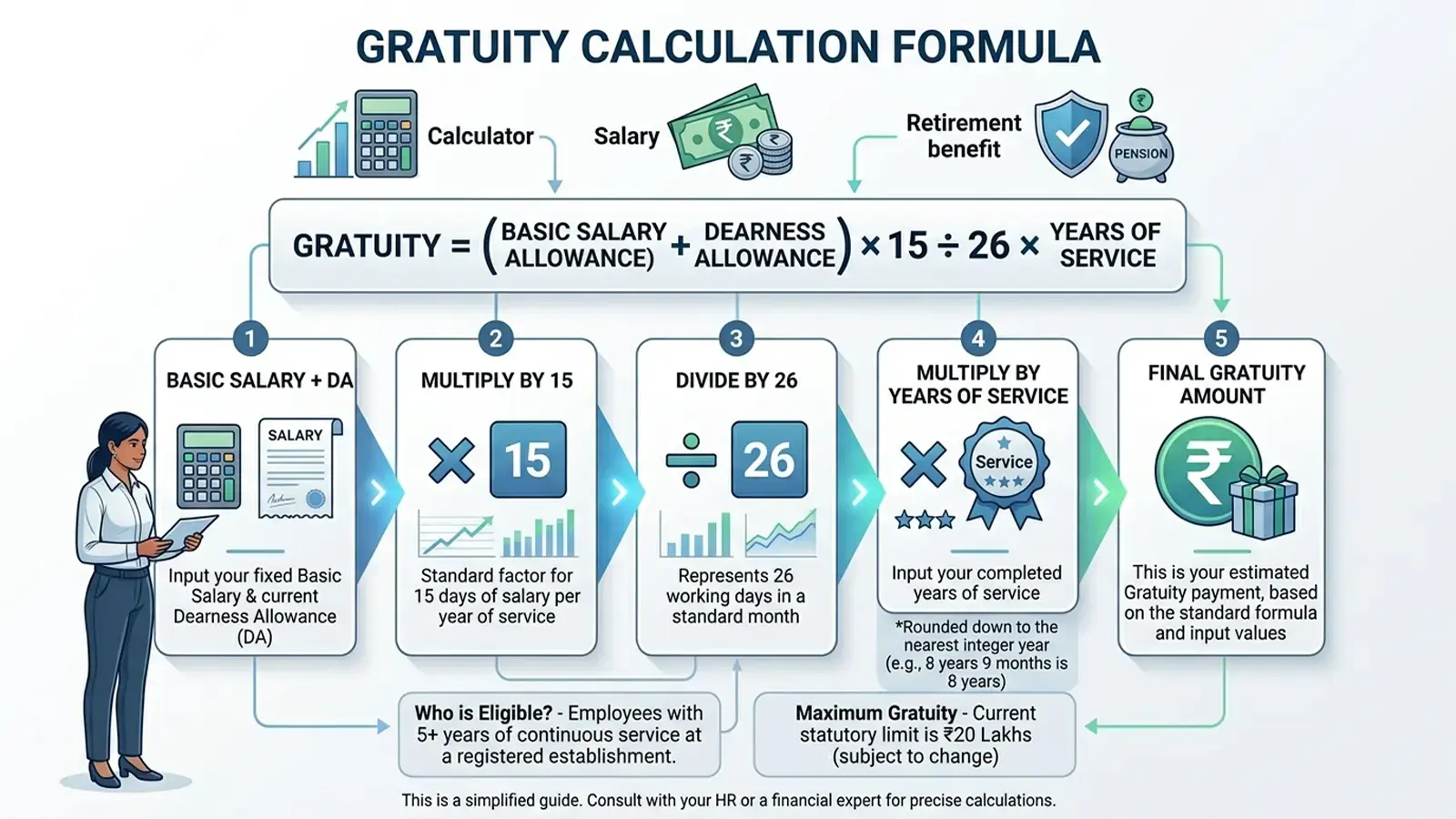
(Last drawn Basic Salary + Dearness Allowance) × 15 ÷ 26 × Years of completed service
Breaking down each component:
Last drawn Basic + DA: This is your basic salary plus dearness allowance in the final month of employment. It does not include HRA, special allowance, bonus, or performance pay. This is why salary structure matters — a higher basic means a significantly higher gratuity.
15: Represents 15 days of salary per completed year of service.
26: Represents the number of working days in a month (the Act uses 26, not 30 or 31).
Years of completed service: Only fully completed years are counted in the standard formula. Six months or more in the final incomplete year gets rounded up to one full year; less than six months is dropped.
For employees at establishments not covered (fewer than 10 employees)
Some employees work for smaller establishments not covered under the Social Security Code. For them, a different formula is commonly used — though any gratuity paid in these cases is typically based on a voluntary or contractual arrangement rather than a statutory obligation:
(Last drawn Basic + DA) × 15 ÷ 30 × Years of service
Note the denominator changes from 26 to 30 in this version, which results in a lower gratuity amount.
Gratuity Calculation Examples
Example 1: Mid-level employee with 7 years of service
Profile: Sunita works as a marketing manager at a mid-sized company in Pune. Her last drawn basic salary is ₹30,000 per month. DA is nil (common in private sector). She is resigning after 7 years and 4 months.
Service counted: 7 years (4 months < 6, so the partial year is dropped)
Calculation:
₹30,000 × 15 ÷ 26 × 7
= ₹30,000 × 0.5769 × 7
= ₹1,21,154
Sunita receives approximately ₹1.21 lakh as gratuity on her final settlement.
Example 2: Senior employee with 12 years of service
Profile: Vikram is a senior software architect at a large IT company in Bengaluru. Basic salary: ₹75,000 per month. DA: nil. He is retiring after 12 years and 8 months.
Service counted: 13 years (8 months > 6, so rounded up to 13)
Calculation:
₹75,000 × 15 ÷ 26 × 13
= ₹75,000 × 0.5769 × 13
= ₹5,62,500
Vikram receives approximately ₹5.63 lakh. His longer tenure and higher basic combine to produce a meaningfully larger payout than Sunita's.
Example 3: High-earning professional with 20 years of service
Profile: Meera is a VP at a financial services company in Mumbai. Basic salary: ₹1,50,000 per month. DA: ₹10,000. She is retiring after 20 years exactly.
Calculation:
(₹1,50,000 + ₹10,000) × 15 ÷ 26 × 20
= ₹1,60,000 × 0.5769 × 20
= ₹18,46,154
This falls below the ₹20 lakh tax-exempt ceiling — so Meera's entire gratuity is tax-free. Had she served another year or two, the amount would exceed ₹20 lakh and the excess would be taxable.
Want to skip the manual calculation? Use the Gratuity Calculator — enter your basic, DA, and years of service to get your exact payout with a step-by-step formula breakdown.
Gratuity Calculation Table
| Last Drawn Basic (₹/month) | Years of Service | Gratuity Amount (approx.) |
|---|
| ₹20,000 | 5 years | ₹57,692 |
| ₹20,000 | 10 years | ₹1,15,385 |
| ₹30,000 | 5 years | ₹86,538 |
| ₹30,000 | 10 years | ₹1,73,077 |
| ₹50,000 | 5 years | ₹1,44,231 |
| ₹50,000 | 10 years | ₹2,88,462 |
| ₹75,000 | 10 years | ₹4,32,692 |
| ₹75,000 | 15 years | ₹6,49,038 |
| ₹1,00,000 | 10 years | ₹5,76,923 |
| ₹1,00,000 | 20 years | ₹11,53,846 |
| ₹1,50,000 | 20 years | ₹17,30,769 |
| ₹1,50,000 | 25 years | ₹20,00,000 (capped) |
Formula used: Basic × 15 ÷ 26 × Years. Amounts capped at ₹20 lakh for tax-exemption purposes.
How Years of Service Are Counted
This is where most employees get confused — and where disputes between employees and HR teams most commonly arise.
The basic rule: Only fully completed years count. If you worked for 6 years and 3 months, you get gratuity for 6 years. The 3 months are ignored.
The rounding rule: The Act allows rounding up when the remaining months in the final incomplete year are six or more. So 6 years and 7 months counts as 7 years. But 6 years and 5 months counts as only 6 years.
What counts as continuous service: The Act defines continuous service broadly. Brief gaps for illness, authorised leave, layoffs, or strikes do not break continuity. An employee who was laid off for 60 days and then recalled does not lose their accumulated service.
What can break continuity: Voluntary resignation followed by fresh re-joining resets the clock. If you leave a company for three years and return, your new tenure starts from the date of re-joining — previous service is not carried over.
The 4 years and 240 days rule — statutory basis and judicial interpretation: Section 2A of the Payment of Gratuity Act (now carried into Chapter V of the Code on Social Security, 2020) defines "continuous service" and provides that an employee who has worked at least 240 days in a 12-month period is deemed to have served continuously for that year. Applied to the fifth year: multiple High Courts have held that an employee with 4 completed years who then works 240 or more days in the fifth year has been held by multiple High Courts to have completed 5 years and to be eligible for gratuity — though this outcome rests on judicial interpretation of Section 2A, is not universally settled, and its application may vary by employment category and jurisdiction. For establishments with a 5-day workweek, the threshold is 190 days. Multiple High Courts — including those of Madras, Delhi, Punjab & Haryana, and Kerala — have upheld this interpretation in gratuity-specific disputes. If you are near the end of your fifth year with 240 or more working days logged, you likely have a strong statutory basis for a gratuity claim — but confirm the exact count with your HR department and verify under the applicable state rules before acting.
Gratuity After Resignation
Resignation is the most common trigger for gratuity claims among private sector employees. The rules are straightforward but often misunderstood:
You must have completed 5 full years. If your resignation date falls one month before your 5-year work anniversary, you would not qualify under the standard rule — though in some circumstances the judicial interpretation of Section 2A discussed above may be relevant. Timing your resignation — or delaying it by a few weeks — can make a significant financial difference.
The employer has 30 days to pay. Once gratuity is due, the employer must pay within 30 days. If they delay beyond 30 days without valid reason, they owe simple interest on the outstanding amount.
Gratuity is separate from notice pay. Your full-and-final settlement will typically include notice pay, leave encashment, pending salary, and gratuity as separate line items. Gratuity should not be netted against any amount the company claims you owe them (except in lawful forfeiture cases).
Offer letter or appointment letter does not override the Act. Some companies include a clause saying gratuity is not applicable or is at the company's discretion. Such clauses are void and unenforceable if the company is covered under the Act.
Gratuity After Retirement
Retirement gratuity typically produces the largest payout because it combines the highest salary (usually at career peak) with the longest service period. There are a few additional considerations:
Superannuation vs voluntary retirement: Both qualify. Whether you retire at your employer's mandatory retirement age or take voluntary retirement under a VRS scheme, gratuity is payable.
No upper limit on years: The formula does not cap years of service. An employee with 35 years of service gets gratuity for all 35 years — but the total payout is still capped at ₹20 lakh for tax exemption purposes.
Multiple employer gratuity: If you worked for different employers across your career, each employer pays gratuity independently for their period of service. These are separate calculations and separate payouts, not combined.
Tax on Gratuity
| Employee Category | Tax Treatment | Legal Basis |
|---|
| Central / state govt, defence, judiciary employees | Fully exempt — no Income Tax ceiling | Section 10(10)(i), Income Tax Act |
| Private sector — covered under Gratuity Act / Social Security Code | Exempt up to ₹20 lakh (ceiling raised from ₹10 lakh by Amendment Act, 2018) | Section 10(10)(ii) |
| Private sector — NOT covered under the Act | Exempt up to ₹20 lakh (CBDT Notification 16/2019, effective from March 29, 2018) | Section 10(10)(iii) |
| Amount exceeding ₹20 lakh — any non-government employee | Taxable as salary income in the year of receipt | Section 10(10), read with applicable slab |
Government employee note: The ₹20 lakh Income Tax exemption ceiling does not apply to government employees — their gratuity is fully exempt regardless of amount under Section 10(10)(i). Separately, the administrative ceiling on the actual gratuity payable to central government employees was raised from ₹20 lakh to ₹25 lakh effective January 1, 2024 (Department of Pension & Pensioners' Welfare, PIB Press Release PRID 2022470). This entire ₹25 lakh remains 100% tax-free.
Old Regime vs New Regime: The Section 10(10) gratuity exemption is available under both the old tax regime and the new tax regime (Section 115BAC). No Finance Act 2024 or Finance Act 2025 (Budget 2025) changed the ₹20 lakh private sector exemption ceiling.
₹20 lakh is a lifetime aggregate limit: This ceiling applies across gratuity received from all employers over your entire career. If you received ₹12 lakh from a previous employer and ₹10 lakh from your current employer, the total tax-exempt amount across both is capped at ₹20 lakh — the remaining ₹2 lakh is taxable.
Practical note for high earners: If your gratuity exceeds ₹20 lakh, the excess is added to your income for that financial year and taxed at your applicable slab rate. This can push you into or further into the 30% bracket for that year. When planning retirement timing, it is worth calculating whether delaying by a year or two pushes the gratuity above ₹20 lakh, and if so, how much additional tax you would pay.
Gratuity in Form 16: The gratuity amount (and exempt/taxable portions) will appear in your Form 16 for the year in which you receive it. Use the Form 16 Analyzer to verify that the gratuity computation in your Form 16 is correctly split between exempt and taxable portions before filing your ITR.
Gratuity and tax-saving: Gratuity is a one-time receipt, not recurring income. If the taxable portion of your gratuity pushes your income up significantly in one year, review the best ways to save tax to see if additional 80C or NPS contributions that year can offset the impact.
Gratuity vs Provident Fund
Both gratuity and PF are long-service benefits built into the Indian employment system — but they work very differently.
| Parameter | Gratuity | Provident Fund (EPF) |
|---|
| Governing law | Payment of Gratuity Act, 1972 (Code on Social Security, 2020 — Chapter V intended to replace it; verify operative commencement at labour.gov.in) | Employees' Provident Funds Act, 1952 |
| Who contributes | Employer only | Employee + Employer (12% each of basic) |
| When accumulated | Calculated at exit, not accumulated monthly | Accumulated month by month over career |
| Minimum service | 5 years for eligibility | No minimum — withdrawable on exit |
| Formula basis | Last drawn salary × years × 15/26 | Contributions + interest compounded monthly |
| Tax treatment | Up to ₹20 lakh exempt | Up to ₹2.5 lakh annual contribution tax-free; interest above threshold taxable |
| Interest during service | None — single payout at exit | 8.25% p.a. (FY 2025-26) compounded annually |
| Shown in salary slip | Usually as CTC component | Yes — employee and employer share |
| Can employee contribute more | No | Yes — Voluntary PF (VPF) allowed |
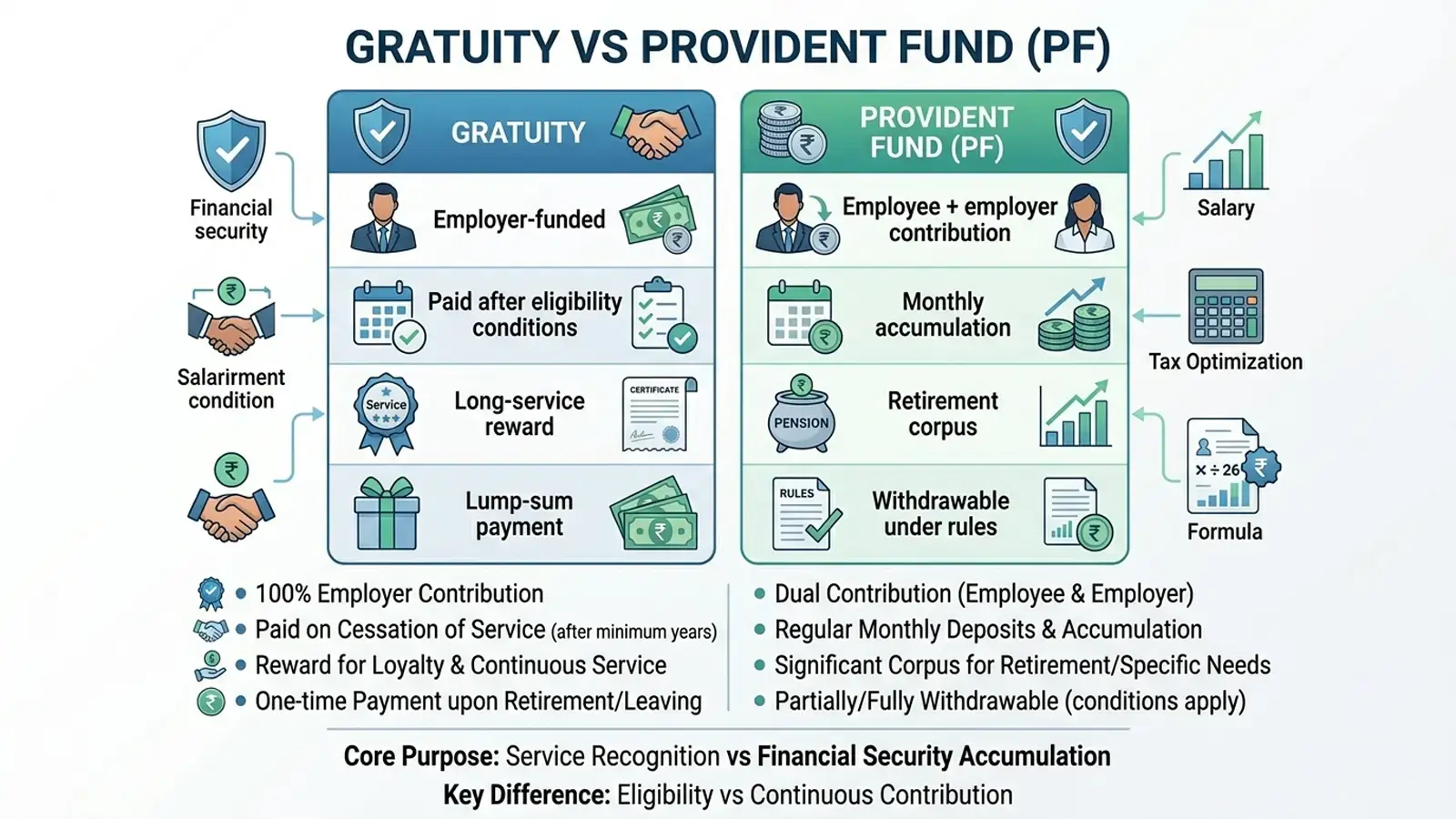
The key difference: PF is a savings vehicle that grows during your career. Gratuity is a reward multiplier triggered only at exit after sufficient tenure. Both appear in your CTC — understanding how they interact is part of reading your salary structure correctly.
Gratuity vs Pension
| Parameter | Gratuity | Pension (NPS / EPF Pension) |
|---|
| Nature | One-time lump sum | Monthly recurring income after retirement |
| When paid | At exit (resignation, retirement, death) | After age 60 (NPS) or 58 (EPF pension) |
| Basis | Last drawn salary × service | Accumulated corpus / average salary × service |
| Employee contribution | None | Yes — part of EPF or NPS contribution |
| Tax on receipt | Up to ₹20 lakh exempt | 60% lump sum withdrawal tax-free (NPS); pension taxable as income |
| Applicable law | Payment of Gratuity Act, 1972 / Code on Social Security, 2020 — Chapter V (once commenced) | NPS: PFRDA; EPF Pension: EPS 1995 |
| Portability | Not portable — each employer pays separately | NPS fully portable; EPF pension portable |
| Guaranteed amount | Yes — formula-based, employer-funded | NPS: market-linked (not guaranteed); EPS: formula-based |
Gratuity vs Severance Pay
| Parameter | Gratuity | Severance Pay |
|---|
| Legal basis | Statutory — Payment of Gratuity Act, 1972 (Code on Social Security, 2020 — Chapter V once commenced) | Contractual or negotiated — no universal statute |
| Trigger | Service threshold (5 years) met at exit | Company-initiated layoff or VRS scheme |
| Formula | Fixed statutory formula | Negotiated — often months of salary per year served |
| Who gets it | Employee who completes minimum service | Employees affected by layoff, downsizing, VRS |
| Can overlap | Yes — both can be paid together | Yes — an employee can receive both in a layoff |
| Tax treatment | ₹20 lakh exemption | Taxable as salary; some exemption under Sec 10(10B) |
A layoff scenario: if Ramesh is laid off after 8 years of service due to a company restructuring, he typically receives both his statutory gratuity (formula-based) and a severance package (negotiated). These are separate payments and both should appear clearly in his full-and-final settlement.
Common Mistakes Employees Make
From full-and-final settlements: HR teams frequently calculate gratuity using the CTC figure rather than last drawn basic salary. The formula uses only basic + DA — not HRA, not allowances, not bonus. Employees who accepted low-basic salary structures for higher in-hand pay during their tenure receive noticeably lower gratuity at exit. The trade-off is real and often only understood at resignation.
From employee relations: Employees who have worked in multiple departments or taken career breaks within the same organisation sometimes find their gratuity calculated from the most recent uninterrupted stint, not from their original joining date. Continuity of service is the operative concept — confirm your original date of joining is recorded correctly in your HRMS before filing the gratuity claim.
From resigned employees: Many employees submit a gratuity claim verbally or assume HR will initiate it automatically. The Payment of Gratuity Act gives the employer 30 days to pay once gratuity is due — but employees must formally apply in Form I (under the Gratuity Rules). Without the written application, the clock for the employer's 30-day obligation does not start.
1. Leaving one month too early. The five-year rule is strict — the day before your work anniversary, you are not eligible. Employees who resign in month 59 instead of waiting to complete month 60 lose their entire gratuity entitlement. Check your appointment letter date carefully.
2. Assuming the company will initiate the claim. Some employers proactively calculate and pay gratuity in the full-and-final settlement. Others wait for the employee to file a formal claim. Do not assume — always submit a written gratuity claim.
3. Including HRA, bonus, or allowances in the calculation. The formula uses only Basic + DA. Employees who mentally calculate gratuity using their gross or CTC salary are almost always disappointed by the actual figure.
4. Forgetting the ₹20 lakh tax ceiling. High-earning employees with long tenures sometimes receive gratuity well above ₹20 lakh. The excess is taxable — not planning for this creates a surprise tax liability at ITR filing time.
5. Not checking the service period calculation. If you took a long sabbatical, a period of unauthorised leave, or were on a zero-salary personal leave for several months, check whether those months were counted as continuous service by your employer. Disputes over the exact service period are common.
6. Not nominating a beneficiary. Every covered employer is required to collect a gratuity nomination form. If you die in service without a nomination on file, the gratuity goes to the legal heir through a longer legal process instead of immediately to your chosen family member. File your nomination on day one.
How to Claim Gratuity: Step by Step
Step 1 — Check eligibility. Confirm you have completed 5 continuous years (or qualify under death/disability exception). Verify your appointment date from your offer letter.
Step 2 — Submit a written application. Use Form I (the prescribed application form under the Gratuity Act). Submit it to your employer or HR department within 30 days of your last working day.
Step 3 — Employer acknowledgement. The employer must acknowledge your claim in writing within 15 days.
Step 4 — Employer calculates and approves. The employer verifies your service period and calculates the amount. They must notify you of the approved amount within 15 days of receiving your application.
Step 5 — Payment. Payment must be made within 30 days from the date gratuity becomes due. If delayed, interest applies automatically.
Step 6 — Dispute resolution. If your employer rejects the claim, underpays, or delays without reason, you can file a complaint with the Controlling Authority (typically a regional labour officer under the state labour department).
Documents Required for Gratuity Claim
| Document | Purpose |
|---|
| Form I (Gratuity Application) | Official claim form currently prescribed under Rule 7 of the Payment of Gratuity (Central) Rules, 1972 |
| Appointment letter / offer letter | Establishes the date of joining |
| Identity proof (Aadhaar, PAN, passport) | Verification of employee identity |
| Last salary slip | Confirms last drawn basic salary for formula |
| Relieving letter / resignation acceptance | Confirms official exit date |
| Service certificate | Documents continuous service period |
| Bank account details (cancelled cheque or passbook) | For direct payment |
| Nominee details (in case of death claim) | Legal heir or nominee documents required |
| Death certificate (if death claim) | Required for nominee claims |
| Medical certificate (if disability claim) | Required for permanent disability claims |
Frequently Asked Questions
What is gratuity in simple terms?
Gratuity is a lump-sum payment your employer makes when you leave after completing 5 or more years of service. It is calculated using your last drawn basic salary and the number of years you worked. It is a statutory entitlement under Indian law, governed by the Payment of Gratuity Act, 1972 (and Chapter V of the Code on Social Security, 2020 once formally commenced) — not a discretionary bonus or voluntary gift.
Is gratuity mandatory in India?
Yes, for establishments with 10 or more employees. Once a company crosses this threshold, it is permanently covered under the applicable statute — the Payment of Gratuity Act, 1972, and the Code on Social Security, 2020 (Chapter V) once it is formally commenced — even if headcount later falls below 10. Gratuity cannot be contractually waived for covered employees.
Can I receive gratuity before completing 5 years?
For permanent employees: generally no, unless you die or become permanently disabled while in service. For fixed-term employees, the Code on Social Security, 2020 proposes reducing the threshold to one year of continuous service — this provision becomes operative only once Chapter V is formally commenced; verify at labour.gov.in. Additionally, multiple High Courts have held, under Section 2A of the law, that an employee who has worked at least 240 days in the fifth year of service may be treated as having completed 5 years — so the practical threshold for permanent employees near the 5-year mark may be around 4 years and 8 months in jurisdictions where this interpretation applies.
Is gratuity taxable?
For government employees, gratuity is fully tax-exempt with no ceiling. For private sector employees, gratuity up to ₹20 lakh is exempt. Any amount above ₹20 lakh is added to taxable income for that financial year.
Can a company refuse to pay gratuity?
Only where Section 4(6) of the Payment of Gratuity Act, 1972 applies — specifically, termination for riotous or disorderly conduct or any act of violence (forfeiture of full gratuity), or termination for any act, willful omission, or negligence causing loss or damage to employer property (forfeiture limited to the extent of that loss or damage). The company cannot refuse gratuity simply because the employee resigned, gave short notice, or because the company is going through financial difficulty.
How long does gratuity payment take?
The employer must pay within 30 days from the date gratuity becomes due. If they fail to pay within 30 days without a valid reason, simple interest accrues on the outstanding amount.
Is gratuity included in CTC?
Yes, almost always. Most employers include a gratuity provision in the CTC — typically around 4.81% of basic salary per year (which is 15/26 expressed annually). This is a provisioning entry in the CTC, not a monthly payment to you.
What salary is used for gratuity calculation?
Only the basic salary plus dearness allowance (DA) in the last drawn month. HRA, special allowance, performance bonus, LTA, and other components are excluded entirely from the gratuity formula.
Does gratuity get paid on resignation?
Yes — provided you have completed at least 5 continuous years of service at a covered establishment. Resignation is a fully valid trigger for gratuity under the Payment of Gratuity Act, 1972.
What happens to my gratuity if my company is acquired?
In a genuine business transfer or acquisition, the new employer inherits all employment obligations — including gratuity liability for the absorbed employees. Your prior service is typically recognised. Get this confirmed in writing during the acquisition process.
Can I get gratuity if I am on a fixed-term contract?
Under the Code on Social Security, 2020 (once Chapter V is formally commenced by gazette notification), fixed-term employees would be eligible for gratuity after completing just one year of continuous service — a significant change from the 5-year threshold under the Payment of Gratuity Act, 1972. Verify the operative commencement date at labour.gov.in to confirm whether this provision currently applies to your contract.
What if my employer declares bankruptcy?
Gratuity takes priority in insolvency proceedings. It is a preferential debt, meaning employees' gratuity claims rank above unsecured creditors. In practice, recovery can still be complicated — contact a labour law professional if this happens.
Can gratuity be forfeited?
Yes, but only partially and only in specific misconduct cases. If an employee is terminated for willful omission causing damage to company property, gratuity can be forfeited to the extent of the loss. For other misconduct, forfeiture of the entire gratuity requires a very high legal threshold.
How is gratuity different from a provident fund?
PF is accumulated month by month from contributions by both you and your employer throughout your career. Gratuity is calculated only at exit and funded entirely by the employer — you never contribute to your own gratuity fund. PF is accessible at any time after leaving (subject to tax rules); gratuity requires 5 years of service.
Is there a gratuity calculator I can use?
PaisaPilotAI is building a dedicated Gratuity Calculator. In the meantime, use the formula: Basic Salary × 15 ÷ 26 × Years of Service. The tables in this article give you quick estimates across common salary and tenure combinations.
What is Form F in gratuity?
Form F is the nomination form that employees submit to their employer to designate a beneficiary for gratuity in case of death. Every employee covered under the Act should fill this form when joining — it ensures your family receives gratuity quickly without going through legal channels.
Does gratuity count toward retirement corpus planning?
Yes. For employees who stay with one employer for 20+ years, gratuity can contribute meaningfully to retirement wealth — sometimes ₹15–20 lakh or more. When thinking about retirement planning and how your salary structure affects long-term wealth, review the Salary Structure Optimization guide which covers how basic salary decisions compound over a career.
Latest Gratuity Updates for FY 2026-27
The following items are relevant for employees in FY 2026-27. Where commencement status is unconfirmed, verify at labour.gov.in before relying on a provision.
1. Code on Social Security, 2020 — Commencement Status (Verify at labour.gov.in)
What is changing: The Code on Social Security, 2020 received Presidential assent on September 28, 2020. Chapter V of the Code is intended to consolidate and replace the Payment of Gratuity Act, 1972. However, the Code requires separate gazette notifications to bring different chapters into force. The operative commencement date for Chapter V should be verified at labour.gov.in or the official Ministry of Labour and Employment gazette portal before treating any of the following provisions as currently applicable.
Who is affected: All employees and employers covered under gratuity provisions in India, once Chapter V is formally commenced.
Key changes proposed under Chapter V (operative only upon formal commencement):
- For permanent employees: no change to the 5-year threshold, formula, or ₹20 lakh tax ceiling.
- For fixed-term employees: eligibility reduced to 1 year of continuous service (significant change from the 5-year requirement under the Payment of Gratuity Act, 1972).
- Wage definition under the Code requires that the components included in "wages" for benefit calculation purposes must constitute at least 50% of total remuneration — intended to prevent employers from suppressing the gratuity base through structural workarounds.
- Employers are required to maintain compulsory gratuity insurance.
Source: The Code on Social Security, 2020, received Presidential assent and was published in the Gazette of India on September 28, 2020. For the operative commencement notification for Chapter V, verify at labour.gov.in.
2. Central Government Employee Gratuity Ceiling Raised to ₹25 Lakh (January 1, 2024)
What changed: The administrative ceiling on actual gratuity payable to central government employees (Retirement Gratuity and Death Gratuity) was raised from ₹20 lakh to ₹25 lakh.
Effective date: January 1, 2024 (triggered when Dearness Allowance crossed 50% of basic pay, per 7th Pay Commission recommendation).
Who is affected: Central government employees only. Private sector employees are unaffected — their ₹20 lakh Income Tax exemption ceiling under Section 10(10)(ii) is unchanged.
Practical impact: Central government employees retiring or dying in service from January 1, 2024 onwards can receive up to ₹25 lakh as gratuity. This entire amount is fully tax-exempt under Section 10(10)(i).
Source: Department of Pension and Pensioners' Welfare, Office Memorandum dated May 5, 2024; PIB Press Release PRID 2022470.
3. No Change to ₹20 Lakh Private Sector Exemption (Verified for FY 2026-27)
The ₹20 lakh Income Tax exemption ceiling for private sector employees under Section 10(10)(ii) and (iii) was last revised in 2018 (Payment of Gratuity Amendment Act, 2018 — S.O. 1420(E), March 29, 2018; and CBDT Notification 16/2019, March 8, 2019). No Finance Act 2024 or Finance Act 2025 (Budget 2025) has changed this limit. The ₹20 lakh ceiling remains current for FY 2026-27.
Important Compliance Note
Gratuity is governed by statute, but its application to any individual situation involves several variables that can affect eligibility, amount, and tax treatment.
Employment circumstances vary. The 5-year threshold applies to permanent employees. Fixed-term employees would qualify after 1 year under the Code on Social Security, 2020 (Chapter V) once it is formally commenced — verify operative status at labour.gov.in. Part-time employees, apprentices, and probationers may have different eligibility depending on their employment agreement and applicable state rules.
Employer policies operate within the law. Employers can offer gratuity terms more generous than the statutory minimum — higher amounts, lower service thresholds, or broader eligibility. Some companies pay gratuity to all employees regardless of tenure as a goodwill practice. What they cannot do is offer less than the statutory minimum to covered employees.
Tax treatment may change. The ₹20 lakh Income Tax exemption for private sector employees has remained unchanged since 2018. Future Finance Acts or CBDT notifications could revise this limit upward or introduce new conditions. Always verify the current exemption limit at incometax.gov.in before a retirement or final settlement event.
State-specific rules may apply. Some states have enacted their own gratuity provisions for specific sectors (government services, plantations, mines). Central law applies to most private sector establishments, but employees in regulated sectors should verify applicable rules.
This article is not a legal opinion. For specific gratuity eligibility disputes, calculation disagreements with your employer, or tax questions about large gratuity payouts, consult a qualified Chartered Accountant (registered with ICAI) or a labour law advocate familiar with the Code on Social Security, 2020.
Final Verdict
Gratuity is one of those employment benefits that tends to be undervalued until the final settlement conversation — and overestimated by employees who have not checked the formula carefully.
Here is what you should take away from this guide:
Eligibility is strict. Five continuous years is the rule. If you are a month away from that milestone, waiting is almost always financially rational. If you die or are permanently disabled, the five-year rule does not apply.
The formula is fixed. Basic + DA × 15 ÷ 26 × Years. Nothing in your salary other than basic and DA counts. This is why salary structure decisions — specifically how much of your CTC sits in basic — have long-term consequences for your gratuity payout. The Salary Structure Optimization guide explains this in detail.
Tax is manageable but worth planning. Up to ₹20 lakh is exempt for private sector employees. Above that, you pay tax at your slab rate in the year of receipt. If you are approaching 20 years with a high basic salary, calculate whether your gratuity will breach the ceiling.
Filing a claim is your responsibility. Do not assume your employer will initiate payment. Submit Form I in writing. Keep a copy. Follow up.
Gratuity is not the whole retirement picture. It sits alongside your EPF, NPS contributions, investments, and personal savings. To see how all of these fit together in your tax planning for the year you receive gratuity, the Best Ways to Save Tax guide and the Form 12BB guide (for understanding how your salary deductions work together) are worth reviewing.
If your employer issues you a gratuity-inclusive Form 16 in the year of separation, verify that the exempt and taxable split is correctly calculated before filing your ITR.
Ready to calculate your gratuity? Use the free Gratuity Calculator — enter your basic salary, DA, years of service, and the calculator will show your exact payout, the formula used, rounding applied, and tax exemption breakdown. No login. Instant results.
PaisaPilotAI Editorial Team | HR & Employee Benefits Research | Last reviewed: June 2026 | For specific gratuity disputes or tax treatment queries, consult a Chartered Accountant (ICAI) or a registered labour law consultant.